
Andy’s Astronomy: Alhena Spotted Below Jupiter
Cool nighttime and early morning temperatures has allowed for some awesome star gazing.
The planet Jupiter remains incredibly bright. To spot Jupiter, about 10:30 pm look just north of west, or for those with a compass along a heading of 283 degrees, and about 43 degrees above the horizon, and there is Jupiter. It is difficult to miss.
Cool nighttime and early morning temperatures has allowed for some awesome star gazing.
The planet Jupiter remains incredibly bright. To spot Jupiter, about 10:30 pm look just north of west, or for those with a compass along a heading of 283 degrees, and about 43 degrees above the horizon, and there is Jupiter. It is difficult to miss.
Now look down and just a bit to the right and spot the star Alhena.
Alhena is located on a heading of 285 degrees and at 10:30 pm is located about 20 degrees above the horizon. Viewers will need a clear view to the west to see Alhena.
Also known as Gamma Geminorum, Alhena is the third brightest star in the Gemini constellation and is a binary star, which means there are two stars appearing very close.
The primary star is located about 109 light-years from Earth, has nearly three times the mass of our Sun, and is putting out about 200 times as much light. It is in a state of flux and is known as an evolving star. This means the star has exhausted the supply of hydrogen at its core and is now classified as a subgiant star. The secondary star is slightly larger than our Sun, but not much else has been determined.
The USS Alhena, a World War II attack cargo ship, was named for the star.
Next week this column will start highlighting planets featured in the original set of “Star Wars” movies.
Keep your eyes on the sky for passing fireballs.
Meteors can flash across the sky anytime, day or night, with extraordinarily bright meteors referred to as fireballs — and they are spotted quite often.
On Saturday, May 9, 42 people across Alabama, Indiana, Kentucky, Missouri, Mississippi, Ohio, Tennessee, and West Virginia reported seeing a fireball.
The fireball was first reported at 20:20 pm Central Time by a skywatcher in Kingston Springs, KY, who reported that it was “really bright and large” and witnessed it “break into two pieces”. The fireball was seen as far north as Wilder, KY, as far east as near Charlestown, WV, as far south as Decatur, AL, and as far west as Jackson, MO. The fireball appeared to travel from northwest to southeast.
Three of the skywatchers reported hearing noise attributable to the fireball and 26 witnessed it fragment into smaller pieces. The fireball was captured in one photograph.
Anyone seeing a fireball is urged to report the sighting to https://amsmeteors.org
Going outside and looking at the night sky can be fun and educational for the entire family.
There are a number of free apps available to help identify stars and constellations, and some of the apps will show satellites.
Happy skywatching!
Before you go...
Thanks for reading The Houston Home Journal — we hope this article added to your day.
For over 150 years, Houston Home Journal has been the newspaper of record for Perry, Warner Robins and Centerville. We're excited to expand our online news coverage, while maintaining our twice-weekly print newspaper.
If you like what you see, please consider becoming a member of The Houston Home Journal. We're all in this together, working for a better Warner Robins, Perry and Centerville, and we appreciate and need your support.
Please join the readers like you who help make community journalism possible by joining The Houston Home Journal. Thank you.
- Brieanna Smith, Houston Home Journal managing editor
Paid Posts
Related Articles
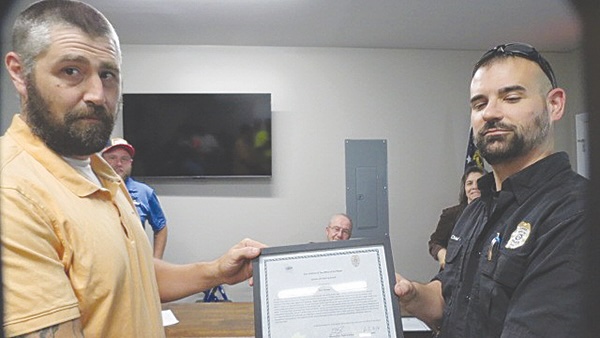
Shiloh Police Officers Honored For Saving the Life of Teenager
The Chief of Police of Shiloh and one of his officers were honored by the Shiloh Mayor and Council during the board’s regular meeting held on June 2.
The Mayor and Council presented Chief Wayne Cato and Officer Roy Harper with Commendations for saving the life of a teenager severly injured in an accident on May 10.
Shiloh Police Officers Honored After Saving the Life of Injured Teenager
The Chief of Police of Shiloh and one of his officers were honored by the Shiloh Mayor and Council during the board’s regular meeting held on June 2.
The Mayor and Council presented Chief Wayne Cato and Officer Roy Harper with Commendations for saving the life of a teenager severly injured in an accident on May 10.
Shiloh Police Officers Honored For Saving the Life of Teenager
The Chief of Police of Shiloh and one of his officers were honored by the Shiloh Mayor and Council during the board’s regular meeting held on June 2.
The Mayor and Council presented Chief Wayne Cato and Officer Roy Harper with Commendations for saving the life of a teenager severly injured in an accident on May 10.