
Bigfoot in Oaky Woods!
Bigfoot is alive and well in Oaky Woods!
Bigfoot is alive and well in Oaky Woods! The woods of the northwest USA have the legend of Bigfoot, a mythical ape man that roams the woods, but is rarely seen by humans. Does Bigfoot really exist or is it the figment of someone’s storytelling imagination? I’m betting it is a tall tale!
But we in middle Georgia have a real Bigfoot!
He’s not a living animal, but a living tree that stands guard over the 32 million year-old sand dollar cliffs in Oaky Woods. He only moves a few inches in a strong wind and endures rain, sun, snow and whatever else Mother Nature dishes out. Instead of breathing in oxygen and exhaling carbon dioxide, he takes in carbon dioxide like all trees and releases life sustaining oxygen back into our atmosphere. He’s a steady, stable and dependable guy, good for the environment!
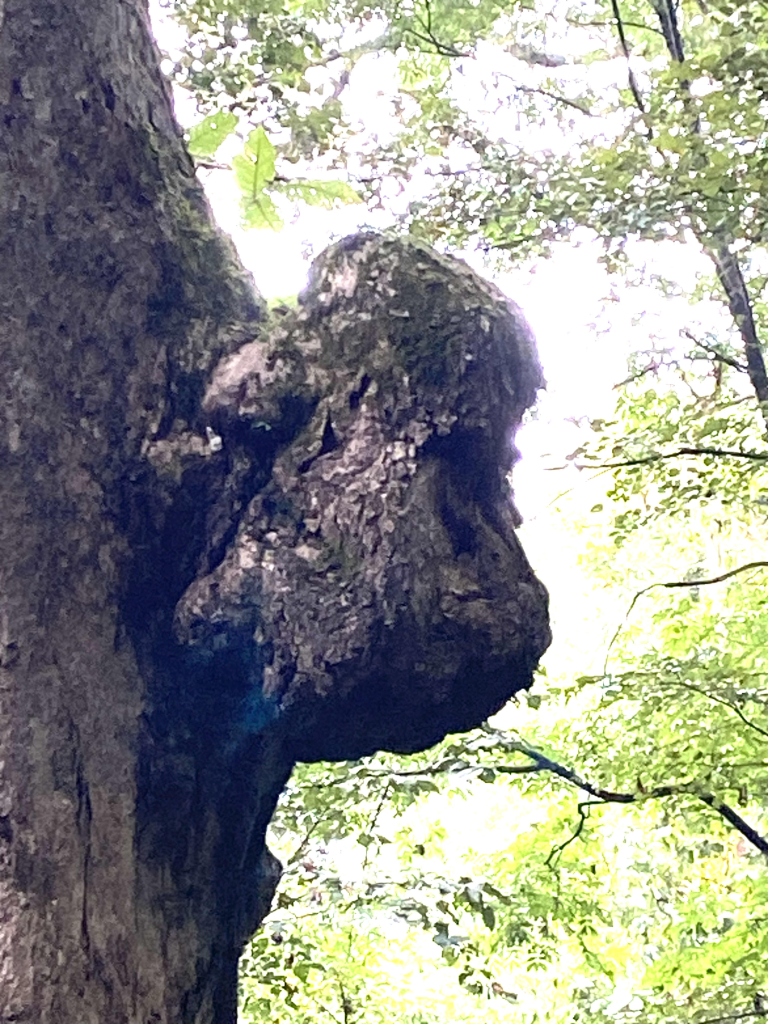
He started as a small fungus growing in the side of an elm tree that I spotted back in the 1970’s. Yep, that was a long time ago. The growth is the trees’ reaction to the fungus and it’s like a large scar on the tree.
I’ve kept an eye on him for all these years, and he has definitely grown in size and greets all the hikers that I’ve taken into Oaky Woods on our winter outings. As you can tell from the photo, the growth really does look like the head of an ape! He has a tall flat forehead, protruding jaw, dark eyes and ears on the side of his head. Yes, it’s a pretty convincing bigfoot.
Bigfoot, also called Sasquatch is a large, hairy mythical creature said to inhabit forests in North America, particularly in the Pacific Northwest. Bigfoot is featured in both American and Canadian folklore, and since the mid-20th century has become a cultural icon permeating media and becoming the subject of subculture with photos of him popping up on signs and billboards, especially around Halloween. There is even a Bigfoot Museum in Blue Ridge, Georgia!
Bigfoot enthusiasts have offered various forms of dubious evidence to support his existence, including claims of sightings as well as supposed photographs, video and audio recordings, hair samples, and casts of large footprints. However, the evidence is a combination of folklore, misidentification and hoax, and the creature is not a living animal. I suspect that someone who sees a black bear in Oaky Woods might think it’s Bigfoot if their imagination runs on the wild side!
Folklorists trace the phenomenon of Bigfoot to a combination of factors and sources, including the European wild man figure, folk tales and stories from indigenous cultures. Bigfoot is often described as a large, muscular, and bipedal human or ape-like creature covered in black, dark brown, or dark reddish hair. Anecdotal descriptions estimate a height of roughly 6–9 feet with some descriptions having the creatures standing as tall as 10–15 feet.
Some alleged observations describe Bigfoot as more human than ape, particularly about the face. In 1971, multiple people in Delles, Oregon, filed a police report describing an “overgrown ape”, and one of the men claimed to have sighted the creature in the scope of his rifle but could not bring himself to shoot it because “it looked more human than animal”.
In 1958, Jerry Crew, bulldozer operator for a logging company in Humboldt, California discovered a set of large, 16 inch, human-like footprints sunk deep within the mud in the Six Rivers National Forest. Upon informing his coworkers, many claimed to have seen similar tracks on previous job sites as well. Some told of odd incidents, such as an oil drum weighing 450 pounds having been moved without explanation. The foot prints and movement of the oil drum were probably caused by a black or grizzly bear.
The logging company men soon began using the word “Bigfoot” to describe the apparent culprit. Crew and others initially believed someone was playing a prank on them. After observing more of these massive footprints, he contacted reporter Andrew Genzoli of the Humboldt newspaper. Genzoli interviewed lumber workers and wrote articles about the mysterious footprints, introducing the name “Bigfoot” in relation to the tracks and the local tales of large, hairy wild men.
A plaster cast was made of the footprints and Crew appeared, holding one of the casts, on the front page of the newspaper on October 6, 1958. The story spread rapidly as Genzoli began to receive correspondence from major media outlets including the New York Times and the Los Angeles Times As a result, the term Bigfoot became widespread as a reference to an apparently large, unknown creature leaving massive footprints in Northern California and the myth won’t die!
In Summary, Bigfoot is an interesting myth. I’m sure we don’t have a huge ape like “Bigfoot” creature in Oaky Woods, but we are fortunate to have a very interesting tree that looks a lot like Bigfoot! Look at the photo to see if you don’t agree!
Before you go...
Thanks for reading The Houston Home Journal — we hope this article added to your day.
For over 150 years, Houston Home Journal has been the newspaper of record for Perry, Warner Robins and Centerville. We're excited to expand our online news coverage, while maintaining our twice-weekly print newspaper.
If you like what you see, please consider becoming a member of The Houston Home Journal. We're all in this together, working for a better Warner Robins, Perry and Centerville, and we appreciate and need your support.
Please join the readers like you who help make community journalism possible by joining The Houston Home Journal. Thank you.
- Brieanna Smith, Houston Home Journal managing editor
Paid Posts
Related Articles

DID YOU KNOW …? Who was the producer’s first choice to host the original “The Price is Right”?
Five hundred columns down, and an infinity of columns yet to go!
After last week’s party for the 500th collection of silly trivia, you’d think I would be ready to give up, right? Heck no. I’m just getting started. In fact, I plan to be around until we hit 1,000 columns and then some!
So while you settle back and enjoy your favorite beverage appropriate for the time of day in which you read this, I’ll be working on future columns to enlighten and entertain you.
Enjoy!

Jesus called Himself ‘Son of Man,’ not ‘Son of God’
The Christian faith teaches that Jesus is the “Son of God,” yet Jesus frequently and consistently called Himself the “Son of Man” — a total of 81 times in scripture.

If you give a coworker a donut
If you give a mouse a cookie…