Scientific method in the spotlight at Houston fair
Students in Houston County put their scientific and engineering prowess on display last week at the Houston Regional Science and Engineering Fair, which took place at the Robins Air Force Base Museum of Aviation in the Century of Flight Hangar.
More than 500 public and private school students from Houston and Peach counties participated, as well as some home-school students.
The projects were a showcase of students’ interests, abilities and creativity.
Lauryn Kearse, 15, of Veterans High School said she decided to try her hand at robotics.
“Well, I want to be an engineer when I grow up. This robotics piqued my interest and I decided to try it,” she said. “I’m sort of interested in being either a petroleum engineer or an aerospace engineer, and I’m leaning more toward aerospace more than anything right now.”
Kearse built a robot that uses two sensors to measure the infrared light in a black line so that it will follow the line and move in different ways. The robot tested well, moving 6 feet in a straight line, oval line and circular line, but failed at a zig-zag line.
“It wasn’t able to go as far because of the way the lines were laid out,” she said. “I would have been able to test how it would handle blocks in its path if I had two more sensors facing forward.”
What she had, though, was enough to earn a $25 cash prize and trophy award from The Read Foundation.
Taking a page out of today’s sports headlines, Matthew Connor, 13, of Bonaire Middle School made his project testing the effects of impact on football helmets.
“I got interested in this after I played contact football in the seventh grade and I realized not all football helmets are designed the same for helping the players in softening the impact,” he said. “It’s a very important topic because some people have gotten killed.”
He used some outside help, sort of, in coming to his conclusion.
“We went to Southern Impact research center in Rockford, Tenn., and used their drop rig equipment in testing,” he said. “Last year we made our own, but obviously it’s not as good as theirs. It was crude but it worked.”
He said he still doesn’t know what he wants be when he grows up, but may consider something in sports medicine.
Veterans High students Lindsey Cauley and Cassidy Erickson pooled their talents and took on the task of finding a good water softener.
“The environmentally safe medium for softening water is kaolin,” Erickson said. “We made a filtration system and then we put kaolin in it and then put well water through it and then tested it for hardness to see how it changed.”
The students used well water, not regular tap water because it was more natural and had fewer chemicals in it.
“It’s a continuation project,” said Cauley. “Last year we tested well water for pH (percentage of hydrogen present), hardness, bacteria, nitrates and different things like that, and this year we just tested well water for hardness. Our conclusion was kaolin is the best water softener.”
At the urging of science teacher Jennifer Douglas, the students used other materials such as sand, sawdust and charcoal, and they all failed.
“We don’t know why; can’t account for that. We were surprised by that. It was a really big difference,” said Erickson.
“This is our fourth science fair and probably our last one,” she continued. “We’re both juniors.”
Glenn Wright, 13, of Feagin Mill Middle School went for a more colorful display. His “Rainbow Fire” project showed different chemicals giving off different colors when exposed to fire due to different energy levels.
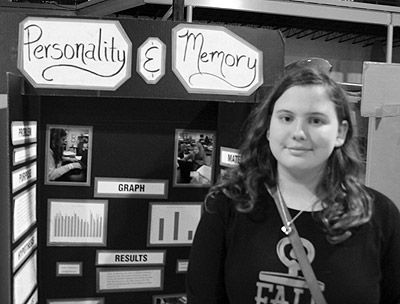
Northside Middle’s Ashleigh Brooks delved into the brain with her project exploring personality and memory. She examined three personality types: extroverts, introverts and endoverts.
Her test subjects were given a personality test and then a test where they had to memorize numbers in a certain order. Extroverts performed the best, she said, while introverts came in second and endoverts performed the worst. She said the results partially confirmed her hypothesis, with the extroverts scoring the best, but she expected the introverts to perform the worst.
“I want to do more tests with more subjects,” the seventh-grader said. “I want to eventually study criminal behavior, why people behave the way they do.”
Ann Williams-Brown, Houston County coordinator of science, directed the fair. The chairperson of the scientific review committee was Cherri Nix, Northside High School science teacher.
HHJ News
Before you go...
Thanks for reading The Houston Home Journal — we hope this article added to your day.
For over 150 years, Houston Home Journal has been the newspaper of record for Perry, Warner Robins and Centerville. We're excited to expand our online news coverage, while maintaining our twice-weekly print newspaper.
If you like what you see, please consider becoming a member of The Houston Home Journal. We're all in this together, working for a better Warner Robins, Perry and Centerville, and we appreciate and need your support.
Please join the readers like you who help make community journalism possible by joining The Houston Home Journal. Thank you.
- Brieanna Smith, Houston Home Journal managing editor
Paid Posts
Related Articles
The Westfield School Calendar 2025-2026: Key Dates & Holidays
The The Westfield School Calendar includes key dates for the school year, such as the first and last day of school, holiday breaks, teacher workdays, and high school graduation. Families can use this to plan ahead and stay on top of important schedule changes.
Houston County School Calendar 2025-2026: Key Dates & Holidays
The Houston County School District 2025-2026 Calendar includes key dates for the school year, such as the first and last day of school, holiday breaks, teacher workdays, and high school graduation. Families can use this to plan ahead and stay on top of important schedule changes.