
Our friends the purple martins
The purple martin is the subject of today’s article.
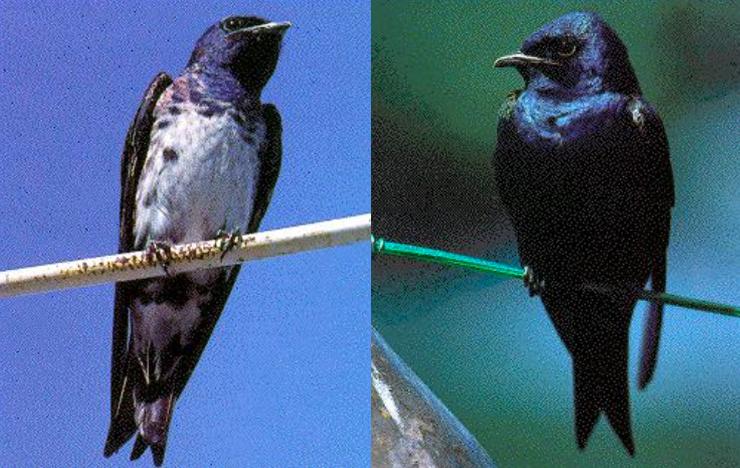
The purple martin is the subject of today’s article. From the American Bird Conservancy and the Purple Martin Conservation Association come many interesting facts about these beloved aviators.
Purple martins (Progne subis) are the largest member of the swallow family in North America. They have a short slightly-hooked beak, broad chest and forked tail. Their flight pattern is typical of swallows: short glides with longer alternating flapping.
Purple martins are long-distance migrants, wintering in the Amazon Basin along waterways and wetlands. Martins head north again with the warming spring temperatures that signal the emergence of flying insects, setting up nesting territories in open spaces close to wetlands, swamps, or wet meadows, where large numbers of insects breed.
These are highly social birds, usually nesting in good-sized colonies. After the breeding season is completed, they form large, noisy flocks, roosting and even migrating together.
Martins appear here in Georgia in late February or early March. Unlike many native birds, the purple martin thrives in close proximity to humans. They are cheerful birds that spend their summer days perching on wires or canvassing the airways in search of flying insects. As guardians of the poultry yard, martins also defend their territory against hawks and crows.
Martins eat butterflies, grasshoppers, houseflies, and dragonflies. Although martins feed on flying insects, their ability to control mosquitoes has been overrated. Studies have shown that most mosquitoes are active at twilight or night, spending most of the day on the ground or near vegetation. And since martins look for food from dawn to dusk, mosquitoes are only available to them at sunrise and sunset.
Adult males (third year) have an all-dark (black/blue/purple) plumage. Second year males have at least one, but can have many, dark purple feathers on their head, throat, or belly. Second year males can easily be confused with an adult female. Adult females have more purple on their head and back than young females and their undertail feathers are much darker.
Martins are becoming more popular these days as interest in the environment and non-chemical pest control grows. If you are trying to attract these feathered friends, you will do well to remember some important things about their lifestyles.
Older martins tend to return to their former nesting sites, while younger ones look for new sites. Once a house is used, it will usually continue to be used from year to year, while new houses will be sought after by yearling martins looking for places to nest.
Once the martins find “home” they are often upset to find locals, like house sparrows and starlings, occupying their abode and making a mess of it with gobs of grass and twigs and droppings along the walls. Chances are good that, if the martin house has a strong team of returning martins, the aggressive birds will drive away the intruders after a few days of sparring. However, if the house is new and the martins are timid, they won’t stay. They need your help.
If possible, get to the openings of the nests, reach in and pull out the unwanted nesting material, eggs, and all. To make this cleaning job easier, you may want to consider putting a house on a pole with a hinge joint at the base. Cleaning can be done by simply leaning the pole over.
Martins make nests from twigs, weeds, dead leaves, grasses, and other materials. The female lays three to eight white eggs and incubates them about 13 days. Only the female can incubate—she has a brood patch, a featherless area on her belly that transfers heat to the eggs. Both parents feed and care for the young who remain in the nest three to four weeks before departing.
One final note about purple martins: they love honey bees. So, if you have beehives, you may expect the martins to eat some of your bees.
Good luck with your lively swallow companions. They will be well worth the effort they require.
Before you go...
Thanks for reading The Houston Home Journal — we hope this article added to your day.
For over 150 years, Houston Home Journal has been the newspaper of record for Perry, Warner Robins and Centerville. We're excited to expand our online news coverage, while maintaining our twice-weekly print newspaper.
If you like what you see, please consider becoming a member of The Houston Home Journal. We're all in this together, working for a better Warner Robins, Perry and Centerville, and we appreciate and need your support.
Please join the readers like you who help make community journalism possible by joining The Houston Home Journal. Thank you.
- Brieanna Smith, Houston Home Journal managing editor
Paid Posts
Author

Related Articles

DID YOU KNOW …? Who was the producer’s first choice to host the original “The Price is Right”?
Five hundred columns down, and an infinity of columns yet to go!
After last week’s party for the 500th collection of silly trivia, you’d think I would be ready to give up, right? Heck no. I’m just getting started. In fact, I plan to be around until we hit 1,000 columns and then some!
So while you settle back and enjoy your favorite beverage appropriate for the time of day in which you read this, I’ll be working on future columns to enlighten and entertain you.
Enjoy!

Jesus called Himself ‘Son of Man,’ not ‘Son of God’
The Christian faith teaches that Jesus is the “Son of God,” yet Jesus frequently and consistently called Himself the “Son of Man” — a total of 81 times in scripture.

If you give a coworker a donut
If you give a mouse a cookie…