Farm Day entertains, educates Lake Joy ES students
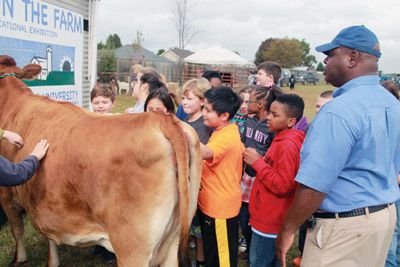
The farm, in its various forms, came to Lake Joy Elementary School last week to educate and entertain students and faculty.
Exhibits on the school grounds highlighted most everything from bees to beef, and from goats to rabbits.
The rear of the schoolyard featured presentations and sometimes animals courtesy of the Beef Board, Perdue Farms, Houston County Farm Bureau, Georgia Forestry Commission, Feagin Mill Middle School, Mossy Creek Middle School, Perry High School, Fort Valley State University, Georgia Department of Natural Resources and firefighting and harvesting equipment. The event was organized by fourth grade teacher Dennis Peavy.
As students went down the fifth grade hall on their way to the exhibits, they were greeted by Becca Webb of Perry, who is an employee of Chick-fil-A and, for lack of a better term, an “eat mor chikin” cow who was dispensing high fives.
Offering honey sticks outside was Miss Georgia Forestry Darlyn Davis, a Houston County native who was watching over a hive.
“I started beekeeping as an FFA project in high school,” Davis said. “Now I’m doing Miss Georgia Forestry, promoting forestry products.”
Davis is currently a student at Georgia College, majoring in communications with a minor in Spanish. Her interest in beekeeping came from her love of animals, she said.
“My mom wouldn’t let me keep an animal that was too big. One day we were riding around in south Georgia and I saw all these big bee boxes in a field and she told me what they were.”
She has one hive in her backyard, she said, down from about 10 in the summer.
“It’s really a hobby for me because it’s pretty hard being in college and just coming home on weekends,” she said. “It’s a lot of give and take, but I’m O.K. with having one hive.”
And the obvious question – How does she keep from being stung?
“I cover up my skin and I wear latex gloves, and most times I smoke them pretty well,” she said. “Now I’ve been stung sometimes as they crawl up my pants leg. But I haven’t been stung all that much, maybe about 50 times in a three-year stretch.”
Principal Tami Godman pointed out where the animals came from.
“The pigs are from Mossy Creek and the rabbits from Feagin Mill Middle School,” she said, gesturing with her arm.
Justin Bennett, agricultural education teacher at Mossy Creek Middle, said the school has about 24 pigs.
“They’re all barrows and gilts about 3 months old; we show them when they’re 6 months old. These go to the market the first of March,” he said.
A barrow is a male pig that has been castrated or rendered incapable of reproducing before he reaches sexual maturity. Castration usually takes place while the pig is very young, at about two or three weeks of age. A gilt is typically a young female pig that has not yet been bred.
“We have two seasons for pigs: summer season which runs from June to October and from about now until the end of February,” Bennett said.
The pigs sport color-coded ear tag numbers: blue are from the state show and the other numbers are the ones that came with the pigs.
“The numbers are for identification purposes, not to indicate they’ve been inoculated or anything else,” he said. “We have them on a pretty stringent diet. They’ve got to be about 225 pounds now, and have to be about 275 pounds in February.”
Working and rubbing one of the gilts was Laynie Mizell.
“My cousin had done it, and I had hung out with her a couple of times at shows and I thought it would be interesting and fun, and it has been,” she said. “We keep them clean. We brush them every time we see them, that’s three times a day. We wash them every now and then; we try to keep their pens as clean as possible. It’s good work.”
With the weather turning cold, Bennett said, care for the pigs becomes more critical.
“We have to take care of them because they can be prone to respiratory conditions like pneumonia when it gets cold,” he said. “We’ll give them some antibiotics when we take them back to school to keep him from getting sick and stuff from getting into the lungs. We had one the other night who was really sick, coughing up a lot and having trouble breathing, but she feels much better now.”
He laughed at a mention of hogzilla, the big boar in the news that was allegedly found in south Georgia some years ago. Further reporting indicated it was a hoax.
“This is a steer. He’s real gentle around kids though some of them aren’t,” said a Mr. Jeffrey from Perry High School. “Some kids freak out at the sight of cows.”
The 15-month-old steer weighs about 1,150 pounds, or a little more than one-half ton.
“His life span is about three more months and then we’ll harvest the meat,” he went on to say. “More likely, we’ll also give the butcher the hide, and he’ll sell it. They’ll use it though, there’s no wasting of that.”
“You’ve got to know your animals,” said the exhibitor from Fort Valley State University, pointing out a brown cow. “You see her coat is getting kind of thick because the weather is getting colder. She has a different coat than she had back in June and July. I had to brush all that old hair out and let the new thick hair come in.”
Students stood by the cow, wide-eyed with curiosity.
“That’s the hip bone,” he said, patting her on the back, “and that’s the udder back here. And she’s got earrings, as you can see. These earrings are numbered, so if she gets lost people can find out who she belongs to. It’s like you and your Social Security number. She just had a birthday in October and she’s 6 years old. Her name is Miss Betty.”
The goats were caged up but walking freely. Mike Woods was talking to students about one goat in particular who seemed to be in charge.
“She is pretty dominant, very territorial. They know where their place is within the herd,” he said. “She can bow her head toward the other ones, and they’ll run. She’s 3 years old.”
A little further down was pecan farmer Casey Anderson, 22, a former Houston County student himself.
“Not very long ago I was a student at Matt Arthur Elementary and I enjoyed it,” he said. “When you get out of high school, you can be a farmer. Or if you show livestock in high school, save your money. You can buy three cows and wind up paying for your own college.”
Anderson is enthusiastic about farming as a career or as a means of gaining wealth. But he’s also not shy about stating it takes a lot of work.
“I’m a pecan farmer, and I farm around Centerville, Warner Robins, Perry. I’ll go anywhere; if there are enough trees to make some money, we’ll do it.”
His season really lasts from spring to winter, almost a year-round effort.
“For the trees, starting in April you have to begin mowing them, spraying them every now and then to keep them free from diseases and insects,” he said as he cranked up a pecan harvester that drowned out other noises.
Winding up Godman’s tour of the Farm Day event was Forest Ranger Travis O’Dell, a Wildland firefighter with Georgia Forestry Commission.
“We mostly fight fires with machines like that bulldozer over there,” he said. That’s mainly what we do.”
Peavy said he was inspired to organize the event after hearing students talk about food only coming from grocery stores, not farms.
HHJ News
Before you go...
Thanks for reading The Houston Home Journal — we hope this article added to your day.
For over 150 years, Houston Home Journal has been the newspaper of record for Perry, Warner Robins and Centerville. We're excited to expand our online news coverage, while maintaining our twice-weekly print newspaper.
If you like what you see, please consider becoming a member of The Houston Home Journal. We're all in this together, working for a better Warner Robins, Perry and Centerville, and we appreciate and need your support.
Please join the readers like you who help make community journalism possible by joining The Houston Home Journal. Thank you.
- Brieanna Smith, Houston Home Journal managing editor
Paid Posts
Related Articles
The Westfield School Calendar 2025-2026: Key Dates & Holidays
The The Westfield School Calendar includes key dates for the school year, such as the first and last day of school, holiday breaks, teacher workdays, and high school graduation. Families can use this to plan ahead and stay on top of important schedule changes.
Houston County School Calendar 2025-2026: Key Dates & Holidays
The Houston County School District 2025-2026 Calendar includes key dates for the school year, such as the first and last day of school, holiday breaks, teacher workdays, and high school graduation. Families can use this to plan ahead and stay on top of important schedule changes.