
Candidates face off in virtual forum
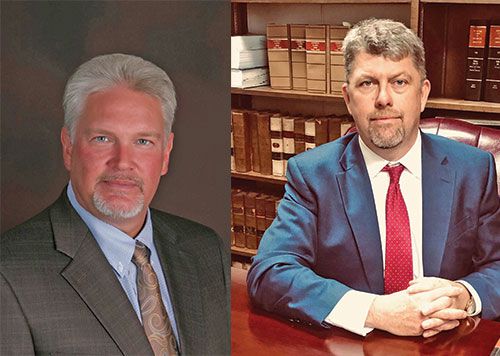
Monday marked the first day of early voting in Houston County, and it was also the day that Robins Chamber sponsored a 90-minute virtual political forum that streamed live via the Robins Regional Chamber Facebook page. The forum was hosted by April Bragg, president and CEO of Robins Regional Chamber and moderated by Frank Malloy of 13-WMAZ. Those that were highlighted in Monday evening’s forum were George Hartwig (I) and Arthur Creque (Houston County District Attorney candidates), Heath Clark (I) and Amanda Britt (State Representative District 147 candidates) and Larry Walker (I) and Franklin Wetmore (State Senate District 20 candidates). The evening’s format did not include debating between the candidates, but Bragg posed several questions to each contender, for which they had one minute to answer.
Creque, challenger for the position of District Attorney (DA) expressed concerns about the backlog of cases in the DA’s office. “Because of the backlog, there is an excess of 1,500 cases dating all the way back to 2001,” Creque pointed out. “A particular concern are the 127 cases still pending from 2017 [and] approximately 370 cases still pending from 2018.” Creque further specified that there were issues of lack of communication between the DA’s office and the victims of those connected to the backlogged cases, as well as the DA’s office and law enforcement. “There has to be a realization that not every issue is resolved by an email or a text. At some point you have to go down to the office and talk to them face-to-face,” Creque emphasized. “They certainly deserve it.”
Hartwig stated that he had no knowledge of where Creque had gotten his figures. He went on to offer insight on the way in which the DA’s office worked, explaining that they prioritized cases and pursued the most serious and violent criminals first. “It has been my priority since taking office to go after, not only the serious violent criminal,” Hartwig said, “but also to go after and seek justice on old cold cases where people had been murdered in this county, people have committed rapes; people have committed some of the most heinous, violent crimes there are—and no one had been prosecuted with those crimes. My office, under my leadership,” he continued, “has gone back to work with law enforcement. Not only to view and revive those old cases, but to prosecute, and prosecute successfully, those old cases.”
One of the questions asked by Bragg to each candidate required that they explain what role, as District Attorney, they would play in justice reform.
“I was actually appointed by Governor Nathan Deal to serve on the Council for Criminal Justice Reform,” Hartwig revealed, “so I have first hand knowledge of some of the things that [have taken] place in that area.” He went on to say, “One of the problems is, you take certain crimes—and I’ll use drug cases as an example—and people can get caught with cocaine and methamphetamines; the penalty on that used to be one to 15 years. When you made a plea offer to somebody—and most of our cases are resolved by plea offers and guilty pleas—there was some incentive for that person to come in and plead guilty because the crime carried a 15-year sentence.” Hartwig went on to say, “Well, our legislature reduced possession of those drugs to three years as a max for smaller amounts. If the max a person gets is three years, there’s not a whole lot of incentive to come in and plead guilty. You hold out for a trial, and again, it just adds to the number of cases that have to go to trial.”
In his response to the same question, Creque began by saying, “I find it interesting that my opponent said he was appointed by Governor Nathan Deal to be a part of the criminal justice reform, and then he wants to turn around and complain about that very act of reform that he was part of.” Creque further stated, “I think criminal justice reform is something that has to be looked at on a case-by-case basis; what it is that the priorities of our society is, what it is that our society as a whole wants to accomplish. Many of the people I speak to talk about the slowness of the criminal justice system, some of them talk about the lack of resources available to prosecutors. But, in this day and age, really it’s a question of what, as a society, we would like to see accomplished in regard to penalties for burglaries, penalties for drug offenses and everything else that will go along these lines.”
As the spotlight shifted to those vying for the seat of State Representative District 147, Bragg asked what each thought was the greatest challenge. The state of Georgia would face in the next couple of years and how they planned to address that challenge, the responses from the both candidates were rooted in the outcome of COVID-19.
“I think the obvious answer right now is just the aftermath of the coronavirus and how we’re going to come out on the other side and be stronger,” was Clark’s reply. “The reality is, we’re looking at having to make some tough decisions in appropriations. We’ve already begun those committee meetings virtually,” he revealed, later stating, “We just finished with Hurricane Michael. We just had to have a special session last year to address some of those issues. With the Great Recession, Hurricane Michael, and now the coronavirus… how to properly appropriate the state’s money to make sure that we can emerge on the other side of this economic disaster strong, better, and in a better position to improve lives.”
Britt’s response had a tone of agreement. “Kind of the same situation; definitely what’s going on with COVID and how we go about handling it afterward,” she said. “A big focus is going to be economics. I do know the governor wants to revise the budget, and word is that teachers won’t be getting their raises this year. I really hope that’s not true,” Britt added, “because our teachers are the forefront of our next generation. On top of that, also, with the COVID situation, is addressing the issues we have in our health care system. We definitely took a hit on those; making sure our hospitals have what they need and making sure our rural areas have hospitals and doctors that they can go to in cases of emergency and with this COVID situation.”
April Bragg mentioned that Georgia had received both criticism and praise for its response to COVID-19. “How would you rate the state’s leadership’s response to this unprecedented crisis?” Bragg asked both candidates.
“I will be honest,” Britt said. “At first when the governor was talking about reopening the state of Georgia, I was very worried about it because I listened to what President Trump said, and that was 14 days of decrease. When we decided to start opening up, we were only on day seven.” Britt went on to explain that her worries lessened once Governor Kemp explained that he had already had a conversation with President Trump about it. “I do wish that our local officials and even our house representatives would have communicated more with us on what’s going on and why things are happening,” she added.
In his response, Clark said, “It hasn’t been easy. Nobody knows the future. I think Governor Kemp took some bold leadership when he looked at the data. He tried to be data-driven and not emotionally driven on his policies,” Clark explained. “When he did the shelter-in-place, he was criticized for not going far enough, and when he lifted it, some of the same people were criticizing him for getting out too early. When you look at it, it’s a hard situation. People have spent 20 and 30 years investing in a business, and now it’s being ripped away from them.” Clark also revealed that he was receiving calls from business owners who complained about being charged rent while they were not able to use the building during the shelter-in-place ordinance. “It’s a hard situation, but I think Governor Kemp showed some bold leadership in getting our state out ahead.”
The evening’s forum ended with all eyes on State Senate District 20 incumbent Larry Walker III and his challenger Franklin Wetmore.
One of the first things Wetmore, a military veteran, said was, “Me running for the Senate is me just wanting to serve in a different way. I have nothing at all bad to say about Mr. Larry Walker. I believe he’s done a lot of amazing things for the community. I wish him the best of luck in his campaign, and I’m going to do the best that I can do in my campaign. We’re two patriots trying to serve our country, and I believe either myself or himself … we will get it done.”
One question posed by Bragg to both candidates was, “What, in your view, is the greatest economic development opportunity for our state right now?”
In response, Walker said, “Where we are with Robins Air Force Base, that’s obviously the economic engine here. I think there’s great opportunity to bring more missions to Robins and all the surrounding support businesses that go along with that. One of the bills I passed that I’m really proud of is to establish Houston County as a military economic opportunity zone. This gives us payroll tax credit so we can offer new industry to come here in support of the base. That’s going to be helpful as we try to get the economy back going and grow industry.” Walker also made it known that Lt. Gov. Jeff Duncan was making an effort to make Georgia the Silicon Valley of the South. “I’m real excited about some of the initiatives surrounding using technology in our workforce development in that area,” Walker stated.
Wetmore stated that he believed the school systems and reforming the prison systems would be great economic development opportunities. “Not only taking people that are in the prison system and reforming them,” Wetmore explained, “but actually teaching them some viable skills that they can use on the outside so that they can be tax-paying contributors to society. Furthermore,” he added, “in the school system is where education all begins before it leads down the path of incarceration and prison school systems. I think better schools in general,” he said. “Houston County has decent schools here, but I think there should be more emphasis and more money pumped into the schools so people learn more while they’re there … about etiquette and how to navigate through society. Wetmore indicated that these things were just as important as subjects like history and science because they help keep people from going down the path of the prison system.
When each candidate was asked how they planned to keep taxes low with the economic slowdown, all while rebuilding the emergency funds and keeping a balanced budget, the responses were wide ranged.
In part, Wetmore stated, “What I’d like to see, is when an agency has surplus money, shave that money off on an honor policy instead of spending that money just to spend it. Put that back in the governmental system to be reallocated with no punishment attached so they don’t have less money allocated to them the following year. That’s the biggest problem with our government; the fact that they keep spending money,” Wetmore said.
In his response to the question of how he’d keep taxes low, Walker admitted, “That’s going to be difficult. We did pass, for the first time ever, a cut in our income tax two years ago,” he said just before assuring his commitment to not raising taxes through this. “We’re going to just have to make some real tough decisions and use technology where we can, to become more efficient in state government. It’s going to be a painful process, but thankfully,” Walker added, “we do have the Rainy-Day Fund of about $2.7 billion. I’m afraid that’s going to be depleted through this, but that’s what it’s for. We’re going to have some hard choices to make.”
For those who missed the live forum on Monday night and would like to hear all questions and answers in their entirety, the video is available for viewing on the Robins Regional Chamber Facebook page.
HHJ News
Before you go...
Thanks for reading The Houston Home Journal — we hope this article added to your day.
For over 150 years, Houston Home Journal has been the newspaper of record for Perry, Warner Robins and Centerville. We're excited to expand our online news coverage, while maintaining our twice-weekly print newspaper.
If you like what you see, please consider becoming a member of The Houston Home Journal. We're all in this together, working for a better Warner Robins, Perry and Centerville, and we appreciate and need your support.
Please join the readers like you who help make community journalism possible by joining The Houston Home Journal. Thank you.
- Brieanna Smith, Houston Home Journal managing editor
Paid Posts
Related Articles
Warner Robins is mowing grass on city streets, but divided on who should do it
The cheapest option isn’t locally based, a point which drew opposition from some on the Council.
Perry won’t see rate increases, but some city savings will go towards expenses
The Perry city council unanimously approved the fiscal year 2027 budget, which included approval for no fee increases and additional fees.
Need to get home grown produce canned? Visit the Argene Claxton Canning Plant this summer
The Argene Claxton Canning Plant in Perry is a useful resource to learn about preserving food this summer.