
Buzzard Roost became “Buzzard Drop” for ringing in the New Year
When you think of buzzards, cute and charming are not words that you would ever use to describe them.
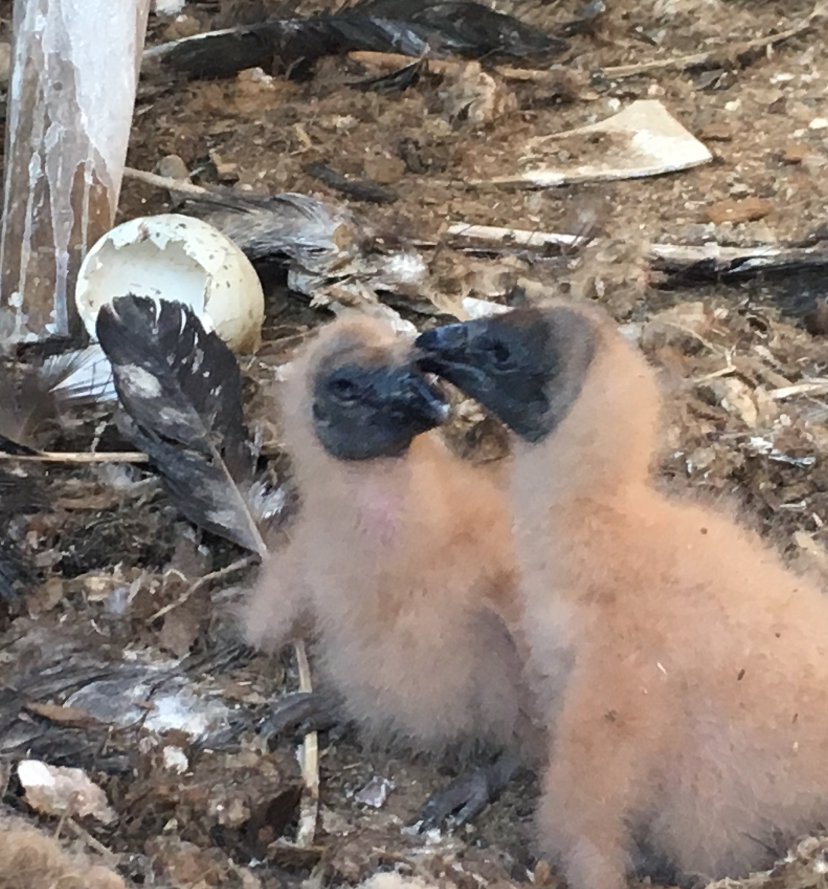
When you think of buzzards, cute and charming are not words that you would ever use to describe them! But recently I checked out an old deer tree stand, and it was abandoned and taken over by nesting buzzards. There were two baby buzzard chicks in the nest and yes, you could describe the baby as sorta cute furry balls with black bills. They were a few weeks old and soon they would go through a growth spurt and become gangly and fairly ugly, like normal buzzards! Luckily for all of us, it’s not just the cute and the charming that are important and valuable in nature.
Vultures offer important ecological services and when they form a clean-up crew with all their best friends, they can clean up carrion (dead animals) and reduce the spread of disease from dangerous and sometimes deadly pathogens such as tuberculosis, rabies, botulism, salmonella, cholera, and anthrax. Their extremely acidic stomach acid allows them to consume carcasses infected with these diseases without becoming ill. In addition to reducing the spread of pathogens, they recycle nutrients and remove odors from the landscape – and hazards from the road. If you see a gang of buzzards working over carrion on the side of the road, be sure to slow down as they can be slow to depart their buffet feast and might fly into your windshield!
As valuable as they are, vultures have not always been appreciated. Their populations have been threatened in the past by people trapping and killing them due to erroneous fears that they spread disease. Vultures were trapped, poisoned, and shot by the thousands until the 1970s. Populations were also affected by the side-effects of the pesticide DDT, but have rebounded in recent decades. The largest current threat to our scavenging friends is lead shot from carcasses and gut piles left by hunters and poisons used for pest control.
According to the Georgia Extension Service at the UGA, there are two species of vulture in Georgia – the turkey vulture and the black vulture. Turkey vultures have hairless red heads (this is much more hygienic when feeding in carcasses), brown to black feathers, and silver/gray bands on the underside of their wings when viewed in flight.
Black vultures are slightly smaller than turkey vultures (a wingspan of 4.5-5ft vs 5-6ft), have hairless black heads, black feathers, and silver/gray “fingertips” on the underside of their wings when viewed in flight. Black vultures hunt by sight, or by following other vultures. They do not have the advanced olfactory senses that turkey vultures do. Black vultures are monogamous, can live for 20 years and are highly social. Most of the supposed “eagles” you see flying over middle Georgia are buzzards, not hawks or eagles.
They have strong social bonds with their family throughout their lives and exhibit intense family loyalty. They will feed their young for up to eight months after fledging and share food with relatives. In Warner Robins, there is a very large group of buzzards. maybe a hundred birds that have been residing around Leisure Lake for several years. I think they probably just like lake living and occasionally they get to eat a dead fish that washes up on the lake shore.
Both species of vultures can live more than twenty years. Since both species of vulture lack a voice box, their vocalizations are limited to raspy hisses and grunts (this probably doesn’t help their appeal). Vultures exhibit some fascinating, though off-putting behaviors. To cool themselves and to kill bacteria, (remember that hardcore stomach acid,) vultures defecate on their legs and feet. Their main defense tactic – which can be very effective – is projectile vomiting. I think we can all agree that vultures, like all wildlife, are best admired from a distance.
Buzzards often rest in large groups at the tops of trees. One such spot is a local legend at the Twiggs and Houston County line at the Ocmulgee River. An old steam engine railroad stop was on the Twiggs County side of the river just a few miles south of the present Highway 96 railroad crossing. The locals named the water stop for the railroad as “Buzzards Roost” for the large number of buzzards that frequently rested there overnight.
But some local ladies thought that Buzzards Roost was a low class name, so they prevailed upon the railroad to change the name to West Lake and it has remained so up until today. The boat landing that was near the water stop for the steam engine frequently attracted fishermen and met the commercial shipping needs of local farmers that would load their cotton onto barges for the trip to Savannah back in the mid 1800s. There was also a boat ramp on the Houston County side of the river and the whole area became known in the early pioneer days as Buzzards Roost.
On the Houston County side, the dirt road traveled through Oaky Woods and became Highway 127 that ran to Perry. Thus, it is only fitting and proper that the city of Perry has bestowed the honor of naming its New Year’s Day festivities as the “Buzzard Drop” to ring in the new year of 2025! Buzzards are finally getting the respect they deserve! Happy New Year to everyone!
Before you go...
Thanks for reading The Houston Home Journal — we hope this article added to your day.
For over 150 years, Houston Home Journal has been the newspaper of record for Perry, Warner Robins and Centerville. We're excited to expand our online news coverage, while maintaining our twice-weekly print newspaper.
If you like what you see, please consider becoming a member of The Houston Home Journal. We're all in this together, working for a better Warner Robins, Perry and Centerville, and we appreciate and need your support.
Please join the readers like you who help make community journalism possible by joining The Houston Home Journal. Thank you.
- Brieanna Smith, Houston Home Journal managing editor
Paid Posts
Related Articles

Seeing is believing … sort of
Blink has a new feature.
The attic goldmine: Ordinary household items worth selling
You are dusting a peculiar ceramic vessel bought at a flea market, or polishing a pair of grandmother’s old brass candlesticks, and the thought hits: If I took this to an appraisal roadshow, would they tell me I’m a millionaire?

Why we Need Memorial Day
Far too many Americans treat Memorial Day as nothing more than the unofficial start of summer.