
Zoom in a big bass
Really big bass are difficult to put in the boat!
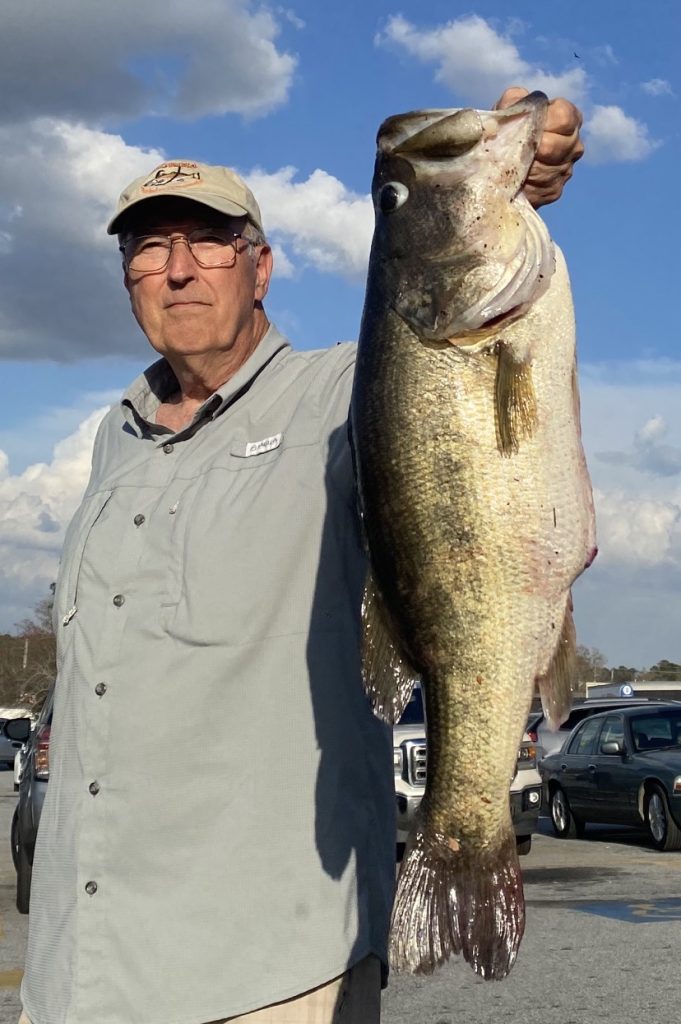
Really big bass are difficult to put in the boat! I’ve caught thousands of bass in my lifetime, but only very few in the 10-pound range. Most have been in the 1-3 pound size and I usually return all bass to the lake to grow bigger.
I’ve been lucky to fish with several great big bass anglers including Charles Sloan, Jack Chandler, Chris Bailey, Monte Walters and Steve Watson, and others, mostly Georgia anglers. Usually my trips have been while I was writing stories for Georgia Outdoor News, and I’m always watching and learning.
Years ago I was fishing with Charles Sloan at a private Wilcox County pond on a cold, damp February day. Charles had scoped out an underwater ditch and knew it held some big bass. Fishing with plastic worms, we boated three nice ones. Charles caught a nine and 11 pounder, while I pulled in a bass of about eight pounds. A pretty good day!
Charles passed away back in 2017, but I arranged to have his biggest bass, which weighed 13 pounds 12 ounces, put on display at the Go Fish Education Center in Perry. He was a great bass fisherman and was always fishing if he wasn’t working or sleeping! Look for his bass on display over the water cooler and I know Charles is fishing and smiling in heaven.
My biggest bass recently is this 9-pound-7-ounce bass that I caught in a private Houston County pond a few weeks ago. I “zoomed’ it into the boat with 6-inch blue with green flake lizard, called a June bug. The Zoom Bait Company, owned by Eddie and Kim Chambers, is based around Watkinsville, near Athens, thus it is a great Georgia based company. (Go Dawgs!)
Want to catch a big bass? Here are some tips to make it happen!
1) Fish in older lakes and large ponds known to produce big bass. It takes many years to grow a big bass, at least 10-15 years, so don’t expect to be successful in newer ponds or places that get a lot of fishing pressure, as many potential trophies are removed from the water before they reach their potential. The world record bass was caught in 1932 by George Perry and weighed 22 pounds 4 ounces and that record still stands, but has been tied by a bass caught in Japan. The Georgia bass was caught in an oxbow section of the Ocmulgee River called Montgomery Lake, near Lumber City.
2) Fish in the late winter to early spring when female bass are getting ready to spawn. Many big bass are taken when they are bedding and anglers look for them in shallow water and get them to attack a bait slowly dragged through the bed. This type of fishing takes a lot of cruising around lakes looking for bass beds and plenty of patience.
3) Fish quietly and make long casts whenever possible, otherwise you’ll spooked the fish. Use a slow and careful retrieve to let the bait fall into the hiding locations and work over limbs. Big bass don’t get trophy size by being dumb and do not do a lot of chasing baits.
4) Use strong quality equipment and line. Many anglers use level wind bait casting reels, which is great, but I prefer a spinning reel with an easy opening bale. The line is very important and I use spider wire braided line, but there are many variations out there, most good! My line is 6/20 which means it has the diameter of six-pound line, fairly small and easy to cast, but a break strength of 20 pounds. I haven’t had a big bass break my line in recent years, but the line wears out quickly with a lot of casting, so I replace it every few months. Stay away from cheap reels and 10 pound line or you’ll be crying when a big bass breaks off.
5) Don’t forget to properly set the drag on your reel. It allows the reel to ease out the line without breaking under the strain of a big bass making a strong run to escape. But it’s got to be tight enough to allow you to set the hook in a bass’s mouth or it may drop out. Not setting the hook with a strong yank is a principal reason big bass are lost when they jump.
6) Always have a large landing net to get the bass In the boat as quickly as possible. Many bass are lost right at the boat when you try to ease them out of the water, then the hook and line is put under tremendous strain. That’s why it’s best to let the bass swim by the boat, just under the surface, and quickly scoop them up in the net.
7) How much does that bass weigh? Im pretty good at guessing weight, but a good digital hand held scale takes the guesswork out of the picture. Recently I was fishing with Judge George Nunn at a private pond and I landed a bass in the 6-pound range and neither of us had a weighting scale with us. We took a few photos and released the bass.
I told Judge Nunn that bass might have gone seven pounds, maybe even eight! He grinned and said “John, just keep talking and you’ll have that bass over 10 pounds!” We were just having fun on a great fishing day.
If you don’t have a good pond in mind to catch a big bass, give Ocmulgee Public Fishing Area, near Cochran, a try. It’s a catch and release bass lake and has a good population of 5-10 pound bass in it. But it can be hard to make them bite, but it sure is nice when a whopper yanks on your line! Flat creek PFA near Perry is also a good fishing lake, but many bass end up in the cooler, so it’s tough to grow a big one there. Good fishing!
Before you go...
Thanks for reading The Houston Home Journal — we hope this article added to your day.
For over 150 years, Houston Home Journal has been the newspaper of record for Perry, Warner Robins and Centerville. We're excited to expand our online news coverage, while maintaining our twice-weekly print newspaper.
If you like what you see, please consider becoming a member of The Houston Home Journal. We're all in this together, working for a better Warner Robins, Perry and Centerville, and we appreciate and need your support.
Please join the readers like you who help make community journalism possible by joining The Houston Home Journal. Thank you.
- Brieanna Smith, Houston Home Journal managing editor
Paid Posts
Related Articles

Foolhardy to let young sprouts go unweeded
The Minister of Youth in a Baptist church bulletin wrote the following note to parents: “Parents, please make it a priority to have your children with us on Wednesday nights at 6:15.”

No waffling. The scoop on fake ice cream
I scream. You scream. We all scream for ice cream!

The books that built a nation: How the McGuffey Readers defined the American mind
Long before Dick, Jane and Spot helped us learn to read, there was another iconic set of children’s textbooks.