
World War II B-17 pilot and former POW, Hicks, shares his story
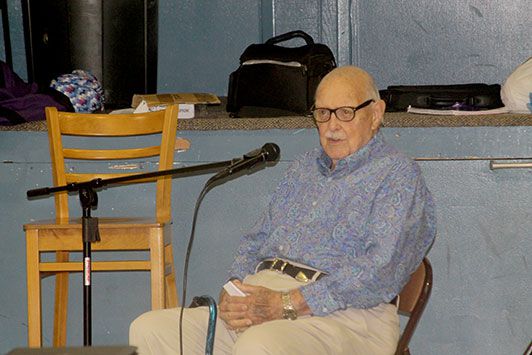
Crawford Hicks had a war time story to tell, and he did so at Green Acres Baptist Church on Monday afternoon.
Hicks signed up for the Army Air Corp in 1942 to find his purpose and a way to fly, but what he found was an entirely different experience when he was captured and held prisoner at camp Stalag Luft III in Germany.
Hicks was born Feb. 10, 1921 in Leitchfield, Kentucky and was raised in a little town right outside of Louisville. After high school, Hicks attended the University of Kentucky for one semester before enlisting in the Army Air Corps in February of 1942, right after his 21st birthday.
“I signed up as soon as I could because I wanted to fly an airplane and this was a way I could do it,” Hicks said.
Before his capture by German Forces, Hicks flew 10 missions in a B-17 aircraft with the Army Air Corps. There were 18 planes per formation and three squadrons of planes with six in each squadron. On Hicks’ first mission, he flew on the right side of the plane as co-pilot to demonstrate how he handled the mission. During his training, and in flying his first mission, Hicks said he was scared.
“I was so scared I almost got sick,” said Hicks. “But I couldn’t get injured, so I had to keep on flying. I would awaken in the morning and be afraid that I was going to get killed. I remember saying ‘Lord, is today the day that I get killed?’ He listened and such a tremendous load fell off my shoulders.”
Hicks was flying a mission on the day he was taken as a Prisoner Of War (POW). During this mission, Hicks and his comrades were under attack and the situation became fatal for them and stressful for Hicks. He was the last one in the plane and concerned about keeping the airplane going straight as they were under attack. Eventually, Hicks realized that he needed to jump, but first looked down and marveled at the realization of how high 15,000 feet actually was.
“I remember looking down at the ground at about 15,000 feet up, and the thing about this at 15,000 feet was I saw a lot of air and the tops of trees, and that’s all I could see, and I had to jump,” said Hicks. “I said ‘Lord help me get through this.”
After jumping from his plane, Hicks was captured and taken to the camp. At Stalag Luft III, Hicks noted that himself and his fellow POW’s at the camp had a fairly good relationship with the camp guards.
Experiences were also different for Hicks within the camp walls. Communication with the outside was slim and the POW’s had little news of what was occurring beyond the walls of the Stalag.
“Come December, we started hearing the Russian guns from the East,” said Hicks. “So we knew something was going on.”
Being a POW in the German camps in the winter could become a very cold experience with temperatures reaching nearly 40 below zero. A short time after hearing the Russian guns, Hicks and many of the other men from the camps in Stalag III were forced to march through the snow with their few belongings strapped to their back.
“In the middle of January of ’45, [with] very cold, snow on the ground, we had to exit the whole camp,” said Hicks. “I think there were about 10,000 or maybe 5,000 guys in each camp,” “We had to march and I took all the clothing I had: two pair of pants, two pair of socks, a shirt and a sweater, I think I remember that, and a scarf which I converted into a hood and I put a hat on top of that.”
After spending 11 months as a POW, Hicks described the day that he and his comrades were rescued from their camp by General Patton himself. The importance of the memory was made even more so to Hicks’ listeners as he cried while reliving the moment of his release.
“Lo and behold there was the most beautiful tank you have ever seen in your life and guess who was in it? Patton himself,” said Hicks. “He came in and broke the face of the curtain down and our flag went up.”
Before you go...
Thanks for reading The Houston Home Journal — we hope this article added to your day.
For over 150 years, Houston Home Journal has been the newspaper of record for Perry, Warner Robins and Centerville. We're excited to expand our online news coverage, while maintaining our twice-weekly print newspaper.
If you like what you see, please consider becoming a member of The Houston Home Journal. We're all in this together, working for a better Warner Robins, Perry and Centerville, and we appreciate and need your support.
Please join the readers like you who help make community journalism possible by joining The Houston Home Journal. Thank you.
- Brieanna Smith, Houston Home Journal managing editor
Paid Posts
Related Articles

Department of Justice reaches $3 million settlement with various Georgia Boards for alleged violations of the Servicemembers Civil Relief Act
The DOJ has reached a $3 million settlement with 42 Georgia Boards to resolve allegations that they did not recognize the Servicemembers Civil Relief Act.
Lori Johnson hoping to continue putting students and faculty first while serving on the Board of Education
Lori Johnson is running for reelection for Board of Education District 2 and hopes to continue her commitment to the students and faculty of the Houston County School District.

Warner Robins shooting leaves two injured, police say
Law enforcement also found and detained a suspect.