
What shapes Warner Robins: A comprehensive guide through city planning and zoning
The Planning and Zoning Department plays a crucial behind-the-scenes role in shaping Warner Robins’ growth, guiding development proposals to align with the city’s vision while encouraging public input every step of the way.
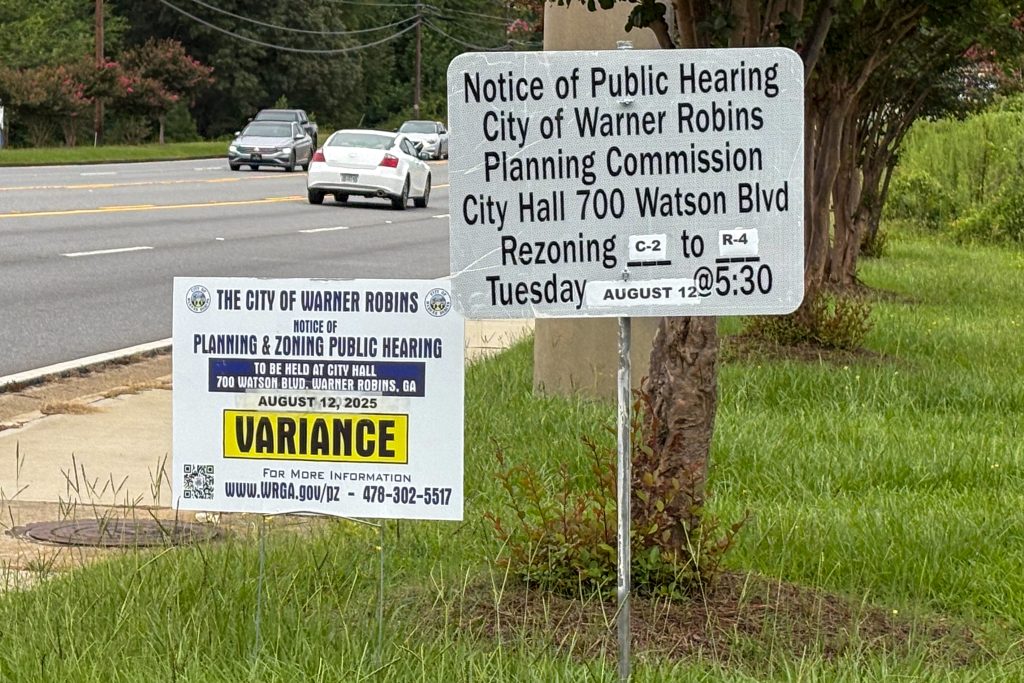
A rezoning and variance request for a parcel of land on Watson Boulevard. (Brieanna Smith/HHJ)
WARNER ROBINS — Have you ever looked at a new building and wondered, “How did that get approved?”
A key player in many new city developments is the Planning and Zoning department, which plays a vital role in the process from proposal to tangible property.
But the city of Warner Robins does not initiate proposals; it responds to them. Proposals typically come from property owners or developers. According to City Administrator James Drinkard, developers often have initial meetings with the city to discuss next steps.
During these meetings, the city aims to educate developers about its vision and guide proposals to align with city standards. Planning and Zoning Manager Darin Curtis explains that many everyday challenges are not monumental shifts or significant changes, but rather small, incremental steps in the right direction.
“If ever we are presented with something that might not exactly meet that vision, we’re often challenging the developers to meet us somewhere halfway, where there’s some sort of in-kind contribution toward quality of life for the residents,” Curtis said.
If the intended use of a property is not allowed by its current zoning designation, the owners must apply for zoning action, such as rezoning or variance, according to Curtis.
For properties within city limits, the application process involves only the city. However, if a property is zoned in the county and the owners wish to access city services, they must apply for annexation.
Once the application is submitted, the city follows a set of procedures outlined by the state’s Zoning Procedures Act. If the request involves annexation, the city coordinates with either the Houston County or Peach County Board of Commissioners, depending on the location of the parcel.
“It’s a formal legal process that dictates the steps that we follow,” Drinkard said.
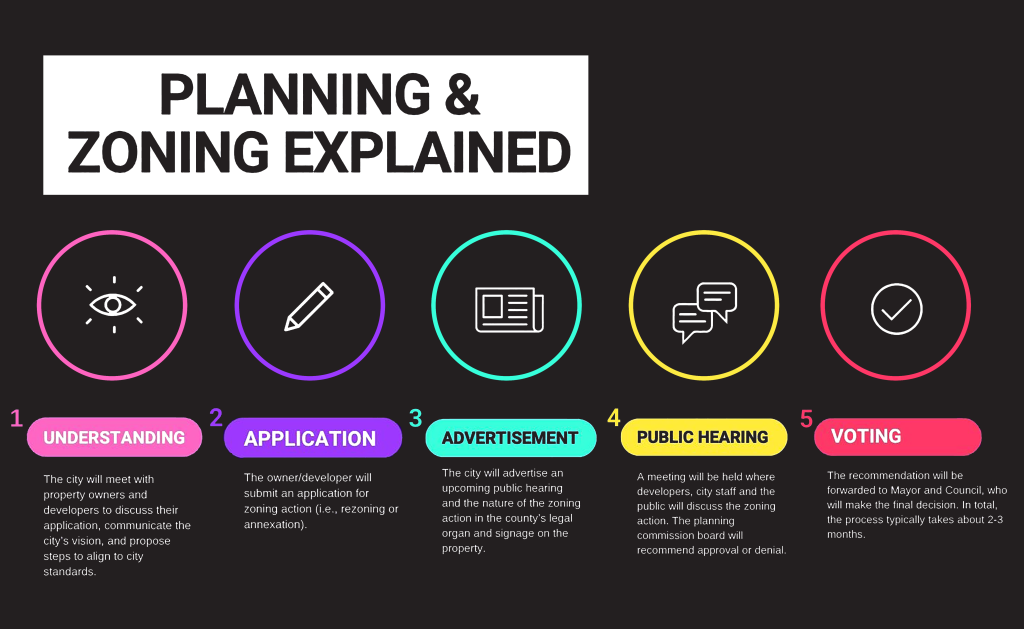
According to Curtis, the zoning process consists of several steps and typically lasts between 60 to 90 days:
- The city will advertise the zoning action in the county’s official legal organ and post signage on the property. This will explain the nature of the action and provide details about the public hearing.
- A public hearing will be held on the second Tuesday of each month, where developers, city staff, and the public can discuss the action. This hearing will be led by the planning commission board.
- The planning commission will make a recommendation to either approve or deny the request.
- The recommendation will be sent to the Mayor and City Council for a final decision.
During the advertising phase, city staff prepares their recommendations, according to Drinkard. Curtis’s department is responsible for assessing whether the proposed use of the land aligns with the Houston County Joint Comprehensive Plan. Additionally, the planning and zoning department gathers feedback from various city departments to inform staff recommendations, which are then communicated to the planning board.
“Within that plan, there are a number of suggested implementation measures for how the city can can move its vision for growth forward. We assess whether the proposed use of the property really meets the criteria that’s outlined in that plan,” Curtis said.
The joint comprehensive plan serves as a guideline and typically does not outright prohibit any activities. Planning and zoning also takes into account various factors, such as local codes and ordinances, traffic patterns, utility demands, and the character of the surrounding area.
For instance, in the proposed downtown development area, the plan promotes walkability, connectivity, intermodal transportation, safety, and beautification. According to Curtis, a mixed-use development—like a loft-style building with retail space on the ground floor and residential units above—would be more likely to receive approval compared to a big-box retailer in this area.
The ultimate goal, as explained by Drinkard, is to find a balance between the rights of individual property owners and the quality of life for the surrounding community. Curtis noted that while a well-thought-out plan is often presented, new information and concerns that arise during public hearings must also be considered.
“I would not, as the manager of the planning and zoning office, provide a positive recommendation for something that either my office or another department had any reservations about. We always make sure to provide all information good and bad, as part of the report to the planning commission,” Curtis said.
Public input plays a crucial role during the public hearing. After a decision is finalized, ongoing public feedback and community acceptance will determine its success.
As Drinkard explained, while the city assesses both successes and challenges, it will also evaluate whether any issues need to be addressed in the city code. If necessary, the planning and zoning department will consider what changes should be made.
“Trends are constantly changing, and new products are coming out in the development world, or new uses may be identified that developers want to pursue. How does our code address that? If it doesn’t address it, well, then we need to tweak the code,” Drinkard said.
The ideal time for citizens to influence the future of their community is during the city’s updates to the comprehensive plan. As Drinkard explained, the comprehensive plan serves as a blueprint, while zoning codes are the materials needed to construct the community.
The city formally updates the comprehensive plan every five years. Updates are scheduled to take place in a few months, and the city will keep the public informed through social media and other communication channels.
With a sizeable impact on the community’s future, the planning and zoning office is essential, and they actively encourage citizen involvement throughout their comprehensive planning process. Drinkard noted that the city is organizing meetings and online surveys to collect feedback.
The collaborative approach not only fosters transparency but also ensures diverse needs and perspectives of the community are considered. As the city moves forward, active participation will be key in shaping a vibrant and sustainable future for all.
“The most important piece in all of this is the public. If they get involved early and then remain involved through the process, they’re more likely to have the community that they want,” Drinkard said. “But if they don’t engage in that process, especially the comprehensive plan update, then we don’t know what’s in their mind.”
For more information, visit the planning and zoning department’s website.
Before you go...
Thanks for reading The Houston Home Journal — we hope this article added to your day.
For over 150 years, Houston Home Journal has been the newspaper of record for Perry, Warner Robins and Centerville. We're excited to expand our online news coverage, while maintaining our twice-weekly print newspaper.
If you like what you see, please consider becoming a member of The Houston Home Journal. We're all in this together, working for a better Warner Robins, Perry and Centerville, and we appreciate and need your support.
Please join the readers like you who help make community journalism possible by joining The Houston Home Journal. Thank you.
- Brieanna Smith, Houston Home Journal managing editor
Paid Posts
Author

Related Articles

PHOTOS: The 2025 Perry New Year’s Buzzard Drop
See the magic unfold as the City of Perry rang in the new year at the 2025 Buzzard Drop on Wednesday, Dec. 31.

Five-year-old dies after illness on Christmas Day, death under investigation
A five-year-old girl died on Christmas Day after being rushed to the hospital with an illness, according to the Houston County Coroner’s Office. Her death is under investigation.

A LOOK BACK: The year 2025 in photos
Step into Houston County’s history as told through the lens of 2025.