
Was the Roman Empire once put up for sale in an auction?
Okay, my trivia friends, I want to ask a question of you.
Okay, my trivia friends, I want to ask a question of you.
Many of you purchased the first collection of silly trivia from this column gathered into a book, back a few years ago. I am now contemplating collecting more from the columns since then into another book.
Since the first book bears the title of the column, I thought I’d call the second one Now … You Know!
The question is … would you buy it? Drop me an e-mail and let me know.
Meanwhile, here’s some of what might make it into that new book! Enjoy!
Did you know …
… the writer of To Kill A Mockingbird was able to write the book because of a Christmas gift? Harper Lee (1926-2016) was having a difficult time balancing her job with her writing. In 1956, she confided in friends about the issue, and her friends gave Lee an entire year’s salary as a Christmas gift, enabling her to take the next year off work and just write. Out of that came the classic novel which went on to win a Pulitzer Prize and sell more than 30 million copies. (I’d have time to write a Pulitzer winner myself if I had a year off with pay.)
… a museum exists dedicated to sea monsters? In Iceland, you can visit the Skrímslasetrið, in the city of Bíldudalur. This museum goes into great detail regarding the area’s history of sea monster sightings. Inside you will find displays, literature, and even eyewitness events. (I’ll believe it when you pronounce Skrímslasetrið for me.)
… the oldest version of the Medal of Honor belongs to the Navy? Authorized in 1861 for sailors and Marines, the Medal of Honor – the highest military award for bravery and valor in the United States – wasn’t authorized for soldiers until the following year. Additional trivia note: the Medal of Honor was originally only authorized for enlisted personnel. Army officers were allowed to receive it beginning in 1863, but the Navy did not allow officers to earn it until 1915.
… the Roman Empire was once put up for sale in an auction? In 193 AD, the Roman Praetorian Guard decided they’d had enough of the shenanigans of Emperor Pertinax (126 AD-193 AD) and assassinated him, then found themselves faced with a quandry – exactly who would take over? The Guard decided to essentially sell the throne to the man who would pay the highest price, and two very wealthy men, Titus Sulpicanus (137 AD-197 AD) and Didius Julianus (133 AD-193 AD) began to bid. When Julianus offered 25,000 sesterces to each soldier, the Guard declared him the winner and new Emperor of Rome. His “reign” lasted 66 days, and came to an end when an army led by General Septimius Severus (145 AD-211 AD) entered the city. Severus had heard about the so-called auction and then led – and won – a battle against the Praetorian Guard. The Senate passed a motion proclaiming Severus as Emperor, and Julianus was hunted down and killed by a soldier in the palace. Severus was the last of the five men who had held the imperial throne of Rome during 193 AD. (I would say Julianus got the short end of the deal, wouldn’t you?)
… turkeys are named after Turkey? No, I’m not trying to confuse you. The bird we know as the turkey was named after the nation of Turkey. Helmeted guinea fowl (what a turkey really is) came from Africa, but British merchants introduced them to Europe through Turkey, and people assumed the bird was from there. (Well, you know what happens when you assume, right?)
… who the last English king to die in battle was? King Richard III (1452-1485) fell in battle at Leicester Cathedral in the Battle of Bosworth Field. Richard’s remains were discovered under a parking lot at the site of the old cathedral in 2012 and after DNA testing to confirm his identity, he was reburied in a tomb inside the cathedral. He was the last of the Plantagenet kings, succeeded by Henry VII (1457-1509) who was of the House of Tudor. (My kingdom for a horse, or something like that.)
… the U.S. government once experimented with insects as weapons? In 1955, the government carried out “Operation Big Buzz” in Georgia. The program called for the producing, storing, loading into munitions, and dispersing from aircraft a huge number of mosquitoes. The idea was to see if the mosquitoes could be used as weapons, once infected with the yellow fever virus. The 330,000 that were dropped into Georgia in May of 1955 were not infected, however; it was just a test to see if the wacky idea would work. And it did work, to an extent: mosquitoes from the drop were located as far as 2,000 feet from the release site. No further use was made of the idea, thankfully. (The mosquitoes showed very little interest in the job, it seems.)
… when the U.S. War Department was established in 1789, the Army had a total of 840 soldiers? Their job was to supervise public lands and guard the frontier of the young nation. (If you were wondering when the idea of drawing down the service after a war started, here you go.)
… we find many examples of irony in history? Case in point: Patrick Henry (1736-1799), famous for his speech including the phrase, “Give me liberty, or give me death!” At the time he made that speech on March 20, 1775, Henry owned 65 slaves. (Practice what you preach, Patrick.)
… executive fraud is very common? While most occupational fraud schemes are committed by accounting departments, upper management is not immune. Most executive frauds result in a median loss of $850,000. (No comment.)
Now … you know!
Before you go...
Thanks for reading The Houston Home Journal — we hope this article added to your day.
For over 150 years, Houston Home Journal has been the newspaper of record for Perry, Warner Robins and Centerville. We're excited to expand our online news coverage, while maintaining our twice-weekly print newspaper.
If you like what you see, please consider becoming a member of The Houston Home Journal. We're all in this together, working for a better Warner Robins, Perry and Centerville, and we appreciate and need your support.
Please join the readers like you who help make community journalism possible by joining The Houston Home Journal. Thank you.
- Brieanna Smith, Houston Home Journal managing editor
Paid Posts
Author

Related Articles
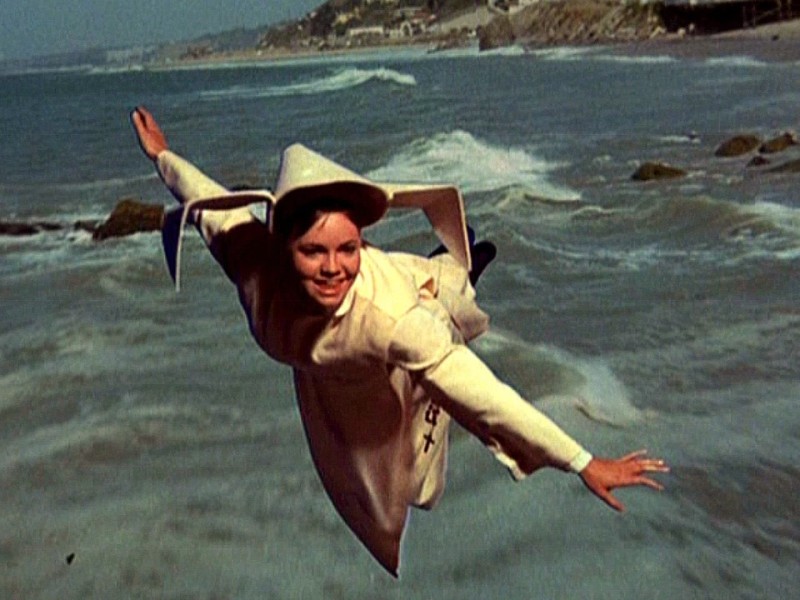
DID YOU KNOW …? Was an iconic star of a 1960s sitcom the first person in the role?
This Saturday is the Fourth of July, which in itself is a wonderful day. But this year, it’s extra-special.
You see, this year’s Independence Day is the 250th anniversary of the signing of the Declaration of Independence, the symbolic thumbing of the nose to King George III of Great Britain by the American colonists.
A pretty nasty war followed that, but once the war was over, these 13 formerly British colonies became a new nation, the one in which you and I live. (Unless you live somewhere else.)
So Happy 250th Birthday, America, and let’s get on with the trivia!

* What To The Slave Is The Fourth Of July? *
Greetings and blessings! My fellow citizens and friends, “Our Unfortunate Democracy In Such A Time As This! Yes, we are about to celebrate our nation’s 250th birthday of freedom and just look at us and where we are now.

DID YOU KNOW …? Did a West Virginia town turn to the Soviet Union for help in getting a new bridge built?
Well, if this ain’t a kick in the head!
Last week, this column – the silliness you’re reading right now – won an award! For the second year in a row, my little exercise in trivia was voted second place in the Lifestyle/Feature Column category in the Georgia Press Association’s annual Better Newspaper Contest.
Apparently, this makes me (gasp) an award-winning columnist!
I didn’t make mention of it last year because it was such a neat, new thing, but now … read on for some award-winning trivia!
Thanks, Georgia Press!