
Tuskegee Airmen honored by Robins Air Force Base
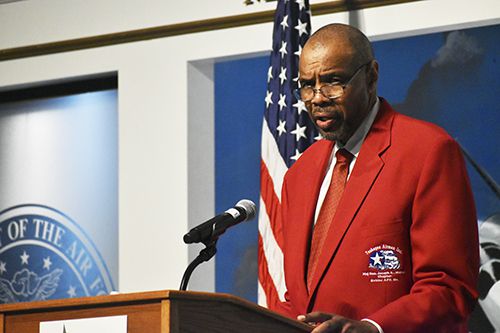
WARNER ROBINS, Ga. — “The Tuskegee Airmen story is our story, it’s America’s story,” Tuskegee Airmen Incorporation President Willie F. Jones said. “Look at how we’re seated in this room together.
“We are not separated by race, color, religion or origin. The segregated lines of 1940 are not here with us today, nor should they ever be with us in the future. The Tuskegee Airmen made history — but as more and more of them transition, it is up to us to build a better world.”
The Tuskegee Airmen, a program many believed was “doomed to fail,” was honored Thursday afternoon by members of Robins Air Force Base and the Major General Joseph A. McNeil Chapter Tuskegee Airmen Incorporation of Warner Robins.
Jones spoke to a crowd collected in the Century of Flight Hangar at the Museum of Aviation, and told them of the airmen’s history, the hardship they faced and the impact they had on the United States.
“Over the years I’ve talked to several of the original Tuskegee Airmen, and all they said was ‘we just wanted to do our part,’” Jones said. “I don’t even think they knew what they were starting when they joined the military.”
Jones told the audience that in 1941, the military contracted the Tuskegee Institute to offer military training for Black men to become the United States’ first Black airmen, the first Black flying unit of any kind.
“There was a widespread belief that Black people could not learn to fly or operate a sophisticated aircraft,” Jones explained. “That was strange to a lot of people, because history had already recorded the legacy of African American soldiers who fought in every major US conflict, dating back to the Revolutionary War. They were kept separate from white soldiers, but they prevailed. They were accomplished, they were successful in their mission.”
The 99th Pursuit Squadron, later the 99th Fighter Squadron, and later still the 332nd Fighter Group, would prove those who doubted them wrong, serving as bombers and fighters in World War II, gaining three Distinguished Unit Citations. When the pilots flying the P-47 Thunderbolts painted the tails of their planes red to better identify themselves as allies to fellow pilots, the group took on the moniker “Red Tails.”
Despite their records staying level with, and often exceeding those of white pilots, the Tuskegee Airmen faced constant harassment, segregation, and were often given sub-par training facilities and equipment. These conditions led to a number of Tuskegee Airmen being reprimanded, simply for asking to be treated like fellow white soldiers.
In 1945, several members of the 477th Bombardment Group attempted to enter an all-white officers’ club at Freeman Army Airfield, beating back against the enforcement of Jim Crowe laws. Over time, there were 162 separate arrests of Black officers, some of them multiple times. Three were court-martialed, and one was convicted.
“The Freeman Field mutiny is generally regarded by historians of the Civil Rights Movement as an important step towards fully integrating the armed forces, and developing a model for later efforts to integrate public facilities,” Jones explained. “They didn’t go there to fight, they didn’t go there to be disruptive. They just went there to have a seat and ask ‘can we be served?’”
In 1948, President Harry Truman issued Executive Order 9981, racially integrating America’s armed forces. In 1995, the actions of the Tuskegee Airmen at Freeman Field would be vindicated, as the reprimands of officers were struck from their records, and the single court-martial conviction was set aside.
During an interview prior to his speech, Jones told The Journal the importance of the Tuskegee Airmen, the mark they left behind, and the impact they had on the future.
“I’m retired from the Air Force, and I know I would never have had the opportunity if it wasn’t for them,” Jones said. “They were our trailblazers. They proved to the world that African Americans can do more than just cook, clean up and sometimes be a policeman.
“At some point in history, the world had to change. That change started in 1941 with the Tuskegee Airman.”
The impact of the Tuskegee Airmen is not limited to just pilots, but Black men on the ground who provided necessary expertise, and Black women who were trained as nurses.
Jones’ portion of the ceremony was followed by TSgt. Christone Robinson’s performance of what is commonly referred to as the Black National Anthem, “Lift Every Voice and Sing,” as well as closing remarks from Col. Sergio Rios.
“80 years of opening doors is what the Tuskegee Airmen have done,” Rios said. “I, ladies and gentleman, am a testament of those doors being opened. As a Mexican American, along with my wingman, I’m proud to say, as the vice wing commander here at this installation, that I am a product of the Tuskegee Airmen.
“Every day in middle Georgia is armed forces appreciation day because of men, because of women, that have opened the doors for us, just like the Tuskegee Airmen.”
As the ceremony came to a close, many moved from the Century of Flight Hangar to the Jones Hangar, where a Tuskegee Airmen display is housed, teaching passerby about the history of the Tuskegee Airmen Program, what they did, who they were and the impact they had, not only on the war they fought in, but on the world, for decades.
HHJ News
Before you go...
Thanks for reading The Houston Home Journal — we hope this article added to your day.
For over 150 years, Houston Home Journal has been the newspaper of record for Perry, Warner Robins and Centerville. We're excited to expand our online news coverage, while maintaining our twice-weekly print newspaper.
If you like what you see, please consider becoming a member of The Houston Home Journal. We're all in this together, working for a better Warner Robins, Perry and Centerville, and we appreciate and need your support.
Please join the readers like you who help make community journalism possible by joining The Houston Home Journal. Thank you.
- Brieanna Smith, Houston Home Journal managing editor
Paid Posts
Related Articles
Lori Johnson hoping to continue putting students and faculty first while serving on the Board of Education
Lori Johnson is running for reelection for Board of Education District 2 and hopes to continue her commitment to the students and faculty of the Houston County School District.

Warner Robins shooting leaves two injured, police say
Law enforcement also found and detained a suspect.

Anya Turpin promoting Perry, reflects on purpose, parenthood | Remarkable Women
Turpin, the executive director of Visit Perry, brings several qualities to the role that align with her experience as a woman.