
Robins AFB launches cross-county effort
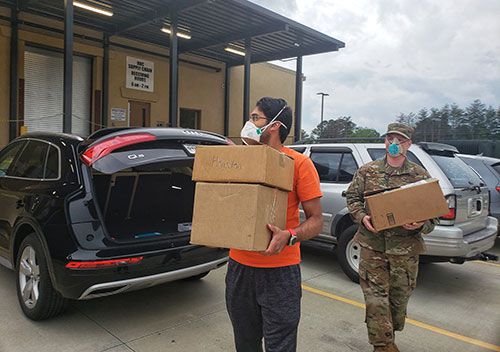
Lieutenant Colonel Jay Vizcarra of Robins Air Force Base (RAFB) is elated about an effort launched by RAFB to reach both inside and across county lines in order to assist in getting much-needed masks to health care workers in Houston County.
“We collaborated with Mercer University, Firestarter Fab Lab, and other agencies on 3D printing solutions,” Vizcarra said. “From an official Air Force standpoint, we don’t directly give 3D printing solutions to Houston; we’ve been coordinating and working directly with the other agencies, including the university and Firestarter Lab with designing, printing and developing these solutions directly.” In addition, Vizcarra explained, “We set up a task force with the community, with the base assisting. 3D printing solutions would be donated to the Firestarter Lab, and then those were hand delivered to the hospital facility.”
Jay Flesher serves as Directing Board Member of Firestarter Fab Lab. He revealed that the Fab Lab houses nearly $400,000 worth of equipment that includes lasers, 3D printers, computers, and more. “What all our organizations and universities are trying to do is to bridge the gap between the emergency need of the health care providers and the mask manufacturing industry which hasn’t yet caught up with the demand; whether it’s with masks, face shields (plastic face guards that protect the face from sneeze splatters) or mask tension strips (which lessen the chances of cuts behind the ears from extended wear of the masks).”
Because of its complex equipment, Flesher said the Fab Lab is able to produce the needed products at a greater speed and in larger quantities than could a smaller, less outfitted lab. “Once the big manufacturers really get on a roll and start producing higher volumes,” he said, “they will begin to out-produce us very quickly, and then we can start looking at what’s next—what other needs are out there that hadn’t been noticed or aren’t being met. We’re just asking everybody what they need,” Flesher continued. “And if we can produce a tool with our equipment that will help them, we will.”
Flesher mentioned that Firestarter’s initial push was in Houston County, but at the time, RAFB hadn’t mobilized to a point of having a need for certain things that citizens outside of the base’s gates were doing. “So, we started with Houston Healthcare, Summer’s Landing, and The Lodge,” he said, noting that today, the need is much greater and involves many more places. “I’m on my way to Navicent right now to drop off 400 of the tension strips.”
Lt. Col. Vizcarra stated that this is an ever-growing effort. A delivery from Mercer University in Bibb County, to Houston Health Pavilion in Warner Robins, took place earlier this month. Regarding that, Vizcarra said, “We assisted Mercer with connections to Houston County, and then they delivered over 100 face shields to Houston County.” According to Vizcarra, other schools have now come onboard and are working with them, including Georgia Tech and Middle Georgia State University. “The efforts have considerably increased,” Vizcarra stated.
Vizcarra shared that the idea of producing these solutions for health care workers in Houston County and surrounding areas was the brainchild of Master Sergeant Benjamin Weiland. “He’s the one who came up with the idea, saying, ‘Hey, can we 3D print all these different solutions for the community?’ And we said, why not?” Vizcarra recalled. “We started 3D printing and designing things, and that’s what started the trend of what’s happening here on base,” he said.
From there, Vizcarra said they reached out to the colleges and joined efforts because they shared the same designs. “Weiland collaborated with the colleges and the professors in the departments, and then helped with the task force. There are multiple airmen who are helping with the effort,” Vizcarra pointed out, “but he was the one that first came to the Robins SPARK Innovation Hub here on base, and that’s how it all started.”
Master Sergeant Weiland said he never had a clue that his idea would turn into such a large project that would involve so people and organizations coming together for a common cause. He said that the idea was initiated by a Facebook message from one of his friends. “They saw an article of an orthodontist in Billings, Montana,” Weiland said. “Then they made a base file for this mask and sent it out, saying, ‘Here’s a base file for a mask; adjust it, make it work.’”
Weiland said that his friend messaged him and asked him if it was something that he could do. “I downloaded the file, looked at it, and eventually, I contacted Colonel Vizcarra. I asked him if it was something we could do on base.” Weiland said his initial thought was just to print them at his house and give them out to some people he knew in the community who he thought might need them. “And then I started wondering if it was something others could benefit from too,” he said.
Once Vizcarra heard the idea and gave it the nod, Weiland said they went into action. “We initially looked at the mask, and then we redesigned one and sent it up to the National Institute of Health with the testing done by Mercer University. Then we went to the medical group on base,” Weiland explained further, “and they asked if they were allowed to use them; they were unsure at that time if [the masks] could be used in a medical setting.”
According to Weiland, the medical group inquired about a face shield to go along with the mask. That prompted Weiland and his team to get with the depot guys at the ALC (Air Logistics Complex) side of RAFB. They asked the ALC team for help with the 3D printing and with the cutting of the face shield, as well as the clear acrylic that goes across the front of the face shield. “They stepped in and helped us out with that,” Weiland reported. “We took three iterations of it over to the medical clinic and they picked out which one they wanted.”
The masks turned out to be just the starting point. Along with the addition of the face shield, Weiland said the medical group saw a hands-free door opener that his team used to keep down the spread of germs. “They liked that a lot. They wanted an ambidextrous one for every door,” Weiland said. So his team started printing those for the medical group to use as well.
Weiland hopes that at some point, these items will become available and accessible to the general public, but for now, the goal is to help those who are need of it the most. He said that there are ways that other individuals can do their part to be of assistance in this global fight against COVID-19, just as he did. “The NIH (National Institute of Health) has a website,” he said. “There’s a big red pop-up at the top that gives you a list of ways you can help. I encourage people to look outside their little bubble and find ways they can help on a widespread basis.”
“It started with one person,” Vizcarra pointed out. “A lot of great stuff starts with just one person starting a small log fire. It’s great to say Robins Air Force Base is collaborating with this or that,” he continued, “but the story from the grassroots approach is very impressive—to show how one person or a few people stepped up and did something that seemed small but resulted in something great. And that’s what this is.”
HHJ News
Before you go...
Thanks for reading The Houston Home Journal — we hope this article added to your day.
For over 150 years, Houston Home Journal has been the newspaper of record for Perry, Warner Robins and Centerville. We're excited to expand our online news coverage, while maintaining our twice-weekly print newspaper.
If you like what you see, please consider becoming a member of The Houston Home Journal. We're all in this together, working for a better Warner Robins, Perry and Centerville, and we appreciate and need your support.
Please join the readers like you who help make community journalism possible by joining The Houston Home Journal. Thank you.
- Brieanna Smith, Houston Home Journal managing editor
Paid Posts
Related Articles
Department of Justice reaches $3 million settlement with various Georgia Boards for alleged violations of the Servicemembers Civil Relief Act
The DOJ has reached a $3 million settlement with 42 Georgia Boards to resolve allegations that they did not recognize the Servicemembers Civil Relief Act.
Lori Johnson hoping to continue putting students and faculty first while serving on the Board of Education
Lori Johnson is running for reelection for Board of Education District 2 and hopes to continue her commitment to the students and faculty of the Houston County School District.

Warner Robins shooting leaves two injured, police say
Law enforcement also found and detained a suspect.