
Perry Council moves forward with updated redistricting plan
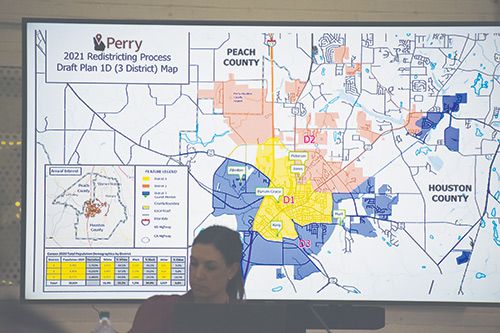
Back in November, Perry City Council voted to move forward with a redistricting plan (1B) following the impact of the 2020 Census results on the city’s voting districts. This past Monday, at the city work session, members of council saw an updated plan (1D) that followed the frame of the one they voted on back in December, while featuring a few updates per council’s request, according to the executive director of the Middle Georgia Regional Commission (MGRC), Laura Mathis.
“At the last council meeting, your decision was to move forward with the three-district plan, and based on that vote, we were charged with seeing if we could make some adjustments and create a new plan that would be within the guidelines,” Mathis said.
She addressed council, pointing out details on the map and in the population numbers.
“You also maintain a majority-minority in District One — and then, as you can see, moving the district line so that you end up with two incumbents in each of the three districts.”
She went on to say, “One of the ways that this was accomplished was: one — we wanted to make sure we realized that in Plan 1B, and that we did not have all of the Oldfield neighborhood in one council district. So we did grab that in Plan 1D, and then we also looked at ways to move Councilman Albritton back into District Three — Plan 1B would have had him in District Two.”
Mathis explained that the area between Sam Nunn Boulevard and Perry Parkway would become part of District One if it were to ever become developed and part of the city limits.
There were multiple census blocks in the East Perry service area that the MGRC was able to divide into Districts Two and Three, according to Mathis.
“We’re locked in by the geography of the blocks, and this was really the only configuration that we could come up with in this area, given the concentration of the population that’s there, to logically divide that area into two different districts, which is what we needed to do in order to accomplish the goal of moving two incumbents in each district,” Mathis said.
The next step in the process, following council’s examination of the plan, would involve a charter amendment. City Attorney Brooke Newby would provide council with the reference numbers required to identify census blocks, while the amendment would also provide legal description of the plan. From there, council would agree on a map, vote accordingly and give concurrence for the process to move forward, according to Mathis.
Mayor Randall Walker commended Mathis and the MGRC for their assistance in Perry’s redistricting.
“I would only say that Ms. Mathis and her staff have done an outstanding job in taking our recommendations and our suggestions — and I guess our pleas, as well — to come up with something that meets all those state and federal requirements but also meets many of the desires that we have as a Council,” Walker said.
Councilwoman Joy Peterson of District Two, Post Two, asked about when this plan would go into effect, and Mathis explained that the charter amendment would contain an effective date — typically occurring at the next election.
Newby then said that the ordinance could be drafted to state that if a special election was to take place (i.e. councilmember moved out of Perry or resigned) before the amendment’s effective date, the draft would deem valid.
Council then agreed to make the charter amendment effective on the day of the second reading of the ordinance.
Holly Wharton, community planner for Perry, said the city has utilized Community Development Block Grants (CDBG) and Community HOME Investment Program (CHIP) grants to revitalize some properties in several neighborhoods, including: Sand Hill, Creekwood, New Hope, Five Points, and Oldfield. Along with these, low-income housing tax credit projects have shown improvements in Berkshire Court and the Oliver Place Apartments.
“These neighborhoods were identified in a housing assessment in 2016,” Wharton said. “So, this assessment identified distressed and failing homes, which helped the city identify which neighborhoods to go forward with applying for grants in.”
According to Wharton, the project started in Sand Hill, where the highest concentration of these failing homes were found. From there, it branched off into neighborhoods.
In 2016, the city was awarded CDBG and CHIP grants to fund projects in Sand Hill, including new windows on some homes, additional upgrades and one total home reconstruction, Wharton said.
The Sand Hill community benefited from another CDBG grant in 2017, funding the demolition of blighted structures, including the rehabilitation and reconstruction of some homes, she said. One project home saw remodeling, vinyl siding and a new porch.
In 2019, Sand Hill and Creekwood saw the funding from CDBG and CHIP grants being put toward new vinyl siding and a new roof on one project home, Wharton said. From there, the neighborhoods also saw stormwater improvements and touch-ups on streets showing deterioration.
Wharton added that 2020 was a successful year for Creekwood improvements, although noting that one project house burnt down. City officials worked with property owners to get the house rebuilt, installing a new roof and featuring some update work to the interior.
These grants have impacted 361 people, rehabilitated 63 homes, demolished seven properties, demolished and rebuilt four properties and provided more than $4 million in project funds, according to Wharton.
She said the next target neighborhood to see improvements from these funds is Oldfield, and city officials are working with residents in that community to improve those housing conditions.
Mayor Walker said he’s hopeful for potential improvements to the Oldfield neighborhood.
“Because of the census tracks, we were not able to apply there over the last four years — but because of the changes, we requested it,” Walker said. “As far as going in there spending grant money, we haven’t been able to do that yet. I hope that we’re successful with DCA [Department of Community Affairs] in next year’s application — we’ll be applying for that.”
According to Wharton, officials with the community development division of the Perry government were selected to represent one of three cities in Georgia attending the Vacant Property Leadership Institute on February 8-11 in Austin, Texas.
“Hopefully from that program, we’ll be able to learn new strategies or ideas or best practices from other communities around the nation regarding ways to help dilapidated and vacant property,” Wharton said.
Representing the state of Georgia, Perry was selected along with South Fulton and College Park. She said cities from three other states will be attending, including: Kentucky, Illinois, and Wisconsin.
There was a detailed process to selecting these cities attending, and Mayor Walker commended his staff.
“But it was really competitive, as I understand, to be selected in that,” Walker said. “So my compliments to you guys being selected. I think it’s going to be a great opportunity for you to travel and see different things and understand so you will bring back a wealth of knowledge.”
Bryan Wood, Perry’s community development director, addressed the Council regarding some details in the new Joint Comprehensive Plan for Houston County — mentioning full-staffed law enforcement offices and fire departments, an enhanced quality of life, improved traffic flow, pedestrian safety, maintenance of drainage facilities, reliable internet that’s affordable and natural resources among other things.
“There’s a need for improved marketing of natural resources in Houston County, meaning that we need to let people know what’s out there to be able to take advantage of as far as our parks, estates, preserved areas, cultural and historic properties and that type of thing,” Wood said.
Lee Parker — Chief of Fire and Emergency Services — said that the Federal Emergency Management Agency opened registration for the Assistance to Firefighters Grant, and the Perry Fire Department would like to apply. The grant would require a 10% match from the city, and they were looking to receive up to $64,000 to acquire a Self-Contained Breathing Apparatus refill station. The Council provided concurrence for the department to proceed with the application process.
HHJ News
Before you go...
Thanks for reading The Houston Home Journal — we hope this article added to your day.
For over 150 years, Houston Home Journal has been the newspaper of record for Perry, Warner Robins and Centerville. We're excited to expand our online news coverage, while maintaining our twice-weekly print newspaper.
If you like what you see, please consider becoming a member of The Houston Home Journal. We're all in this together, working for a better Warner Robins, Perry and Centerville, and we appreciate and need your support.
Please join the readers like you who help make community journalism possible by joining The Houston Home Journal. Thank you.
- Brieanna Smith, Houston Home Journal managing editor
Paid Posts
Related Articles
Centerville’s proposed budget up from last year
Budgeting was the main topic at the City of Centerville’s latest meeting.
Residents speak out against Airport Road annexation request, council approves interim community development director
A proposed townhouse development has returned to the council chambers, and residents are continuing to voice concerns.

Perry author publishes first novel in remembrance of her twin sister
Longtime Perry resident Kaitlyn Dryden, recently published her first novel, “Love Ya Mean It”, a story about finding happiness after losing a loved one.