
Mass casualty exercise trains first responders, students in active shooter response
Central Georgia Technical College’s Division of Health Sciences and CGTC Police partnered with local agencies for its annual training event.
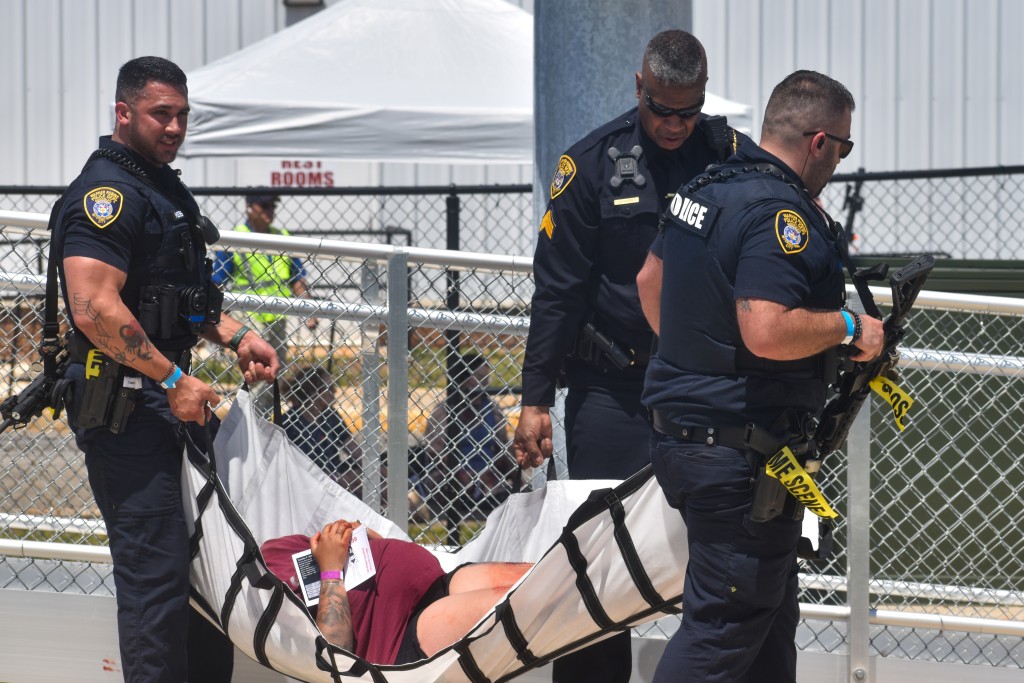
WARNER ROBINS – Central Georgia Technical College’s Division of Health Sciences and CGTC Police partnered with local agencies for its fourth annual disaster and mass casualty training event on Saturday, April 19.
Local law enforcement, including Warner Robins, Perry, and Centerville Fire and Police Departments, Houston Healthcare, Houston County Emergency Management, Houston County Fire Department, Houston County Sheriff’s Office and Houston County 911 participated in the training.
Trinity School of Medicine students also participated in the exercise to provide medical care knowledge.
The exercise provides a real-world on-campus active shooter scenario, where agencies are trained on how to respond in case of a similar incident.
This year, the training was held on the campus’s soccer field. Volunteers acted as if a shooting had taken place at a game. To make it as real as possible, volunteers had fake blood and were in panic.
Ambulances were on site to transport the “injured” volunteers to the college’s mock hospital, where medical students were trained on how to respond and aid victims.
Warner Robins Police Department Certification Manager Lt. Patrick Allen explained they were dispatched to a “shots fired” call on the college campus. He added in this type of incident, every first responder will show up, no matter the agency.
The mock shooting allowed law enforcement to work on coordination with other departments. In the exercise, they went through initial response, threat containment and post-incident. This includes helping the injured, dealing with the people arrested, and post-incident investigation, Allen explained.
He said it’s a wonderful event where local agencies come together.
“It’s good to see all the agencies come together with first responders. Between fire, EMS and the police department, to be able to come together and do a joint exercise in this nature so that we can plan on coordinating [and] working together so that we can solve critical incidents in this nature,” he said.
Allen said this also allows them to practice communication among differences in technology. This allowed them to incorporate what they already know, see where their deficiencies are and better their service to the community.
The training scenarios have grown in depth. Allen shared previous years had a car accident scenario, a shooting and this year, evolved into a shots fired incident. In the past, they have also conducted a missing children and bombing scenario.
Allen advises those caught in a similar situation to remain calm. He said he knows it is a stressful situation and when people hear gunshots, their first instinct is to run. Allen also advised thinking about how to get out and looking for the safest place to hide.
“The main thing I can say is remain calm. Find a safe location [and] don’t do anything erratic because we are coming. Don’t do anything that may put you in potential danger,” he said.
CGTC’s Director of Nursing Jessica Willcox shared a lot of work has gone into the project. Behind the scenes, she said they have been working on putting together the exercise for over a year. She shared seeing it all come together has been wonderful and hearing students sharing what they have learned and how they can improve has been a “proud instructor” moment.
“Our faculty and staff and students have really started to make those connections into what the real world might look like for them and so that describes the best thing of how I felt today,” she said. “It’s very rewarding to see that they’re making those decisions and making that difference in how they’re going to move forward and help take care of our community care system.”
In the soccer match scenario, medical students from the Trinity School of Medicine sorted and prioritized patients. The students then reported to a triage area where they helped EMS students, an interdisciplinary team approach, as described by Willcox.
EMS students are in ambulances, taking care of patients with a paramedic from Houston Healthcare, who is giving reports to nurses in the triage area. From there, they go to the college’s mock Emergency Room, where nurses are helping make treatment decisions. Willcox said they have done “a little bit of everything” during the exercise.
Florida State University recently experienced a shooting similar to the training scenario. Willcox shared that they have put in place protocols for students’ and participants’ safety due to the recent event.
“I think it hit home to some of the students that they’ve seen this recently on the news. They didn’t realize at that time that these things were going to happen the same week we’re doing this. For them to have that realization that it can happen, it can happen at our university, it can happen at these events and how close it was to us,” she said. “They’re able to take that event and think about it, in not only a healthcare way, but also a mental health way: how do we address the mental health side of that because it does hit home emotionally to us as well.”
Willcox said mass casualty events happen every day and students at some point are going to encounter an event or triage. She shared the majority of students want to work in ER because they love the adrenaline rush, which is why it’s important to have the experience in a safe environment like the training event.
“We’re controlled [and] we’re safe. They can make a mistake today, and it’s not going to harm a live patient. That way, we can use the simulation and say, ‘Okay, well something went wrong,’ restart the scenario this afternoon and say, ‘Okay, what would you do different?’ That quality improvement is a big piece of this,” she said.
Kassandra Allison and Lisette Martinez are nursing instructors currently in the college’s Associate of Science in Nursing program.
Allison describes the training as vital, especially collaborating with neighboring partners. She said it’s important for them to be on their toes so they can be well-adapted in cases of emergency and mass casualties.
“It’s really important to really just have them [students] always be on that level of critical thinking,” she said. “It really helps them not only with what do I do if a situation like this were to happen but how do I go about communicating with the whole healthcare team such as the physicians, radiology, EMS, how do we all work together as a team to best take care of these patients that are coming in.”
Martinez said from the feedback they’ve been given from students, they saw how the exercise has been crucial for experience, especially with emergencies and working with different professions, before doing it in real life.
During the training, they worked with all sorts of patients, which allowed students to see a range of different types of individuals they could encounter during a mass casualty event, Martinez said.
Allison shared it was neat for students to see the progress from their beginning steps in the program. During the exercise, they saw how they had flourished as nursing students and how they’ve been able to adapt and think critically in the scenario.
“It’s been really insightful and just great to see,” she said.
Before you go...
Thanks for reading The Houston Home Journal — we hope this article added to your day.
For over 150 years, Houston Home Journal has been the newspaper of record for Perry, Warner Robins and Centerville. We're excited to expand our online news coverage, while maintaining our twice-weekly print newspaper.
If you like what you see, please consider becoming a member of The Houston Home Journal. We're all in this together, working for a better Warner Robins, Perry and Centerville, and we appreciate and need your support.
Please join the readers like you who help make community journalism possible by joining The Houston Home Journal. Thank you.
- Brieanna Smith, Houston Home Journal managing editor
Paid Posts
Author

Related Articles
$5 million budget increase proposed for Warner Robins. Here’s what it’s going to.
Cities statewide are preparing spending plans for fiscal year 2027, including Warner Robins.
Water rates and sales tax to increase in Houston County. What to know about the FY2027 budget
Houston County’s FY27 budget has increased 13%, most notably connected to rises in the water fund and sales tax.
HHJ sits down with Perry’s new finance director to talk about leading her department
The City of Perry welcomed Lyn McDonald as its new Finance Director earlier this month, and the HHJ sat down with her to hear about her goals.