
Is Mother Nature voting in this year’s presidential election?
It’s hard to study a map of the areas hardest hit by Hurricane Helene and not conclude that somebody is highly annoyed with Republicans.
Could the weather gods be messing with our politics? Maybe even engaging in election interference?
Probably not, but it’s hard to study a map of the areas hardest hit by Hurricane Helene and not conclude that somebody is highly annoyed with Republicans.
Even Republican Congresswoman Marjorie Taylor Greene, who represents northwest Georgia, noticed the political tilt to Helene’s path through the southeastern U.S. But she doesn’t think Mother Nature is to blame. Instead, she claims that “they” – whoever “they” are – have the technology to “control the weather” and seems to be suggesting that the hurricane was ginned up at NOAA to hurt former GOP President Donald J. Trump’s comeback bid.
Trump himself hasn’t gone that far (at least not yet), and some of the notorious MTG’s fellow Republicans in Congress have publicly, and hotly, rejected her claim.
Helene, of course, hit the southeastern United States like a slow-moving nuclear bomb late on the night of September 26th. It made landfall as a Category 4 hurricane near Perry, Fla., and rolled up through Florida’s Big Bend region, then into southeast Georgia and north into western North Carolina and eastern Tennessee. Along the way it dipped into South Carolina and wreaked a bit of havoc there as well.
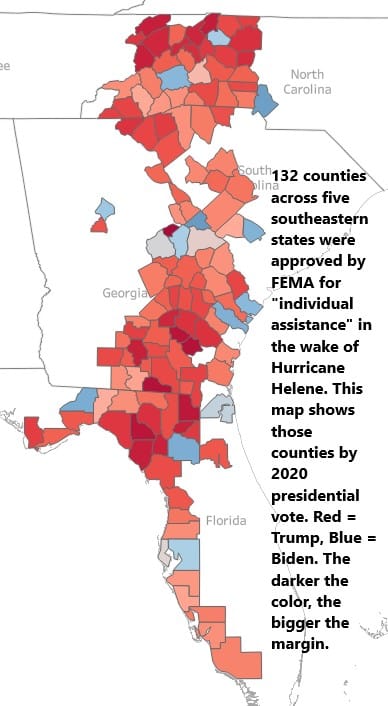
Based on my research, 132 counties across those five states were qualified by the Federal Emergency Management Agency (FEMA) for “individual assistance,” meaning these were probably the counties that were hardest hit and suffered the most loss of life and property damage.
Here in Georgia, 53 of the state’s 159 counties were qualified by FEMA for “individual assistance,” which makes the 2.1 million Georgians living in those counties eligible for a wide range of help, including cash, housing and transportation.
But here’s the thing: 116 of the aforementioned 132 counties went for former President Donald J. Trump in the 2020 presidential election, most of them by landslide margins of 20 percentage points or more.
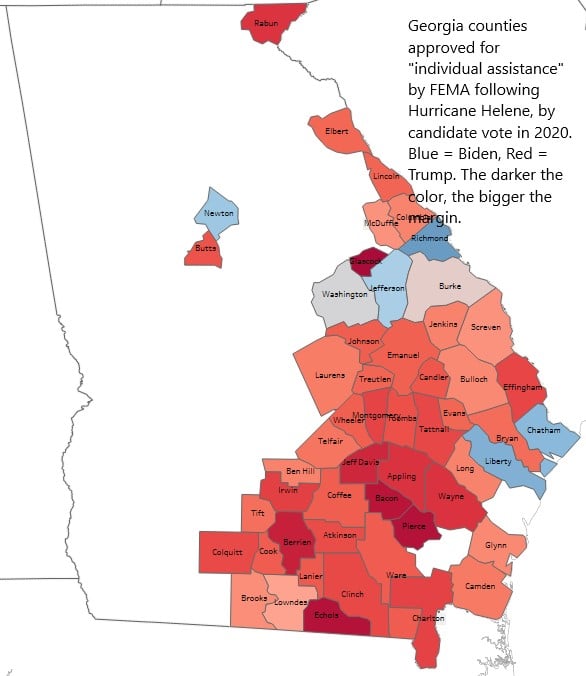
Here in Georgia, Trump carried 47 of the 53 Georgia counties approved for “individual assistance,” and 43 of those gave him at least 60 percent of their vote. All the Trump counties were relatively small, sparsely populated rural counties that have historically voted Republican, and Democratic precincts did not completely avoid Helene’s wrath. The five “individual assistance” counties that sided with President Joe Biden in 2020 included the major population centers of Augusta and Savannah.
Overall, though, Trump Country took the hardest hit. The former president carried the 53-county “individual assistance” region of Georgia by nearly 130,000 votes.
The question, of course, is whether Helene will affect voting in that part of the state in this year’s presidential election, early voting for which is already underway. Secretary of State Brad Raffensperger and others are insisting that it won’t, that the six weeks between the storm and the November 5th General Election is more than enough time to correct for any damage Helene might have done.
Maybe so. But it sure seems fair to wonder if Helene might not take a toll on voter turnout, and in fact the recent increase in election-season storms has spawned a cottage industry of academics and others who parse election data trying to answer that question.
Scan the studies and papers you can find on the world wide web and you’ll find a range of results, often contradictory. One study found that rain and snow actually drove up Republican turnout.
But the paper that seems most analogous to our current situation was published in the University of Chicago’s “Journal of Politics” in October 2022. Kevin Morris and Peter Miller, researchers for the Brennan Center for Justice in New York, studied the impact on the eight Florida counties that were hit the hardest by Hurricane Michael on October 10, 2018 – less than a month before that year’s General Election.
Their finding? Those eight counties suffered a seven percent drop in voter turnout in the 2018 election, for a combination of reasons. Morris told a Miami public radio station that while individual problems created by the hurricane contributed to the drop-off, a bigger factor was the loss of polling places and difficulty in getting to them.
Apply that hypothetical seven percent drop to Georgia’s 53 “individual assistance”-approved counties and the impact is significant. Nearly 900,000 votes were cast in those 53 counties in 2020.
Trim all those numbers by the seven percent figure and the 53-county region loses more than 60,000 votes, with Trump taking the biggest hit. Recalculate the state’s total 2020 vote holding the other 106 counties at their actual totals while reducing the 53 counties by seven percent and Joe Biden’s famous 11,799-vote margin jumps to nearly 21,000 votes.
In a state where all the polls are calling the race a toss-up, who knows? Hurricane force winds might well make the difference.
Charles Hayslett is the author of the long-running troubleingodscountry.com blog. He is also the Scholar in Residence at the Center for Middle Georgia Studies at Middle Georgia State University. The views expressed in his columns are his own and are not necessarily those of the Center or the University. Distributed by the Georgia Trust for Local News.
Before you go...
Thanks for reading The Houston Home Journal — we hope this article added to your day.
For over 150 years, Houston Home Journal has been the newspaper of record for Perry, Warner Robins and Centerville. We're excited to expand our online news coverage, while maintaining our twice-weekly print newspaper.
If you like what you see, please consider becoming a member of The Houston Home Journal. We're all in this together, working for a better Warner Robins, Perry and Centerville, and we appreciate and need your support.
Please join the readers like you who help make community journalism possible by joining The Houston Home Journal. Thank you.
- Brieanna Smith, Houston Home Journal managing editor
Paid Posts
Author

Related Articles
The expanse of war – Entebbe
It has now been 50 years since the most elaborate air/rescue mission in history was mounted in Israel.

‘Toon’ In for April — Jim Balletto
April’s comics from cartoonist Jim Balletto.

Two architects of Georgia’s Republican agenda retiring from house
There’s a saying commonly attributed to the executive branch of government regarding hiring and appointments: People are policy.