
IMC presents new senior housing proposal to Centerville Council
Mayor John Harley and the members of Centerville City Council met Tuesday evening for their normal Council Work Session. The meeting was closed to the general public due to heightened precautions surrounding COVID-19. A select number of people were given physical access to include a staff member of Houston Home Journal.
In the way of old business, Chief Jason Jones of the Centerville Fire Department requested approval to move forward with the RFP for the construction of the new fire station. The request was unanimously approved.
Among new business on the agenda was a request to approve a home-based business—GH Gordon Consulting, LLC (owner: Golda Gordon, 101 Jamestown Ct.). Based upon information shared by Councilman Edward Armijo, Gordon is a practicing registered nurse for 26 years and has obtained certification as a certified legal nurse consultant. With her certification, she will provide nursing consultant education and clinical expertise uniquely to attorneys and insurance companies. Council unanimously approved the new business.
One item of new business – Housing Team Update Work Plan – was motioned, by Councilman Justin Wright, to be tabled until the next meeting, citing the desire to keep Tuesday’s meeting brief in order to comply with some of the social distancing requests that have been made. Wright’s motion was seconded and unanimously approved by the board. The next item of new business was the adoption of a Severance Agreement that received the approval of all board members.
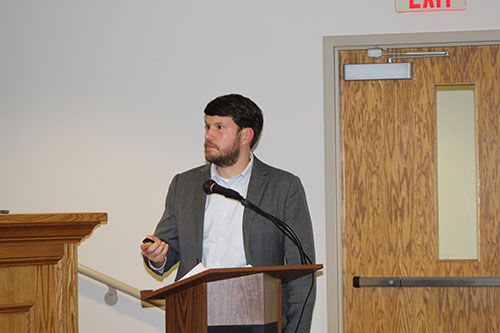
Mayor Harley, along with other board members, stepped from the dais for the final new business item, which consisted of a detailed slideshow presentation by Acquisitions and Development Manager Joseph Johnson of Investors Management Company (IMC) of Valdosta, Georgia. In his presentation, Johnson proposed the creation of a new senior housing development on Gunn Road in Centerville. Johnson describe IMC as a family-run construction development and construction management company all in one, and stated that they took pride in the fact that IMC has never developed a deal that they turned around and sold to another investor. Mentioning that there is a high demand for affordable, quality housing funded with tax credits for seniors in Georgia, Johnson revealed, “We have a portfolio of about 50 properties throughout the state, and we manage more than 2,000 units.”
As a part of his talk, Johnson noted that the total cost for developing the community would likely reach $15 million, which equates to about $216,000 per year. He pointed out that quality housing is always an argument that comes up from opposition. Johnson said when IMC builds these communities, they do a lot of things that are above and beyond the minimum standards set by the state building code, including having a third party to come in and independently verify that they’ve done what they said they were going to do. “A lot of time, energy, and money will be spent making this community very energy efficient so that the residents that live there won’t have to pay high utility bills,” Johnson said. “It will improve the overall quality of the community.”
Housing tax credits, which work through a private-public partnership, were also covered in the IMC presentation. Johnson noted that the purpose of the tax credits is to reduce the number of people that are paying more than 30% of their income on rent. The tax credits were necessary, he informed, because the free market doesn’t have the ability to reduce rental rates. Showing a chart that defined “cost burdened” and “severely cost burdened,” Johnson explained that “cost burdened” identified anyone who spent 30% or more of their income on housing, whereas “severely cost burdened” was the term used for those who spent 50% or more of their income on housing.
“In the renter category,” he said, “Houston County as a whole is almost at 50% of the population who are cost burdened.” Johnson said one factor that drives this cost burden metric is when the median rent rises faster than the median income. “From 2000 until 2018, the median income dipped way down,” he stated. “And when you factor in inflation, [income] has just come back to what it was at the 2000 level. We’re still trying to recover the income we lost 20 years ago in real dollars.”
According to Johnson’s report, the average rent in Georgia has increased to $958 per month, and everyone paying that amount would need to earn at least $8.42 per hour, 40 hours a week for 52 weeks a year without ever taking any kind of unpaid time off. “This is more than seniors make through Social Security,” Johnson stated. “The average annual income from Social Security in the state of Georgia is only about $13,000, so affordable housing for seniors in a big issue in this state.”
Johnson informed that IMC would apply for the funding needed to cover the cost of construction through the state of Georgia. If funding is awarded, IMC has to agree to keep the rent affordable for a minimum of 15 years. Eligibility for living in the community includes being 55 years of age or older, no children allowed under any circumstances, an annual income of $30,960 for one person and an average Social Security annual amount of about $13,018. If someone has a criminal history or has bad rental references, they would not be allowed to live in the community regardless of income qualifications.
Johnson’s housing proposal consisted of 80 units of senior living in a two-story development on 7.22 acres of property with the maximum amount of separation from the single-family homes nearby. Amenities would include a community building (inside of which would be a computer lab and a wellness center). “The wellness center is important because we’re going to be putting, out of our own pockets, $90,000 into preventive health care services for the residents who live here,” Johnson said. “We’ll put it into a reserve account, and then every year, the property will contribute another $4,500. So we will actually provide preventive health care to the residents who live here, free of charge, over a 15-year period.” Johnson mentioned that that service will reduce the number of hospital visits and keep the people who live there a lot healthier than they normally would be. An added amenity is a community garden that will introduce fresh fruit and vegetables to residents that may not be able to afford them.
Average housing costs, based on Johnson’s estimation, will be $400 for a one-bedroom unit and $470 for a two-bedroom unit. These rates, according to Johnson, will save senior residents somewhere between $200 and $400 per month. Stating that he had submitted the zoning application earlier on Tuesday afternoon, Johnson said IMC’s next meeting would be with the Planning Commission on April 2, and then with Centerville City Council on April 6. “We would turn in the funding application by May 21 and wait until November 15 to know if we receive it.”
After a brief period for questions, Mayor Harley thanked Johnson for his presentation and the meeting was adjourned.
HHJ News
Before you go...
Thanks for reading The Houston Home Journal — we hope this article added to your day.
For over 150 years, Houston Home Journal has been the newspaper of record for Perry, Warner Robins and Centerville. We're excited to expand our online news coverage, while maintaining our twice-weekly print newspaper.
If you like what you see, please consider becoming a member of The Houston Home Journal. We're all in this together, working for a better Warner Robins, Perry and Centerville, and we appreciate and need your support.
Please join the readers like you who help make community journalism possible by joining The Houston Home Journal. Thank you.
- Brieanna Smith, Houston Home Journal managing editor
Paid Posts
Related Articles
Perry City Council hears drought restrictions, draft of quarterly operations report
City Manager Robert Smith shared the city’s first quarterly report and drought restrictions during recent council meeting.
County hears from Assembly Warner Robins, concur with annexation
Houston County Commissioners heard from Assembly Warner Robins Pastor, Darrell Yarborough, and concurred with an annexation that is awaiting the City of Perry’s approval.

Central Georgia Technical College, Houston County School District commits $100 million to new STEM facility
The STEM/Allied Health Academy is expected to open August 2027. It will be located off Highway 41 near Russell Parkway.