
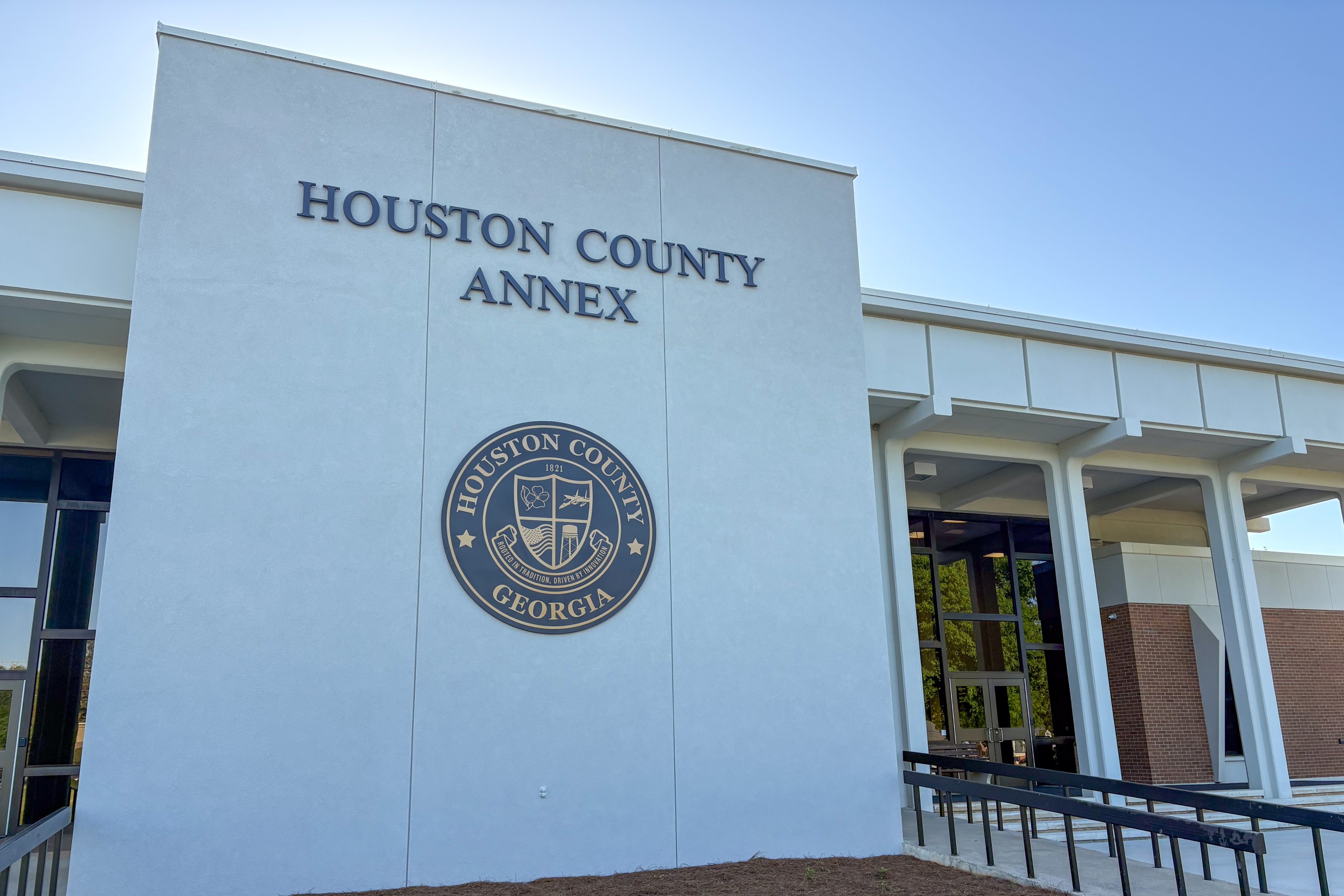
HOUSTON COUNTY — Data centers are popping up across the United States, including in Georgia. In Houston County, lawmakers aren’t ruling out the possibility of a data center making its home here, but it’s unlikely to happen anytime soon.
According to datacentermap.com, Georgia has 226 data centers, and the United States has the most in the world, at 4,420.
Houston County officials say nothing is currently planned.
“In the short term, let’s keep the status quo, which is no data centers,” Chairman Dan Perdue said in an interview.
Perdue said he can see both sides of the issue. A pro-data center stance is that they have a large tax base, they don’t draw in large amounts of traffic, and are needed due to the amount of people who use AI resources. He said those against data centers argue that they use too much power and water, drive up utility rates, and produce too much noise and pollution.
“Those are the two sides that exist in my mind, and I believe that the truth is somewhere in the middle,” he said.
Perdue discussed the possibility of a data center with the county commissioners and said they agreed to a wait-and-see approach. He said the county would like to see how data centers fare in other communities, and then decide if it is a good fit for Houston County.
“We currently are not looking for a data center.”
Dan Perdue
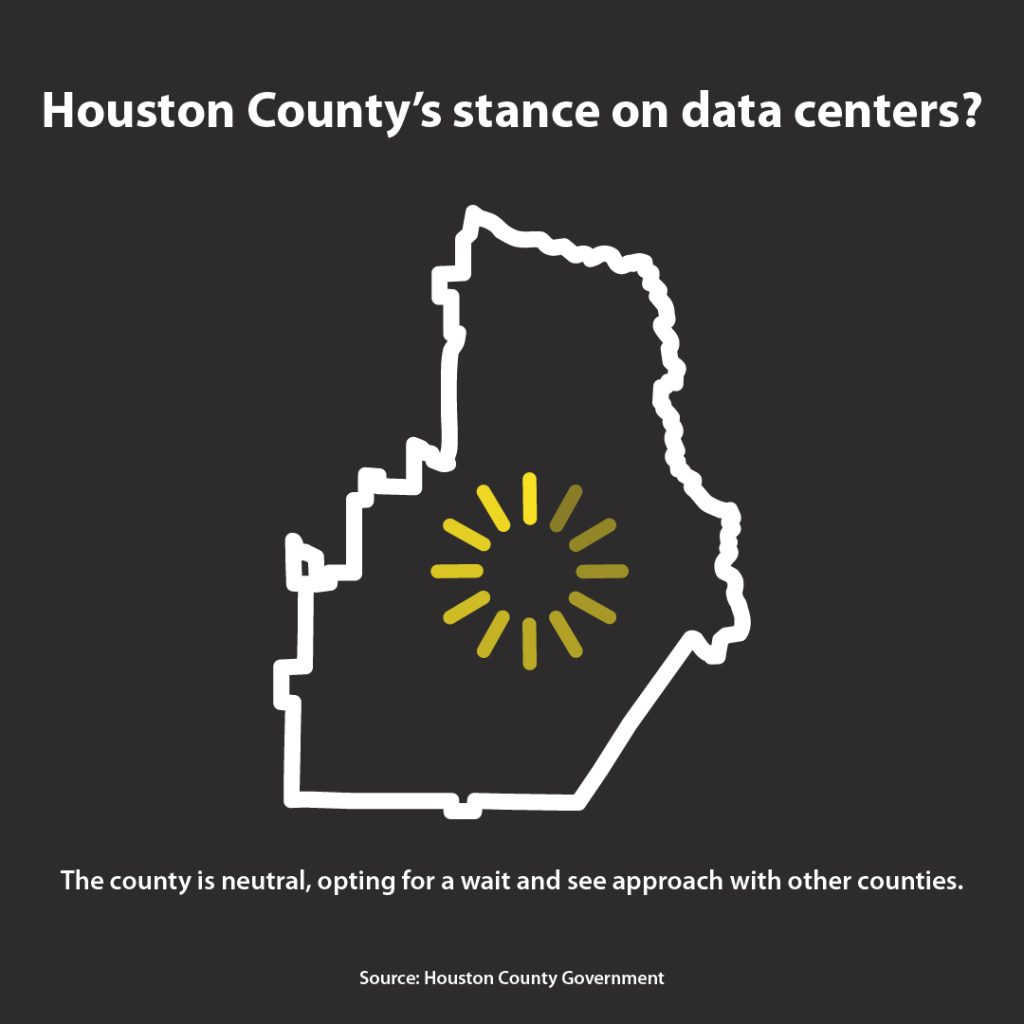
Is Houston County ready for data centers?
The short answer is no. Future data centers in Houston County don’t qualify for the state’s data center development sales tax and use exemption.
According to the Georgia Department of Revenue, to receive this exemption, a data center must meet a minimum investment threshold based on the population of the county where it is located, as reported in the most recent United States census.
In Houston County, the investment threshold for data center development is $250 million as of May 2022. This statistic has not been updated since.
On the county legislative side, special ordinances must be in place for a data center to make its home in Houston County. The county does not have these ordinances in place and has also not issued a moratorium, unlike the City of Perry. Perdue said they are not currently trying to attract data center companies to Houston County.
“We would need to do some ordinance work to get prepared if a data center wanted to locate here and got really serious about it,” he said.
The county has been contacted by two data center developers. Perdue said they are not targeting Houston County specifically, but wherever there’s enough land, water and power to support it. When asked who these developers were, Perdue declined to comment, but noted there’s nothing in the works.
“[Data center companies] are not pressing us nor do we have lots of people pressing us at our meeting to take some sort of stand,” he said.
County commissioners have not yet publicly addressed their stance.
“I don’t think our commission feels like we need to take a stance against them just to take a stance against them,” Perdue said.
From the public works side, Utility Director Terry Dietsch said the main measure public works would take is to provide water to the data center. Dietsch said planning could entail building a new water plant, large water mains or wells.
“It would probably take a year and a half or two years to accommodate [a data center] with the infrastructure needed for additional water,” he said in an interview. “[Planning for one] will be a lot of work and a huge undertaking.”
Dietsch said Public Works would not be prepared if a data center were to come today. He said immense planning and accommodation needs to be done beforehand.
“[Right now] we’re just going to see what happens and that’s our view,” Dietsch said.
Data centers could have legal ramifications if one came to the county.
County Attorney Tom Hall said his office is slowly working on data center ordinances to prepare in case one comes.
His role would be to look for any contracts that need to be signed and draft official zoning regulations for data centers.
Hall said a potential legal concern could arise if residents believe the data center would become a nuisance. He said if citizens feel the data center would affect where they live, they have the right to sue the data center company. Residents would need supporting evidence to be successful.
Perdue said the public would have multiple chances to share opinions if a data center is proposed in Houston County. He said there would be significant public hearings on the matter.
“Going through that public process will enable the community to give feedback and inform that process of what they want to see there,” Perdue said.
Data center concerns in Houston County
One promise AI companies make is that data centers will increase the property tax base and shift tax burdens from homeowners to the data center.
Perdue said a main concern for him is whether companies will actually follow through with that claim.
“If that’s part of the promise of locating a data center, then we need to set up a tax structure that actually accomplishes that,” he said. “You can’t be sold the promise of lower property taxes because you have a big, heavily taxed entity there that is worth a lot of money that you’re taxing, and then not actually being able to accomplish that because you abated their taxes too low.”
Perdue also wants a green space conservation plan if a data center comes to Houston County, whether that means using portions of Oaky Woods now privately owned, exploring wildlife management areas or placing more emphasis on parks and recreation.
Developers have tried to set up shop in Oaky Woods in the past. In 2024, Silicon Ranch, a solar farm company based in Nashville, Tennessee, requested to host a second solar farm in the county, right next to Oaky Woods Wildlife Management Area. Commissioners didn’t approve the request due to potential impacts the solar farm could have on the black bear population in Houston County.
Even though citizens have expressed concern about the level of development in the county, Perdue said there is still plenty of green space for conservation. According to the Houston County Tax Assessor’s Office, the conservation use acreage in the county is 68,902 acres.
He’s also concerned whether the data center would bear the cost of any impacts on the population. Perdue wants to mitigate the effects on residents and ensure AI companies pay their fair share for new infrastructure. That could include transportation, power and water.
In Houston County, Perdue said there would be a lot of controversy surrounding data centers, similar to Twiggs County. The Twiggs County Commissioners approved a proposed data center in September 2025. The citizens sued the county due to their opposition to it.
Twiggs County won the lawsuit, but the citizens are appealing it.
Before you go...
Thanks for reading The Houston Home Journal — we hope this article added to your day.
For over 150 years, Houston Home Journal has been the newspaper of record for Perry, Warner Robins and Centerville. We're excited to expand our online news coverage, while maintaining our twice-weekly print newspaper.
If you like what you see, please consider becoming a member of The Houston Home Journal. We're all in this together, working for a better Warner Robins, Perry and Centerville, and we appreciate and need your support.
Please join the readers like you who help make community journalism possible by joining The Houston Home Journal. Thank you.
- Brieanna Smith, Houston Home Journal managing editor
Paid Posts
Author

Related Articles
Rescue Ranch hopes to bring affordable spay and neuter clinic to Perry
A popular spay and neuter clinic is expanding to Perry. Officials hope for a fall 2026 opening.

What’s the buzz about a new takeout spot in Warner Robins?
Taste Good Restaurant kicks it up a notch with smash burgers and specialty dishes like this “salmon exquisite.”
Warner Robins Jody Town celebrates 5-year anniversary of historical marker
Several generations gathered over the weekend to honor the historic Jody Town community in Warner Robins.