
Hero to hero: Former student gives ultimate gift to mentor
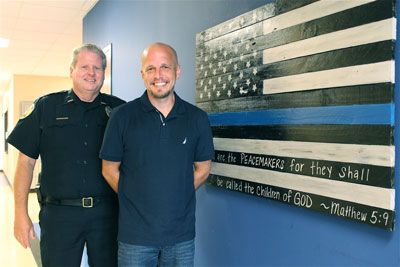
To serve and protect is the motto that Sgt. Porter Wood has lived by for 26 years as a policeman for the Warner Robins Police Department. However, faced with the difficult news four and a half years ago that he has a rare kidney disease, Wood has finally received the good news that a former student of his desires to be a service to him.
Diagnosed with IgA nephropathy, Wood’s former DARE (Drug Abuse Resistance Education) student, Trey Ammons, who has been with the Warner Robins Utility Department for almost eight years, says he felt compelled to help.
On YouCaring.com, Wood’s wife, Teresa, posted a message several weeks ago asking for the public’s help in finding a donor.
“Many of you are blessed to have crossed paths with my sweet husband, Porter,” she stated. “You may have known him as a dedicated airman at Robins Air Force Base, where he was stationed from 1978-81. Or, you may know him as a humble servant of the church, having served as deacon, teacher, coach and mentor for more than 30 years at Second Baptist Warner Robins and eight years at First Baptist Centerville. Or, you may know him from his almost 26 years of dedicated service with the city of Warner Robins Police Department, where he first served as a patrol officer, then as a DARE officer in the Houston County school system and finally as sergeant over the school liaison unit since 1999. You may be one of the innumerable lives he has touched in a positive way.”
On May 31, Teresa excitedly posted the good news that “God has so graciously provided for Trey Ammons, a city of Warner Robins employee and former DARE student of Porter’s, to be Porter’s kidney donor!”
During an interview at the Warner Robins Police Department earlier this week, Ammons said he’s never known of anybody who needed a transplant. He said he had been asked once before if he would ever donate an organ.
“I said, ‘Yes, when I’m dead,’” he commented. “Never really gave it any thought.”
However, Ammons said the moment he saw the post about Wood needing a transplant on Facebook one night, he knew — it took only a minute to make up his mind. He said his grandfather was a minister and told him “when God talks to you, just do what he tells you to.”
Seen as a heroic action on his part by many, Ammons says he’s just doing something selfless.
According to the Mayo Clinic website, “IgA nephropathy, also known as Berger’s disease, is a kidney disease that occurs when an antibody called immunoglobulin A (IgA) lodges in your kidneys. This results in local inflammation that, over time, may hamper your kidneys’ ability to filter wastes from your blood. IgA nephropathy usually progresses slowly over many years, but the course of the disease in each person is uncertain. Some people leak blood in their urine without developing problems, some eventually achieve complete remission and others develop end-stage kidney failure. No cure exists for IgA nephropathy, but certain medications can slow its course. Keeping your blood pressure under control and reducing your cholesterol levels also slow disease progression.”
Wood said it’s a kidney disease that can lie dormant in a person’s body for many years and then suddenly something can trigger it, where it becomes active.
“It can either be slow or very progressive and mine was very progressive,” he said. “They have no idea what triggers it or anything and there is nothing they can do for it.”
Wood, who goes for a physical every year in October, said when he got a physical the year that he was diagnosed, the doctor looked at his blood work and commented that it didn’t look right. His blood work was redone, which came back worse than before.
“That’s when he said, ‘Your kidneys aren’t functioning right,’” Wood said.
He was then sent to a specialist, starting out with a high dosage of steroids about four times higher than what is normally taken.
“They said for some reason, it will help slow it down in a lot of patients,” he said. “And it did for me for a little while.”
However, Wood said he had to go through the process of losing a lot of weight in order to get on the deceased donor list, which took almost four years. When asked if he had any symptoms, he said he would get tired, but he figured it was due to work since he used to work extra hours.
“But it got worse,” he said, noting he had started a project at home building a deck, but he couldn’t finish it. “I didn’t have the energy to do anything.”
Wood said after he lost a lot of weight, he regained a lot of his energy and his kidney function improved a little, which kept him off the deceased donor list at that time until it dropped again.
“It’s one of those things that just wears you out. You just don’t feel good,” he said.
According to the Mayo Clinic, “IgA nephropathy usually doesn’t cause symptoms in the early stages. The disease can go unnoticed for decades and is sometimes first suspected when routine tests reveal protein and red blood cells in your urine that can’t be seen without a microscope (microscopic hematuria).”
They list the following signs and symptoms of IgA nephropathy when kidney function is impaired:
• Cola- or tea-colored urine (caused by red blood cells in the urine)
• Repeated episodes of cola- or tea-colored urine, sometimes even visible blood in your urine, usually during or after an upper respiratory or other type of infection
• Pain in the side(s) of your back below your ribs (flank)
• Swelling (edema) in your hands and feet
• High blood pressure
Recalling the night he saw the Facebook post about Wood needing a kidney donor, Ammons said, “I read the post, got in contact on the website, filled out the questionnaire and then they (Piedmont Hospital) contacted me the next day.”
To see if he was a match, he had to take three days worth of blood pressure readings twice a day. He also had to do blood type, enzyme and urine tests.
“All that came out to be a match,” he said.
Since Wood had been a DARE officer in the Houston County school system for five or six years, Ammons remembered him being at his elementary school when he was younger. Seeing his photo on Facebook, he said, “That’s what clicked in first, because when I saw him, I was like, he has more gray hair than he used to (he said laughing).”
“That’s from working around the schools,” Wood said, smirking.
“We caused all of that,” Ammons said, jokingly.
The years may have passed, but the teacher-student bond is still evident.
“It’s a humbling experience that someone would think that much about you to do it,” Wood said about Ammons. “But, like I always like to say, too, put the credit where it’s due.”
He said people tell him that he must have really made an impact on his students.
“I always say, ‘No, it’s not me. It’s God who had an impact on them. He just used me to be there,’” Wood said. “God knew what he was doing back then when he put us together because he knew the day that I’d be needing one (a kidney).”
He said he has had several of his former students take the survey to see if they are a match to be a donor. Other than Ammons, Wood said another student who now lives in Ohio came back as a match also. He said he doesn’t know exactly who’s testing due to confidentiality. It’s up to the donor to reach out to make contact and let him know. After doing in-house testing in Atlanta and being approved, Ammons informed Teresa and Wood of the good news.
“I had a good feeling about it,” Ammons said.
For those who would like to be a donor, Wood and Ammons encourage them to do so.
“There are plenty of good people out there who need it,” Ammons said.
Wood encourages those who considered being a donor for him to please consider somebody else.
“I’ve been contacted by a couple of people who are in need that just found out they had a kidney disease and didn’t know which way to go,” he said, noting he’s trying to help with getting them donors.
Paying it forward, Wood says he simply looks at it as, “God gave us two kidneys and we can function just as fine with one, so maybe he gave us two for a reason to give to somebody else.”
He said even after his diagnosis, his hope never wavered. His outlook was: “God’s got it either way, whether I get one or not. It’s in his hands.”
He added, “If God didn’t see fit to give me a kidney, that’s fine, too.”
What’s next?
The transplant surgery is scheduled for later this month on June 23 at Piedmont Hospital in Atlanta. Teresa asks, “If you can make a donation of any amount to help cover costs associated with the surgeries and future transplant-related care, we would be so grateful! Thank you for your continued prayers and support!”
A couple of more testings for Wood and Ammons will be done prior to surgery. With the date set and soon approaching, Wood said he and Ammons are both excited and nervous. He says he’s just ready for it to all be over.
Following surgery, Wood will have to stay in Atlanta for at least a week to make sure that his body is not rejecting the kidney. He will have to take at least two pills ($4,000 a piece) a day for the rest of his life and visit Piedmont Hospital for appointments. Ammons will have to go back after two weeks following surgery and then after six months. He said every year for the rest of his life, he has to take a kidney function test, which can be done by a primary care doctor.
Wood says he hopes for a quick recovery and to get back to work, and Ammons’ hope is that everything goes well for Wood.
“I’m happy that he’ll be able to live his life,” Ammons said.
“I tell people he’s my hero now,” Wood said. He advised if others would donate, they can also be somebody’s hero. “They’ll save somebody’s life,” he said.
Wood noted in Georgia alone, more than 10,000 people are waiting for a kidney transplant, but the majority of them will not make it. He said the waiting time on the deceased donor list is about six to eight years.
Blessed to be sitting next to someone who has committed to being his donor, Wood said, “A person with a living donor is going to live longer than they would with a deceased donor. I’m trying to encourage people to step up and help somebody.”
A hero in his own right, Wood continues to serve and protect his community.
HHJ News
Before you go...
Thanks for reading The Houston Home Journal — we hope this article added to your day.
For over 150 years, Houston Home Journal has been the newspaper of record for Perry, Warner Robins and Centerville. We're excited to expand our online news coverage, while maintaining our twice-weekly print newspaper.
If you like what you see, please consider becoming a member of The Houston Home Journal. We're all in this together, working for a better Warner Robins, Perry and Centerville, and we appreciate and need your support.
Please join the readers like you who help make community journalism possible by joining The Houston Home Journal. Thank you.
- Brieanna Smith, Houston Home Journal managing editor
Paid Posts
Related Articles
Fellowship Bible Baptist Church to perform first-ever immersive Easter experience
Fellowship Bible Baptist Church will tell the story of the true meaning of Easter as they will perform an immersive Easter experience on Friday, April 3.

Big Air bounces to offer unique family fun in Warner Robins
Big Air held their grand opening on Saturday, March 21. The action park is ready to offer unique family fun to the community.
Sky Zone celebrates grand opening in Warner Robins
Not one, but two trampoline parks bounced into the spotlight with grand openings over the weekend.