Growing greens and young minds at Westside
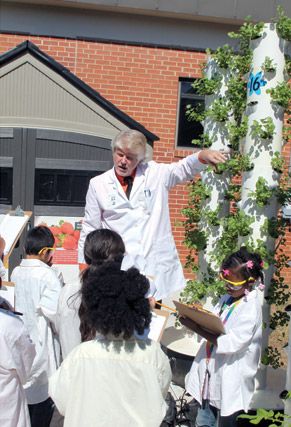
Student gardeners at Westside Elementary School wear makeshift lab coats and address each other as “professor.” The coats are large shirts, and students are serious as they work at Westside Gardens.
Second grade teacher Ken Hammond shepherds his science class students between the towers where they chart the growth of vegetables.
This isn’t your typical backyard garden with neat rows of plants. Instead, you have 15 aeroponics towers with herbs and vegetables that are grown by students and watered on a timer. There is no soil for them to get dirty by, either.
This is the second complete year for the gardens, said principal Cynthia Hammond.
Back in September, state Department of Agriculture officials visited the school expressly to see the gardening setup, Hammond said, and were impressed enough to notify the U.S. Department of Agriculture in Washington, D.C., and Audrey Rowe, its food and nutrition service administrator.
Rowe and other officials visited the school Oct. 15 and sampled some of the produce such as beans, lettuce and greens.
She said it was important that students can see their food being grown and that trips to the supermarkets will take on more meaning for them.
“We’re extremely proud the USDA visited our school,” Hammond said. “They said they thought a lot about our efforts, and we thanked them.”
She noted that most schools have one or two towers while Westside boasts 15.
“Most people are shocked when they hear we don’t use soil. I think it’s relatively new to Georgia, and I feel it’ll take off,” Hammond said.
The towers do limit what can be grown, with root vegetables not being particularly well-suited for the setup. But herbs, beans, cherry tomatoes, zucchini and cucumbers can be relatively easily grown and harvested.
It’s not a setup where one can just put seeds in, water and walk away, she said.
“The insides have to be cleaned every three months,” she said. “You have to work with it, clean it, and make sure there are no bugs on the plants.”
Students have been fed homegrown lettuce at the school’s cafeteria, she said, and bags of produce are offered to the parents.
“We have even sold our lettuce to a sandwich shop; they love our lettuce,” she said. The money the gardens raise help maintain the gardens, she said.
The gardens are an excellent resource for teachers, who can use the growing cycle of plants in science, mathematics, reading and writing classes, Hammond said.
The gardens are also an excellent resource for students, who take pride in it, she added.
“They are proud of the garden and want to be a part of it,” she said. “They love to watch things grow.”
She said the gardens will be helpful in the school’s STEM (science, technology, engineering and math) certification.
Second grade paraprofessional Renee Kelly worked with students who were inspecting the kale they planted a month ago.
“It looks good; I think we can leave for today and get it later,” Kelly said as students wrote in their workbooks.
“The gardens have been a blessing for us, and we are real proud to have it,” Hammond said.
HHJ News
Before you go...
Thanks for reading The Houston Home Journal — we hope this article added to your day.
For over 150 years, Houston Home Journal has been the newspaper of record for Perry, Warner Robins and Centerville. We're excited to expand our online news coverage, while maintaining our twice-weekly print newspaper.
If you like what you see, please consider becoming a member of The Houston Home Journal. We're all in this together, working for a better Warner Robins, Perry and Centerville, and we appreciate and need your support.
Please join the readers like you who help make community journalism possible by joining The Houston Home Journal. Thank you.
- Brieanna Smith, Houston Home Journal managing editor
Paid Posts
Related Articles
The Westfield School Calendar 2025-2026: Key Dates & Holidays
The The Westfield School Calendar includes key dates for the school year, such as the first and last day of school, holiday breaks, teacher workdays, and high school graduation. Families can use this to plan ahead and stay on top of important schedule changes.
Houston County School Calendar 2025-2026: Key Dates & Holidays
The Houston County School District 2025-2026 Calendar includes key dates for the school year, such as the first and last day of school, holiday breaks, teacher workdays, and high school graduation. Families can use this to plan ahead and stay on top of important schedule changes.