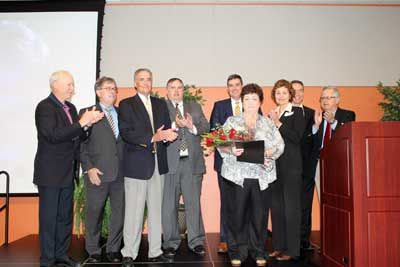
Go Red for Women luncheon brings out the best in locals, Houston Healthcare
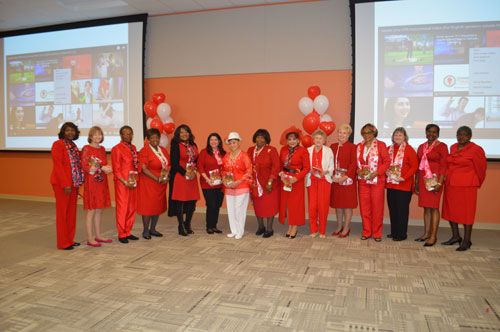
Houston Healthcare hosted their annual Go Red for Women luncheon Tuesday. Beth Jones, RNC, director of community education and services for Houston Healthcare, said the luncheon promotes and brings awareness to women’s cardiovascular health.
“For many years it was though that heart disease was just a man’s disease, but we know now that heart disease is the number one cause of death in women and this is true for Houston County as well.”
Jones shared with those in attendance that in July of 2017 Houston Healthcare did a community needs assessment. The results of the assessment showed that cardio vascular disease is the number one cause of death in the Houston County area, which follows along with the state of Georgia and nation.
“We talk about women and heart disease because women are famous for taking care of everyone else except for them selves,” Jones said. “A national poll was taken on why this is and some of the answers were, women think they’re not old enough to be at risk, some feel like they’re just too busy and some say they are just too tired to worry about it. But we must take care of our selves and make our health a priority.”
Jones then introduced the guest speakers of the luncheon. The first speaker was Doctor Nisreen Jallad. Jallad is a board certified interventional cardiologist and is on the medical staff at Houston Medical Center.
“This subject is near and dear to me because I lost my mother to this disease,” Jallad said. “There are so many different symptoms that we have to be aware and mindful of along with the many risk factors. Those risk factors are family history, if one is diagnosed with diabetes, high blood pressure, obesity or sleep apnea. We as females try to be superheroes, but even superheroes need to be careful and be taken care of.”
Jallad also shared the warning signs of a heart attack, which are chest discomfort, pain that occurs in either the left or right arm, back neck, jaw or stomach, and shortness of breath.
“A lot of my patients have shared with me that when they had a heart attack they experienced headaches or toothaches,” Jallad said. “So women don’t necessarily have the classic textbook symptoms. The heart is a large muscle and it’s like the engine for your body. We must practice good health by being active in exercising, eating healthy and visit your physicians.”
The second guest speaker was Ray Jones, RN and associate director of cardiovascular services for Houston Healthcare. Ray began with sharing statistics from the American Heart Association. Some of the statistics he shared are as follows:
-1 in 3 deaths are related to cardio vascular disease.
-Everyday there are 2,300 deaths calculating at 1 person dying every 38 seconds from cardio vascular disease.
-Cardio vascular disease kills more people than all forms of cancer and chronic lower respiratory diseases combined.
“This disease is real and happens all the time,” Ray said. “I know today is suppose to be a nice fun gathering, but the message is really serious. If we’re going to change these statistics this is where it happens, right here with more education and awareness. Dr. Jallad talked about the different symptoms and warning signs of a heart attack and as you learn they are very vague, which is the most dangerous thing about it. Most people have those symptoms everyday with pain in their back, headaches or fatigue. So how do you know if you’re having a heart attack? I don’t have the answer and really no one else does, but what I can tell you is what we hear frequently from our patients. They tell us they had some of the symptoms, but were afraid to admit they knew it was their heart. If you have any of those symptoms go ahead and make a plan right now on what you will do. If you feel like you’re having a heart attack do not drive to the hospital call 911 immediately. Our medics can begin treatment right away and it is ok if it turns out to be a false alarm. It’s better to be safe.”
The last guest speaker was Cindy Watson, RN, lead nurse educator and human resources for Houston Healthcare.
“We heard a lot today about the heart while it is still beating,” Watson said. “But my part is to talk about what we, the community, needs to know when it stops and how to take care of those patients. If you see someone collapse and you listen to see if their heart is beating or check for a pulse. If there is no beating or pulse you then begin chest compressions. Prior to 2010, with CPR (Cardiopulmonary resuscitation) you had to do the chest compressions along with mouth-to-mouth breathing. Well now you don’t have to do the breathing. Through research it was found that chest compressions is sufficient enough because you still have enough oxygen in your lungs and blood that will support the patient until professional help arrives.”
Watson then demonstrated on a manikin how to do chest compressions. She said you take the heel of one hand placing it in the center of the chest then place your other hand on top. Push down hard and keep pushing at 103 beats per minute until medics arrive.
“This may sound funny, but when you do chest compressions do them at the tempo of the song, ‘Staying Alive,’ Watson said. “That song is 103 beats per minute. But once you start the compressions you can’t stop until help arrives.”
HHJ News
Before you go...
Thanks for reading The Houston Home Journal — we hope this article added to your day.
For over 150 years, Houston Home Journal has been the newspaper of record for Perry, Warner Robins and Centerville. We're excited to expand our online news coverage, while maintaining our twice-weekly print newspaper.
If you like what you see, please consider becoming a member of The Houston Home Journal. We're all in this together, working for a better Warner Robins, Perry and Centerville, and we appreciate and need your support.
Please join the readers like you who help make community journalism possible by joining The Houston Home Journal. Thank you.
- Brieanna Smith, Houston Home Journal managing editor