
Freight train derails near Robins AFB
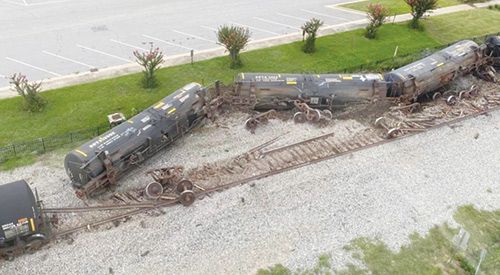
WARNER ROBINS, Ga. — Local authorities responded to a Norfolk Southern train derailing near Watson Boulevard, State Route 247 and Robins Air Force Base shortly after 5 p.m. on Tuesday evening. No injuries have been reported from the incident.
According to a Facebook post from the Houston County Emergency Management Agency sent out at 10 p.m. Thursday evening, the rail crossing at Watson Boulevard and SR 247 is back open. As of 10:30 a.m. Friday morning, the only roadways still affected include a closure of South Armed Forces Boulevard from Watson Boulevard to the Avis/Budget Rentals building — but the rest of Armed Force Boulevard is now open.
Chris Stoner, Houston County fire chief and emergency management director, said three fire departments responded to the scene Tuesday along with other county and state personnel. Per an automatic aid agreement between the county and the fire response personnel at Robins Air Force Base, responding entities included the Robins Air Force Base Fire along with Houston County Fire, Warner Robins Fire, Georgia State Patrol, Houston County Emergency Management Agency, Georgia Department of Transportation, Houston County Sheriff’s Office, Warner Robins Police Department and Norfolk Southern Railroad.
Stoner said Assistant County Fire Chief Kevin Noles was assigned to handle operations on the ground while he flew over the scene with a Georgia State Patrol helicopter crew to obtain an aerial view of the situation, perform an assessment, determine if evacuations needed to occur and identify potential leaks and specific tank car numbers that would otherwise be difficult to tell from the ground.
“Once we got on scene, we quickly realized it was tank cars; it was roughly 20 or so that had derailed right there at the Watson [Boulevard] intersection — pretty much some on either side of the intersection,” Stoner said.
Local residents were curious on social media regarding what was being stored in the tank cars, especially if anything was hazardous and happened to be leaking. Stoner verified that nothing actually leaked from the railcars, but sulfur was on board.
“We sent us and Warner Robins Fire Department in with protective gear to do an assessment, and they quickly realized it was molten sulfur in the railcars — but that the sulfur was not in a molten state at the time,” Stoner explained. “So it was cool; it was [at] a solid state.
“So at that point, there were no threats of hazards from those. And then, by air, I was able to fly down through the entire length of the train and verify that there were no other additional leaks or concerns.”
From there, the responding crews were able to shift their efforts into a recovery phase, with law enforcement handling traffic flow and providing Norfolk Southern the opportunity to proceed in assessing the situation, repairing equipment or preparing it for cleanup. Most of the fire department units, besides a few that stayed behind as a safety detail, were released from the scene around 6:30 p.m.
Stoner explained that while this situation did not call for any official hazardous response, county personnel regularly train and are prepared for those types of scenarios. For the incident on Tuesday, there were two hazmat trucks and crews on site, including the one from the county and one from the base nearby.
“Fortunately for this one [situation], it was more of a traffic hazard and a recovery issue than it was any immediate life threats,” he said. “That was a blessing for us — but we did have the resources there if it had been something along those lines.”
He explained that from the fire department operations side, basic firefighting courses cover hazardous materials training — and students must acquire a specific operations certification.
These certifications include an awareness level involved in identifying hazardous materials and hazmat-appropriate situations. They also include an operations level to teach students how to manage spills, and a technician level to teach them how to place themselves into the contaminated area to patch, stop or contain the spill from becoming worse.
He said the mid-tier operations level is the local minimum for area fire departments.
“A lot of our staff has exceeded that and went up to the technician level,” Stoner said. “And of course, our hazmat teams are groups of those technician-level firefighters that respond out, so they can be the ones that get in the full suit.
“If one of those railcars had been leaking, we’ve got equipment on our truck that they would [use to] go up and actually stop that leak and [for] preventing it from coming out anymore. And then they deal with what’s already spilled and on the ground.”
He added that a representative of every agency involved took part in a unified command arranged to make “combined, educated decisions on what needs to happen and the best course of action for mitigations.” The National Incident Management System played a significant role in the operations on Tuesday, he said.
“All in all, everything went fantastic,” Stoner said. “We work well together on incidents, whether it’s in the city or the county. Between all the agencies we’ve got a great relationship, and that response right there was just a testament to the relationships we’ve built between the agencies and the cooperation we have.”
A frequent topic of discussion in the previously mentioned command post involved the handling of traffic flow relative to the base, small businesses and key roadways nearby. Stoner said Thursday afternoon that Norfolk Southern was efficient in their response and ability to reopen those areas to traffic.
“I went by there this afternoon, and they’ve got almost everything completely opened back up,” Stoner said. “There’s still four or five railcars off to the side of the rail, but there was a train coming down the tracks already today.”
He said SR 247 was closed down for a few hours following the initial incident in order for personnel to assess the hazard, and it was reopened shortly following.
“We still had several rail crossings closed, obviously, but we had the major thoroughfare opened as quick as possible and got the base back functioning in a normal capacity as far as their gates,” Stoner added.
Throughout Tuesday night and into Wednesday, partial closures took place for southbound traffic on SR 247 between Green Street and Martin Luther King Jr. Boulevard to facilitate equipment for Norfolk Southern and cleanup efforts. The derailed cars could remain on the side of the tracks for some weeks to come, Stoner said.
“Before we actually broke down the unified command that night, every rail passing was reopened with the exception of Watson Boulevard, essentially,” he explained.
Detours were arranged to direct traffic around the Watson rail crossing to nearby businesses and the base.
“They essentially just had to go down MLK [Boulevard] to Armed Forces Boulevard, and they were able to get right back to Watson to get access to all those businesses and things like that,” he added.
Stoner said this incident makes for the third train derailment in his time serving Houston County.
Connor Spielmaker, communications manager with Norfolk Southern Corporation Media Relations, spoke with The Journal Thursday afternoon regarding the incident. He said the cause of the incident is currently under investigation by the Federal Railroad Administration, and he confirmed from that no leaks occurred.
“It was a mixed freight train carrying a variety of commodities,” Spielmaker said. “There were 140 cars total in the train, 22 of which were part of the derailment.”
He spoke on the potential frequency of derailment incidents considering the many potential variables involved.
“Derailments are both frequent and infrequent, and I say that because a derailment is technically any time a single wheel is not correctly aligned on the track,” Spielmaker said. “So with that level of technicality, surely the numbers are high.
“But as far as larger-scale incidents like this, they’re not exceptionally rare, but they’re not frequent. They do happen from time to time just like with any type of transportation.”
HHJ News
Before you go...
Thanks for reading The Houston Home Journal — we hope this article added to your day.
For over 150 years, Houston Home Journal has been the newspaper of record for Perry, Warner Robins and Centerville. We're excited to expand our online news coverage, while maintaining our twice-weekly print newspaper.
If you like what you see, please consider becoming a member of The Houston Home Journal. We're all in this together, working for a better Warner Robins, Perry and Centerville, and we appreciate and need your support.
Please join the readers like you who help make community journalism possible by joining The Houston Home Journal. Thank you.
- Brieanna Smith, Houston Home Journal managing editor
Paid Posts
Related Articles

CRU Lounge shooter sentenced to 15 years in prison
Katlyn Green was convicted of aggravated assault in April and sentenced on May 5.

Houston County set to increase water usage rates in July, Chairman explains
Starting July 1, 2026, Houston County will increase water usage rates by 25 cents as part of their three-year water adjustment plan.

Perry author releases novel inspired by South Georgia: About ‘finding yourself’
Bo Hunter, a Perry-based author, is dipping into the past for a humorous and introspective look at identity, perseverence and nostalgia with his debut release.