
Fortifying the Flying Fortress
WARNER ROBINS, Ga. — There’s nothing quite like going to a museum.
You probably went to your first one as a kid. Maybe your mom took you on her day off, or your granddad took you after a dentist appointment. Either way, you walked alongside them, got your ticket and stepped inside. The world was never the same.
If you grew up in Houston County, and likely went to the Museum of Aviation, you saw man-made wonders, massive metal beasts capable of flight and the intricate ins and outs that go into giving people the ability to fly — though maybe you didn’t understand it.
When you got older, it changed again. You’d gone to school at that point, you knew what many of these planes did, where they went, and the kinds of things they saw. In history class, you probably studied why they became necessary. A natural wonder, while still present, was joined by something new: reverence for the history that you were standing within.
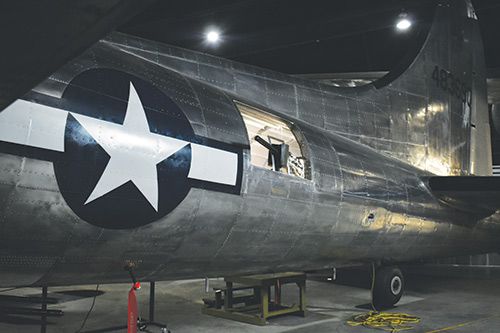
Adding a little extra wonder and reverence to their collection, the Museum of Aviation has been working on one project for eight years: a Boeing B-17 Flying Fortress. The four-engine heavy bomber is equipped with chin and cheek guns, a depressurized cabin, an aluminum exterior and space in the wings for enough fuel to make a nine-hour flight.
Made iconic by its work during World War II, the B-17 dropped more bombs than any other aircraft during the war, and served as one of the major daytime bombers over the Axis powers in Europe.
Michael Woods, the museum’s volunteer aircraft restoration leader, spoke with The Journal about the plane and its history, how it came to be with the museum and the work that’s gone into restoring it.
“This airplane can get shot to crap and still come home,” Woods said. “There are times this plane would come home with half a wing, no tail, the tail literally shot away. When the plane landed, it was scrapped, it could never fly again, but it got the boys home.”
That toughness may still ring true, even today.
Built by Douglas Aircraft Company, the museum’s B-17 never saw combat since it was one of the last bombers produced before the end of the war. But after spending some time in a hangar at the National Museum of the US Air Force between 1945 and 1950, the aircraft was outfitted with radios and antennas, and modified to work as a Mother Ship Drone Director.
The craft would take to the sky, manned with a crew, and would be the operating center for remotely controlled, unmanned drones. Some of its most pertinent missions were completed near the sites of nuclear bomb tests, some in Nevada and Utah, where its crew would fly drones through the blast area after an explosion for testing.
When this program ended in the early ’60s, the plane flew into Bunker Hill Air Force Base in Indiana, now Grisham Air Force Base, and sat in a field for years rotting away. In 2015, it was purchased by the Museum of Aviation, and restoration could begin.
The museum’s restoration team worked to chemically remove the paint put on the plane by its former owners, remove wildlife and damage inside and out, and then began the work of restoring.
“When I first saw it come in, I thought there was no way this thing was recoverable,” Woods said. “We literally pulled her out of the grave and got it to where it is now.”
The restoration team had to replace aluminum that had been eaten away by the acidity of bird droppings, empty the wings and bomb bay of water, rebuild parts and mechanisms that haven’t been produced since the war and much more. The project, up to this point, has taken eight years.
Today, 80-85% of the B-17 is comprised of its original parts. The rest was remade and replaced by the museum’s restoration team. It supports its own weight, standing on landing gear, and much of the insides of the plane have already been rebuilt as well.
This task of rebuilding this plane shouldn’t be understated. The museum’s restoration team has worked tirelessly to restore what they could, rebuild what they couldn’t and find a replacement when all else failed.
During the war, these planes were being built on a production line that put out a new plane every 55 minutes. Great machines stamped out parts, and a team of riveters built the beast in less than an hour.
The restoration team doesn’t have any stamping machines, they don’t have a production line and Rosie the Riveter isn’t here to help. They’re armed with technical drawings, blueprints, manuals, a rudimentary sheet metal shop down the hill and the tools they can carry on their hip.
This plane most likely won’t ever fly again — according to Woods, that would require “a total rip-down,” 10 additional years of labor and somewhere around $4 billion — but you can view the outside of the plane as it approaches archival standard, its original engine, its defensive guns and aluminum body, and even sometimes the restoration team hard at work, by visiting the Scott Hangar at the Museum of Aviation.
The museum’s B-17 will be completely restored externally within the year, leaving the inside to be finished. Woods told The Journal that portion should follow within one or two more years, and then the plane could be, on occasion, toured.
For updates on museum projects or events, you can visit the museum’s Facebook page, “Museum of Aviation Robins AFB, Warner Robins, GA.” You can also find more information on museum programs, like their ongoing STEM Academy, you can visit the museum’s website: www.museumofaviation.org.
The Museum of Aviation will continue to do work in restoring aircraft and preserving history. They act as a cornerstone to our community, inspire young minds and help those in the future remember those who came before.
For Woods, it’s a passion.
“This project is bigger than any one of us alone,” Woods said. “This is history; once it’s gone, it’s gone, and we have to preserve it for the future.”
Additional projects will be announced throughout the year, and more restoration projects are well in the works.
HHJ News
Before you go...
Thanks for reading The Houston Home Journal — we hope this article added to your day.
For over 150 years, Houston Home Journal has been the newspaper of record for Perry, Warner Robins and Centerville. We're excited to expand our online news coverage, while maintaining our twice-weekly print newspaper.
If you like what you see, please consider becoming a member of The Houston Home Journal. We're all in this together, working for a better Warner Robins, Perry and Centerville, and we appreciate and need your support.
Please join the readers like you who help make community journalism possible by joining The Houston Home Journal. Thank you.
- Brieanna Smith, Houston Home Journal managing editor
Paid Posts
Related Articles
‘Christmas at the Crossroads’ brings the community together to celebrate the meaning of the holiday
Despite rainy weather, Christmas at the Crossroads united local pastors, city leaders and worshippers for a shared reminder that Christ is central to Christmas.

Family Promise provides needs for Houston County’s children experiencing homelessness
The organization has been assisting families for over a decade, providing practical and sustainable help.

Local author’s latest book ‘Hope in Action!’ highlights outreach in El Salvador
Proceeds from book sales will also go towards outreach efforts in the country.