
‘Every single act counts:’ Middle Georgia synagogue takes stand against anti-Semitism
MACON, Ga. — On June 23, Warner Robins neighborhoods woke up to anti-Semitic packages on their doorsteps. The same day, members of a neo-Nazi extremist group attacked outside Macon’s Temple Beth Israel.
In response, members of Middle Georgia’s Jewish community and supporters gathered at Temple Beth Israel for a peaceful protest but they weren’t done making a stand. On Sunday, they held what they called “A Service of Love and Unity” at Mulberry United Methodist Church in Macon.
At the inter-faith service, members of the Jewish community, church leadership of multiple faiths, elected officials and the public gathered for multiple speakers and performances, showing love and solidarity at the two-hour service.
According to Rev. Dr. Ted Goshorn, pastor of Mulberry Street United Methodist Church, around 900 people attended the service, with a sizeable amount watching online.
During the event, the Congregation Bet Haverim Chorus, the Temple Beth Israel High Holidays Choir and the Community Church of God praise team performed to uproarious applause and standing ovations.
The event opened with remarks from Temple Beth Israel President Simon Becker, Community Church of God Pastor Jason McClendon, Macon Mayor Lester Miller and Islamic Center of Middle Georgia Imam Shaikh Adam Fofana, which all had the same thread connecting them, saying that hate has no place in the community and they are taking a stand.
“There is no place here — I repeat, no place — for the ignorance, the hate, the anti-Semitism directed towards our Jewish neighbors last weekend. No place for discrimination of any kind in any form. We stand here together with our neighbors,” Miller said. ” … Those who sought to install fear failed. Instead, we stand together here today in love, in unity, and without fear.”
Rabbi Mike Rothbaum from Congregation Bet Haverim Atlanta and Congressman Stanford D. Bishop Jr. also spoke to the crowd, echoing remarks made earlier by local leaders.
“To believe what the Shema says in the book of Deuteronomy … ‘Adonai’ is one. All of humanity, created in God’s image, is also one. And it means that we fight tooth and nail for the dignity of every life created in God’s image: every Jewish life, every gay life, every Muslim life, every refugee life, every trans life, every disabled life, and yes, every Black life. Amidst the forces of terror and death that reared their ugly faces here, we stand together as a beacon for life, insisting on life,” Rothbaum said.
“Last weekend’s neo-Nazi rallies, not just in front of Temple Beth Israel, but in other parts of our state and our nation were attempts to separate us from our Jewish brothers and sisters. It was an attempt to make them feel vulnerable, unwelcomed and threatened … Today, we stand up and we’re speaking out for justice for [fearlessness,] for tolerance, for love and for peace,” Bishop said.
The event continued with Rev. John R. Johnson, from St. Joseph Catholic Church, Rev. Goshorn and Rabbi Aaron Rubinstein of Congregation Sha’arey Israel.
“Together we respond in the face of hatred. We stand in solidarity with our Jewish brothers and sisters. Together, by being present today, we say ‘we are with you.’ We are with you, following the example of God, who is always with us,” Goshorn said.
The keynote speaker at the event was U.S. Senator Jon Ossoff, who opened by showing solidarity with Temple Beth Israel and says much of the community does the same.
He told the true story of Nathan, a young man in present day Lithuania. In 1941, his city was bombed and taken under Nazi rule.
In March of 1943, Nazis took Nathan to present-day Estonia, where he was made to work, beaten and provided very little food and unsuitable clothing. His father, who was taken with him, suffered from dysentery.
Two weeks later, his family was sent to a death camp. Out of his family in Lithuania, only he and his cousin survived.
He escaped from his camp and for six months fought for survival, before surrendering to Soviet troops and spending two years in a displaced persons camp in present day Germany. Finally, Nathan sought for his aunt in Peabody, Massachusetts and was able to immigrate to the United States.
Ossoff gave three reasons for telling the story; the first was driving home the meaning behind the swastika, the recognizable symbol of the Nazi party.
“It’s painful, but important to remember that the swastika is not merely a symbol of hate. Hate is an idea or a feeling. The swastika is a symbol of massacre, slavery, medical experimentation, extermination and genocide,” Ossoff said.
Ossoff’s second reason was a family connection. Nathan’s aunt was Ossoff’s great-grandmother.
“I know for Middle Georgia’s Jewish community, these aren’t abstractions or ancient stories. These are the experiences of beloved family members with whom we were raised and grew up,” Ossoff said.
Ossoff’s final reason was to show America as a beacon of light, but the light requires work to keep it going.
“America still is and still represents to the world, the values of universality, of human rights, of tolerance, of love, of kindness, that are the only antidote to the forces of hatred and genocide, which have and will throughout human history, risen and continue to rise and rise again,” Ossoff said.
He closed by thanking the congregation for their solidarity.
“This, right here, is what makes America great,” Ossoff said.
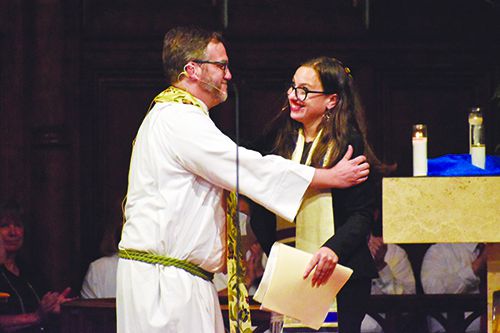
Finally, leadership from Temple Beth Israel took the podium, including Vice President Mike Kaplan and Rabbi Elizabeth Bahar, who organized the event.
Bahar told a story of a man living in luxury but with average character, who passed away. When he faced judgment, a set of scales sat in the center of the court. One side had the man’s good deeds, and the man’s bad deeds on the other side.
The scales tipped towards negative; he was sentenced to eternal punishment and desperate to avoid it. His defense found one more good deed that was originally not counted, because it wasn’t his idea. It shifted the scales in his favor.
“From this tale we learn that every single act of compassion can hold immense significance. It reminds us of our capacity to make a difference. No matter how small, every single act counts. It can transform not just our own fate, but the fate of others around us,” Bahar said.
Bahar witnessed the attack on June 23. She admitted actions that day scared her; with family who had gone through the Holocaust, she knew what unchecked anti-Semitism could lead to.
Skeptical at first due to rising anti-Semitism nationwide, Bahar didn’t expect much response but was glad she was wrong. As she began to organize the event, she found multiple people offering to help.
She said anti-Semitism can lead to other forms of hatred, but was grateful to the community for showing the opposite and banding together.
“Hatred doesn’t stop; it snowballs. It divides one American from the other. It erodes trust in our government, in our non-government institutions. It undermines our very democracy, whose words we heard said out loud from this very pulpit today. And yet, that’s not what happened here,” Bahar said.
Before the final performance of the day, Bahar announced that she is planning a trip to Eastern Europe, and encouraged the public to donate to various causes. She finally invited the public to attend services at Temple Beth Israel.
If you want to check out the service, Mulberry Street United Methodist Church has the livestream on their Facebook page: “Mulberry Street United Methodist Church.”
HHJ News
Before you go...
Thanks for reading The Houston Home Journal — we hope this article added to your day.
For over 150 years, Houston Home Journal has been the newspaper of record for Perry, Warner Robins and Centerville. We're excited to expand our online news coverage, while maintaining our twice-weekly print newspaper.
If you like what you see, please consider becoming a member of The Houston Home Journal. We're all in this together, working for a better Warner Robins, Perry and Centerville, and we appreciate and need your support.
Please join the readers like you who help make community journalism possible by joining The Houston Home Journal. Thank you.
- Brieanna Smith, Houston Home Journal managing editor
Paid Posts
Author

Related Articles

Warner Robins Mayor LaRhonda Patrick aiming to excel in 2026
Warner Robins Mayor LaRhonda looks back on the city’s accomplishments and challenges in 2025. Now, she is looking ahead to 2026.

Houston County Public Works to lower Houston Lake for scheduled dam maintenance
Houston County Public Works will lower Houston Lake by four feet as part of scheduled maintenance on the dam starting on Jan. 20.
Warner Robins Mayor LaRhonda Patrick and council sworn in at first council meeting of 2026
A recurring theme was gratitude for supporters and unity amongst the council.