
Council discusses taxes, utilities, and more at District 2 open house
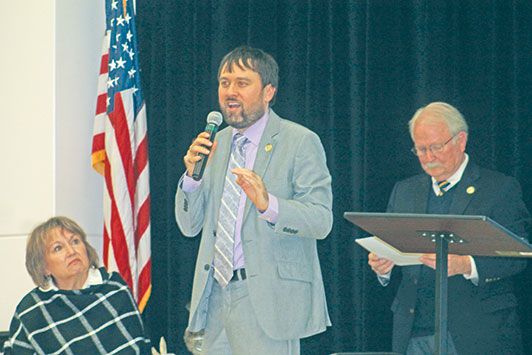
Mayor Randall Walker, as well as Councilwoman Joy Peterson and Councilman Robert Jones, presented information to constituents gathered at Matt Arthur Elementary School for the District Two Open House on Monday evening. The meeting’s agenda included the topic of Kathleen mailing addresses, explanations of city service bills, property taxes, updates and further plans for the district, as well as a question and answer time portion.
Regarding citizens of Perry with a Kathleen mailing address, Peterson said that she had the same question that many constituents have: If I am a citizen of Perry, why then is my mailing address in Kathleen, GA? Peterson explained that new developers wanted to be able to apply for the benefits of Perry, such as fire protection, water, and sewage among others. To obtain these services, the areas had to be annexed into the city. Peterson commented that the Kathleen addresses are a function of the United States Postal Service and added that the city has attempted on multiple occasions to work with the postal service to change this. Some developments that fall in this category include Black Hawk, Mossy Meadows, Wind River, and Wooden Eagle. Peterson also shared that she wanted all Perry citizens to know that they are just as much a part of the city as those with a Perry address. Jones later echoed this thought, expressing that regardless of where constituents live in the city limits, their concerns matter to council.
When Keith Busha suggested the notion of having the post office at Kathleen’s City Hall. Peterson responded that, Kathleen is a zip code. “It’s discouraging to live where the only service your town offers you is a zip code. That’s what Kathleen is; it’s a zip code. It’s a great area, but it’s just a zip code and so it’s good for people to understand that.”
Jones explained the break down of Perry City Service Bills, saying that though it is commonly referred to as a water bill, it is actually more than that, including fees for things like gas—which like water, is based on consumption, solid waste charges, state manded storm water utility fee, and the fire protection fee. Jones said because of the annexing of developments into the city, there had to be measures taken to insure fire protection as a feasible asset to these areas, as well as to maintain an adequate fire fighter presence and ability to the city as a whole. Jones said that SPLOST funds were used to build the Davis Farm Station on Houston Lake Road, but to allot for adequate staffing of that station, as well as the remaining stations throughout the city, a fire fee was enacted on the city services bill. According to Jones, all tax paying residents pay the same fee. One of the benefits of this fee mentioned, was that of the area’s ISO rating, which because of the construction of the Davis Farm Station, has been lowered to a rating of four. Jones said that this could translate into savings on home insurance policies and suggested that constituents check that their home is being rated with an ISO of four as opposed to ten.
Brad Harrison asked if there was the possibility that the fire protection fee may be added into taxes resulting in a tax increase. Mayor Walker responded that the fee was charged to everyone in town and that he would say that it would not, and further explained that if it were added to the taxes anyone who was exempt from those taxes would no longer pay the fee.
Mayor Walker spoke on the subject of property taxes. Walker first addressed the current millage rate for the city, which is 14.05 mills. This translates to $14.05 for every $1,000 of the assessed value of a home. Walker said that the millage rate has dropped from 2013, when it was 14.13 mills. In addition to the city millage rate, Walker explained the Perry citizens also pay a millage rate for the Houston County Board of Education—13.30—and the Houston County Board of Commissioners—11.11—both of which are calculated in the same fashion as the city. Walker pointed out that the 1% local option sales tax goes to the Houston County Board of Education.
Walker went on to explain that the city has a number of uses for those. He shared that Debt services—which consists of things like bonds and financing that help to purchase items such as fire engines and tractors—takes around 13.76% of property taxes. A large portion of property taxes that are paid by Perry citizens, he stated, go to public safety.
“If we are going to get one thing right, your protection both from the police department and fire department is extremely important to us,” Walker said. He further explained that 51.11% of property taxes go to the Perry Police Department, and 18.46%, in addition to the fire fee, goes to the Perry Fire Department.
Public works, Walker noted, receives 14.08% of funds collected to aid in things like infrastructure, building maintenance and landscaping, as well as 2.62% going to leisure services to aid in items such as destination parks and the new splash pad at Creekwood Park.
Peterson informed constituent updates in District Two, citing the repaving of various roads as well as the installation of sidewalks near Matt Arthur Elementary and crosswalks to enhance the safety of the children. Peterson also informed that the new water treatment facility is targeted to come into use in July of this year, and that it will enhance water production capabilities to 4,000,000 gallons per day, which is targeted to service the eastern part of the city. Peterson mentioned the coming of a new passive park, as well as the update of the gas system.
In addition, Peterson recognized Director of Leisure Services Sedrick Swan, citing that the department offers things such as the opportunity to learn a foreign language, as well as sports. Peterson also gave credit to Anya Terpin, Special Events Coordinator, listing events like Food Truck Fridays as well as the upcoming International Festival to be held downtown.
Aside from updates, Jones shared future plans for the district. He spoke of the LMIT grant which is used to resurface Perry streets, and shared that council likes to take the suggestions of constituents as to which roadways are in need of attention and that if citizens have a recommendation to reach out to their councilmember. Jones also said that he would like to see the addition of a destination type park closer to the Matt Arthur area, and mentioned that they are in contact with the Houston County Board of Commissioners in regard to making that idea a reality.
Jones noted that the council has been focused on guiding the growth of the city and its development. “We want to grow as a city, but we want to remain balanced in that growth so that we don’t lose the charm of the small town feel of Perry that I think all of us are very proud to enjoy,” Jones said.
Jerry Willis posed the question of how the city handles the development of infrastructure such as roads, sewers and water in regard to new development. Mayor Walker said that council considers factors such as developable acres as well as factors as what type of roadways were needed for the area. Walker shared that it is critical for council to plan for growth, and what council needs to anticipate at certain points in the future.
Keith Busha brought the subject of a traffic light at Bear Branch Road forward. City Manager Lee Gilmour informed that the specific request had been received by council and submitted to the DOT. Gilmour also advised that the major parameters for traffic lights are the occurrence of fatalities as well as major traffic accidents. He said that the DOT also considers traffic counts, but as a lower parameter. Gilmour stated that many times the funding for traffic lights comes from the DOT. Local monies for the device may provide some consideration, but does not guarantee that a light will be installed.
Before you go...
Thanks for reading The Houston Home Journal — we hope this article added to your day.
For over 150 years, Houston Home Journal has been the newspaper of record for Perry, Warner Robins and Centerville. We're excited to expand our online news coverage, while maintaining our twice-weekly print newspaper.
If you like what you see, please consider becoming a member of The Houston Home Journal. We're all in this together, working for a better Warner Robins, Perry and Centerville, and we appreciate and need your support.
Please join the readers like you who help make community journalism possible by joining The Houston Home Journal. Thank you.
- Brieanna Smith, Houston Home Journal managing editor
Paid Posts
Related Articles
Lori Johnson hoping to continue putting students and faculty first while serving on the Board of Education
Lori Johnson is running for reelection for Board of Education District 2 and hopes to continue her commitment to the students and faculty of the Houston County School District.

Warner Robins shooting leaves two injured, police say
Law enforcement also found and detained a suspect.

Anya Turpin promoting Perry, reflects on purpose, parenthood | Remarkable Women
Turpin, the executive director of Visit Perry, brings several qualities to the role that align with her experience as a woman.