Coaxing branches to bloom during the winter
It looks as though winter will be soon behind us, judging
from the recent Groundhog Day festivities. The daffodils have been blooming
since late January as they usually do. Average temps have been relatively high,
making for some mighty nice outside work days.
I’m betting we will have some more cold weather yet,
however. Until the warmer spring conditions arrive to stay, there is one thing we
can do to help add sunshine to those gloomy winter days that are sure to come.
Branches from many spring-flowering shrubs and trees can be cut
and forced into bloom now. Once their dormancy requirements have been satisfied
by the winter cold, these branches can be coaxed into blooming indoors without
much difficulty. With the proper treatment they can be forced into bloom
earlier than normal. Provided with adequate light and proper temperatures,
along with proper conditioning in water, they will flower in five days to two
weeks after cutting.
We can, of course, experiment with whatever we have growing
in our yard. Some to try include: azalea, beautybush, crabapple, forsythia,
quince, magnolia, pussy willow, redbud, serviceberry, spirea, witch hazel and
fruit trees such as peaches, apples, cherries and pears.
Some plants, such as forsythia and quince, are very easy to force,
while those which bloom later, such as viburnum and lilac, are much more
difficult. The latter are best cut close to their regular flowering time.
February is a good month to force many of the earlier flowering specimens.
March is better for the later flowering ones.
By the time winter arrives, the flower buds are already
formed on trees and shrubs, but a period of dormancy is required before they
will bloom. Plants differ in the degree of chilling, moisture, light, and
warmth necessary to stimulate the spring flower buds. By February in most years,
winter temperatures have satisfied the flower buds’ dormancy requirement. Once
that’s done, all you have to do is duplicate spring conditions.
Choose a mild day to cut branches and try to cut them during
the warmest part of the day when the buds are filled with moisture. Choose
branches that are well budded and have interesting curves. Be sure to follow
good pruning practices and prune to maintain the natural shape of the plant.
Allow the flowers to develop slowly to encourage large
blooms with good color. First, mash the bottom inch or two of the stems with a
hammer and place in water. Add a floral preservative or sugar with a drop or
two of bleach. Bleach serves to kill would-be harmful bacteria. Change the
water every four or five days during the forcing period. Leave the branches in
a cool, dark spot until bud swell begins, then move them into a well-lighted
area to encourage the flower color to develop. Do not place the branches in
direct sunlight.
Following the aforementioned practices extends the life of
the branches by reducing the number of bacteria in the water, thus keeping the
stems unclogged. Keeping room conditions cool will allow the buds to develop
slowly and maintain flower color. When color first appears in the flower bud it
is time to arrange the branches in containers. Do not wait until the blossoms
are fully opened.
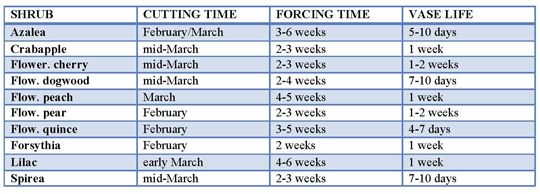
Following are cutting and forcing times and vase lives for a
few of the more commonly forced shrubs and trees.
Tim
Lewis is a Georgia Green Industry Association Certified Plant Professional,
gardening writer, former Perry High School horticulture instructor, and former
horticulturalist at Henderson Village and Houston Springs. He and his wife,
Susan, own and operate Lewis Farms Nursery located on Hwy 26 two miles east of
Elko, where he was born and raised. He can be reached at (478)954-1507, timlewis1@windstream.net,
LewisFarmsNursery.com, and LewisFarmsProduce.com.
HHJ News
Before you go...
Thanks for reading The Houston Home Journal — we hope this article added to your day.
For over 150 years, Houston Home Journal has been the newspaper of record for Perry, Warner Robins and Centerville. We're excited to expand our online news coverage, while maintaining our twice-weekly print newspaper.
If you like what you see, please consider becoming a member of The Houston Home Journal. We're all in this together, working for a better Warner Robins, Perry and Centerville, and we appreciate and need your support.
Please join the readers like you who help make community journalism possible by joining The Houston Home Journal. Thank you.
- Brieanna Smith, Houston Home Journal managing editor