
Centerville Police Department– New hire K9 Bono
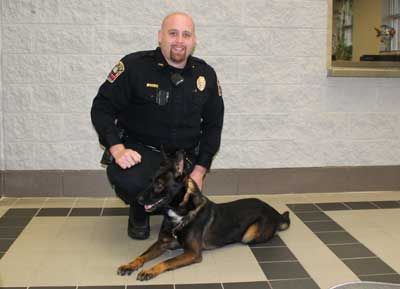
The Centerville Police Department has recently hired a new officer — and he works for toys.
The police dog Bono has been purchased by the department and works with his handler, Officer Jon Simpson. Simpson has been an officer for five years, and he’s been a member of the CPD for about three months, moving from the Savannah area.
Bono, on the other hand, is new to the force.
Dogs are trained for different duties. Narcotic dogs don’t take quite as long to train as patrol dogs, which is what Bono is. He and Simpson had to train together for about eight weeks before Bono was certified for duty.
“And tons of training afterward,” Simpson said. “It’s continuous training.”
Lt. Scott Radebaugh, who has also worked with police dogs, said it takes about 1 1/2 years to turn a puppy into a working dog.
“Just like law enforcement officers have continued education and teachers have continued education, you have to keep the dogs training up,” he said. “We do four hours a week of specifically K9 training, and then we’ll work on everything from patrol apprehension to tracking and narcotics work.”
Narcotics dogs take on four weeks of training learning how to sniff out drugs, and patrol dogs then have additional training in apprehension and tracking.
“They can track missing people, criminals that run from us. He’s trained in marijuana, meth, cocaine and ecstasy,” Simpson said. He added that Bono is also trained in the derivatives of the drugs.
Centerville’s K9’s begin their training with South Georgia K9. Lt. Marsha Peavy with the Dooly County Sheriff’s Office trains the dogs in narcotics searches while Darby Colvin does the tracking portion. The officers who will utilize the dogs’ talents in the field are introduced on the first day.
“As soon as we start training, day one is when we get introduced to the dogs, so it’s kind of an interesting thing to go through when you don’t know the dog, the dog doesn’t know you. You gotta learn each other,” Simpson said.
Radebaugh agreed: “That’s why they spend two months before their certification, so they start confidence building and working on developing longer and longer tracks, and confidence building in the canine’s nose work as far as the narcotics detection work goes.”
The dogs and their future partners will work anywhere from 8 to 14 hours a day to build a bond and confidence in one another and their team before certification. That bond is further built because the team doesn’t go to separate places at the end of the workday — K9s live with their partners. Even after a successful career, the dogs continue to live with their former partners in most cases, becoming the personal property of the officer. Police Departments can expect six to eight years of service out of the $13,000 to $15,000 investment in a K9 unit.
Human officers are not let of the hook so easily. After the monetary investment the police department puts into its human officer in learning how to work with a dog, the department will often send another dog to work with the officer.
“By that time, from a training standpoint, with four hours a week, so 16 hours a month, times eight years is a lot of time spent, a lot of money invested in his ability to handle and train and problem solve with a dog,” Radebaugh said.
A dog’s nose is so powerful, that when it tracks a human, it isn’t simply following the human’s odor. Whenever a person takes a step on grass, it degrades the blades of grass and kicks up certain smells in the soil itself. Dogs can smell those odors and understand it is because the ground has been disturbed. The disturbance of ground coupled with the constant flaking of skin cells or hair follicles allows the dog to associate the two scents and follow one path in favor of another and to also know which path is more recent.
The dog, however, does not know whether it is following a criminal it needs to take down or a lost person who needs assistance.
“It falls on the handler,” Simpson said. “When you’re tracking a missing person, you’re going to treat it differently than if you’re tracking an armed robbery suspect. You’re not going to, as we would say, you’re not going to ‘stim’ the dog or give it a lot of stimulation because obviously they’re just tracking somebody that just wandered away. It’s different if you have somebody that just committed an armed robbery.”
Radebaugh said that with his former K9, it reacted when he suddenly accelerated his vehicle. It would peacefully sit all day, but the moment he suddenly sped up in order to initiate a traffic stop or get to a crime scene, his partner would react because it knew it may get a chance to do some work. The dog, he said, picks up on environmental cues so that even if it doesn’t know what’s going on, it associates certain changes in an officer’s behavior as an opportunity to begin work.
As most people are aware, a dog will have a tell for when it has detected narcotics. In Bono’s case, he will have a change in body posture and breathing, and he will also sit and stare to signal Simpson that his nose has found an illegal substance.
Radebaugh said what the dogs get for finding an illegal substance, is a toy and praise.
“With narcotics training, I use a pipe (12-inch piece of soft PVC pipe) for him as a reward,” Simpson said. “When I’m playing with him, it’s completely different, I use a KONG. I don’t want him to get that mindset that ‘I’m going to get my pipe every time.’ It has to be separated. They need to know when they’re working and when they’re playing.”
However, as Radebaugh explained, the dog isn’t looking for a narcotic — he or she is actually looking for a toy. The pipe “miraculously” appears from the environment when the dog hits on an illegal substance. For example, if a dog hits on a desk drawer as having a narcotic, the officer will have hidden the pipe behind his arm, and then slide it up from the drawer so that it simply appears to the dog.
“They chain odors; they associate odors,” Radebaugh said. “So they smell the narcotic and the PVC pipe. They start off just finding the PVC pipe, then they start pairing the narcotic odor with the PVC pipe, and then eventually you can take the pipe out of it, and the dog are looking for that narcotic odor.”
When a human smells a cheeseburger, he said, we simply smell cheeseburger. Dogs, however, smell the bun, meat, cheese, ketchup and other toppings separately. When a dog is trained to find narcotics, it can smell the pipe, cocaine and marijuana as separate items. The trainers then take one of the “ingredients” away, and the dogs can associate smells. Eventually, Radebaugh said, a dog will realize than the smell of meth is the same as smelling its toy. Dogs do not have different signals for different types of narcotics.
“Once you do it, you’ll always want to come to work with a dog,” Radebaugh said. “You’ve got to be dedicated to the job, you’ve got to be dedicated to the task and you’ve got to be a dog lover. Once you start policing with a dog, there’s nothing else like it.”
HHJ News
Before you go...
Thanks for reading The Houston Home Journal — we hope this article added to your day.
For over 150 years, Houston Home Journal has been the newspaper of record for Perry, Warner Robins and Centerville. We're excited to expand our online news coverage, while maintaining our twice-weekly print newspaper.
If you like what you see, please consider becoming a member of The Houston Home Journal. We're all in this together, working for a better Warner Robins, Perry and Centerville, and we appreciate and need your support.
Please join the readers like you who help make community journalism possible by joining The Houston Home Journal. Thank you.
- Brieanna Smith, Houston Home Journal managing editor
Paid Posts
Related Articles

‘Christmas at the Crossroads’ brings the community together to celebrate the meaning of the holiday
Despite rainy weather, Christmas at the Crossroads united local pastors, city leaders and worshippers for a shared reminder that Christ is central to Christmas.

Family Promise provides needs for Houston County’s children experiencing homelessness
The organization has been assisting families for over a decade, providing practical and sustainable help.

Local author’s latest book ‘Hope in Action!’ highlights outreach in El Salvador
Proceeds from book sales will also go towards outreach efforts in the country.