
Bo Adams and Jeffrey Grube: Candidates tout experience in Superior Court race
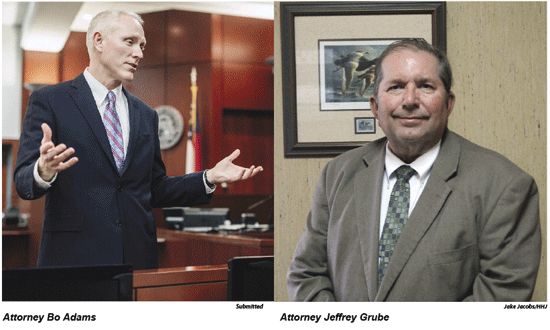
Houston County Superior Court run-off candidates Bo Adams and Jeffrey Grube already have experience being on the bench, and each is looking to kick it up a notch by succeeding a retiring Judge George Nunn.
The runoff election is scheduled for July 26. Adams led the four-candidate field in the May primary but did not gain a majority in the contest. Runner-up Grube earned the right to try again.
Adams, a University of Georgia graduate, began his career by being a law clerk for Nunn and Judge L.A. “Buster” McConnell in 1994 before joining forces with lawyer Ed Varner in 1996.
“I have a pretty general civil practice, don’t do a whole lot of criminal,” Adams said in his law office on Russell Parkway. “I’m an associate magistrate judge, which is part-time, and what you’re doing is setting bonds for those in jail and signing arrest warrants.”
Due to his position he’s not allowed to practice criminal law because “you could end up setting bonds for potential clients. But we do a pretty general civil practice, family law, personal injury and others, but no criminal or bankruptcy cases.”
Grube has been practicing since 1979 after graduating from the Walter F. George School of Law at Mercer University.
“One good thing about my practice is that I’ve been able to do different things, like the 10 years I represented the school board,” Grube said. “That was a different type job for me. Well, as lawyers we have to wear different hats. I would handle cases a different way if I was representing the school board, or if I’m defending people in criminal cases which I’ve done for 37 years, and I’ve been a municipal court judge, so you have to learn how to juggle things. I mean I’ve been doing this for 37 years so I must be doing something right.”
Both men say handling a variety of cases and clients has served them well and will prove to be invaluable experience for superior court.
“One good thing about having a general practice is that you delve into a lot of different areas, all of which may end up in superior court,” said Adams.
“It was probably in high school where I got more interested in the law, and my intent was criminal law and prosecution specifically,” he continued. “Even in law school that was my intent; I wasn’t focusing on private practice. But God directs things and a path opened up here, it worked out well, and 20 years later here I am. It’s not my original intent but I’m thankful for it. I’ve been blessed.”
Grube said he gets different perspectives from handling different types of cases.
“One good thing I can bring to the table by being a Superior Court judge is I know how lawyers are and I know what to expect from lawyers,” he said. “I’ve appeared before many other judges in many other places, and there is no question that we are blessed with the judges we have here compared to judges in some other places. I know how it is to get the best out of lawyers in their representing people in cases that I’ve handled before.”
Both men also addressed a phenomenon that sometimes hits judges called “robe-itis.”
Robe-itis” (or “black robe-itis”) is an affliction suffered by some robed judges. A person can put on a robe and assume a god-like attitude and power, forgetting that he or she is a servant to the law and the facts.
“I’ve seen it as a lawyer,” Adams said. “It’s a sense of empowerment that some people get and will use it to push their way around.”
He’s held a variety of judgeships and said he doesn’t think lawyers will fear him coming down with a case of it.
“I’ve been criticized for a long time in that I haven’t worn a robe in years but of course that will change once I’m in Superior Court,” said Grube. “I don’t want people to be afraid of the judge. I’m humbled by the opportunity in the capacity that I have to be a Municipal Court judge or a Juvenile Court judge. We do hear of judges that have ‘robe-itis,’ and I don’t think that’s something that anybody has ever accused me of.”
Handling rejection like losing a case is necessary and helps build an attitude that keeps a judge on an even keel, the men said.
“I can’t promise clients that I’ll win all the time; all I can do is promise I’ll do my dead-level best, bust my fanny for them,” said Grube. “Any lawyer that promises you an outcome in any case, be it criminal or civil or anything else, is not being truthful because it’s like riding a roller coaster.
“A lawyer can’t be a poor sport about things or not be able to handle rejection, because it happens. I mean, I can be trying a case and the judge be giving my client a life sentence and people will tell me ‘Why don’t you take a couple of days off?’ I’ve got to go to the next file the next day. I don’t have time to sit around and feel sorry for myself. I mean, you’ve got too much to do. You’re not giving your client good service if you’re going to sit around and mope about the day before.”
How does one maintain a balanced point of view after taking some cases where they’re with people who are sometimes acting out their worst?
“In cases that involve custody, family law or the like, the litigants can be very emotional and you have to be neutral or detached in that regard and allow each side to have their full say in presenting their case,” Adams said. “It’s not so much making the decision as the challenge is expressing that decision. You don’t want people to be bitter about your decision, no matter if they win or lose.”
Public service is important to both candidates.
Grube said a lot of the criminal cases he takes is because he’s appointed on them by the court and does them for a far less fee than normal.
“Public service has always been important to our family. Through the years I’ve been involved with a lot of activities through the church,” he said. “We just wanted to make sure that we all gave back to the community.”
His family has been involved with the Little League program a good while, and he used to be president of the Northside boosters club, and was first president of the Houston County High boosters when they opened in the 1991.
“I’m the public address announcer for all their football games, and I really, really enjoy that,” he said. “It’s that old saw about service before self, and that’s what my family has tried to do all these years. Get out there and try to help people. Practicing criminal law is an extension of that.”
Lawyers also perform a public service at the beginning of most jury trials, Adams said.
”The lawyer will warn jurors or the potential jurors that what they’re about to experience is not entertainment, not what you see on television,” he said. ”It’s the real world.”
HHJ News
Before you go...
Thanks for reading The Houston Home Journal — we hope this article added to your day.
For over 150 years, Houston Home Journal has been the newspaper of record for Perry, Warner Robins and Centerville. We're excited to expand our online news coverage, while maintaining our twice-weekly print newspaper.
If you like what you see, please consider becoming a member of The Houston Home Journal. We're all in this together, working for a better Warner Robins, Perry and Centerville, and we appreciate and need your support.
Please join the readers like you who help make community journalism possible by joining The Houston Home Journal. Thank you.
- Brieanna Smith, Houston Home Journal managing editor
Paid Posts
Related Articles

‘Christmas at the Crossroads’ brings the community together to celebrate the meaning of the holiday
Despite rainy weather, Christmas at the Crossroads united local pastors, city leaders and worshippers for a shared reminder that Christ is central to Christmas.

Family Promise provides needs for Houston County’s children experiencing homelessness
The organization has been assisting families for over a decade, providing practical and sustainable help.

Local author’s latest book ‘Hope in Action!’ highlights outreach in El Salvador
Proceeds from book sales will also go towards outreach efforts in the country.