
WRPD addresses community’s concerns at first town hall meeting of the year
The Warner Robins Police Department hosted its first town hall meeting of the year inviting the community to voice their concerns.
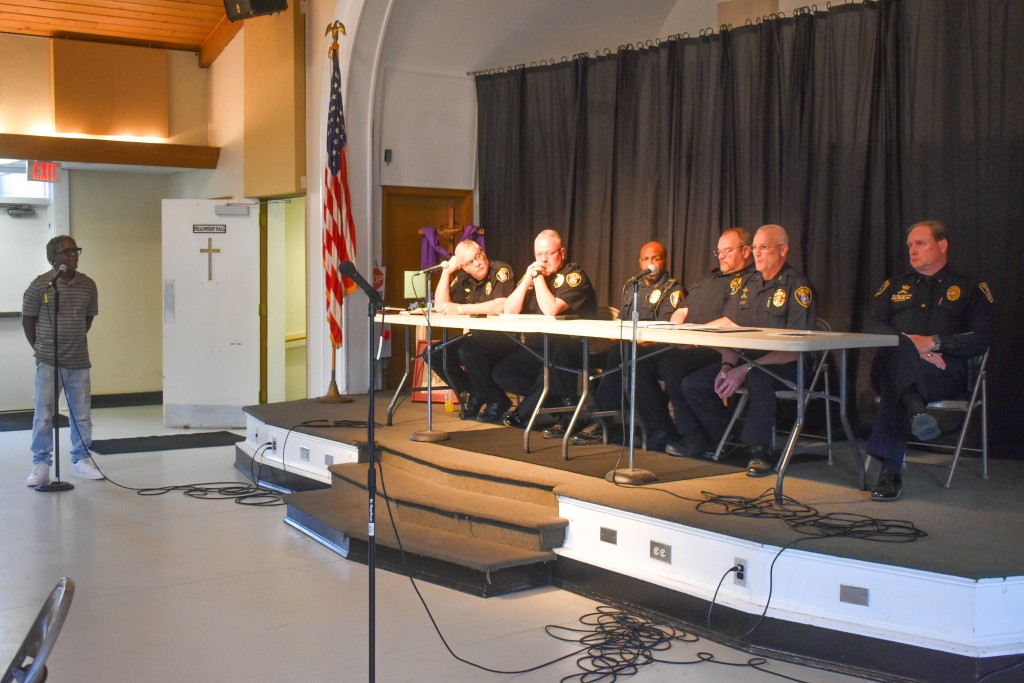
WARNER ROBINS – The Warner Robins Police Department hosted its first town hall meeting of the year inviting the community to once again voice their concerns and ask questions.
The meeting took place on Thursday, March 27, at First United Methodist Church. WRPD officials, including Chief Wayne Fisher, were present to answer questions and get involved in their community.
FLOCK Cameras
One of the issues raised was the FLOCK system. A concerned resident of Bonaire, Caly Hess, asked Fisher what guarantees a person’s information is not going to be utilized for various purposes by nefarious actors. Fisher responded that the police department does not collect any data and FLOCK maintains it for 30 days.
A citizen, Lawrence Dixon, asked Fisher about accountability. Dixon was wrongfully given a citation from a Georgia State Patrol Officer, who accused him of using his phone while driving. However, his dash camera proved the officer wrong and the citation was dismissed. Dixon also said it may cross over with FLOCK cameras when facial recognition goes wrong. He again asked who would take accountability in those situations.
Fisher said they will address the situation, even if the officer is involved with another agency like Georgia State Patrol. As far as facial recognition, he said they would never make a case until they have clear information. He also said their investigations have multiple layers. Fisher apologized to the citizen for wrongfully receiving a citation.
Another citizen, Daniel Lewis Crumpton, spoke about FLOCK cameras, saying he’s skeptical of agencies having access to personal data. However, his primary concern was taking away the community’s fundamental rights: the Fourth Amendment, First Amendment and Sixth Amendment. He is worried those rights are at risk for the sake of security and safety.
He said he understands the police department wanting to prevent crime, but does not believe it is worth sacrificing people’s fundamental liberties or privacy.
Fisher assured attendees that FLOCK cameras do not do anything in terms of facial recognition; their purpose is to identify vehicles. He also mentions a case where the cameras were beneficial in identifying tag information and resulted in four suspects in custody.
He agrees it has its pros and cons. Fisher shared he has spoken to FLOCK safety before and he assured citizens they are very judicious and mindful of the constitution application.
Assistant Chief Todd Edwards gave a different perspective on FLOCK cameras. He said the technology has helped the police department in numerous ways from tracking vehicles, finding missing people with medical issues like Alzheimer’s or suffering with dementia episodes, hit and runs and recovering stolen vehicles.
“I don’t think sometimes they hear those stories as they all come together. But again, I will sit at this table and tell you, I share some of your concerns and us being in the business, that’s a good thing that we can keep an eye on that. We can make sure it’s not going down that dark winding road,” he said.
Edwards thanks attendees for voicing their concerns because it reminds him to stay vigilant and balance it with their constitutional rights.
Homelessness and mental health
A citizen new to the area said the church serves a lot of people in the community who are experiencing homelessness and poverty. He asked how WRPD is trained to handle people with mental instability and mental health. He said they strive to help their neighbors, however, they do not have the training to handle mental health crises.
Fisher said they are trained in understanding behavioral health issues, but they are not licensed. They are also involved in a government initiative program that teaches de-escalation. Depending on the situation, the police department seeks out crisis lines and licensed professionals.
Major Lee Van Osdol said there is a large degree of mental health issues among the homeless community, but it is not the sole reason some individuals are homeless. Another reason may be addiction. He also told the resident what people see as mental health, the individual may see as their way of life.
Van Osdol advises people to have compassion for homeless individuals but also protect the private property of citizens; since some individuals set up camps on people’s businesses.
A resident also spoke about an incident where a woman was being aggressive. She said they called the police as a last resort because they didn’t want to get the woman in trouble. Eventually, another person calmed her down.
Fisher believes the state of Georgia is behind in having resources to deal with mental health issues. He believes society needs to work with its legislatures to come up with a solution. Fisher shared that Mayor LaRhonda Patrick and the council have done outstanding work in finding ways to help the homeless.
Fisher advises attendees to use caution in engaging with people they don’t know.
Another citizen new to Houston County shared she worked with a nonprofit organization in Los Angeles where she met with local therapists. She also shared she has dealt with people who have serious mental issues. She asked the police department if they have a similar nonprofit, which can help deal with mental health crises.
Captain Eric Gossman said the department would love to have a community-based solution. Fisher said he is willing to sit down with her and have a conversation about the organization.
He shared in situations involving a mental health crisis, the police department contacts Middle Flint Behavioral Health Center or the Georgia Crisis and Access Line to help in the situation.
Early in the meeting, a resident, Michael Jones, shared he spoke up during a city council meeting expressing disagreements he had with protocols. He shared Fisher and Assistant Police Chief Todd Edwards have been welcoming and communicative, something he appreciated. He said to continue that relationship, he proposed to establish a Citizens Oversight Committee or a Civilian Review Board. He said the board will be made up of citizens selected demographically by local organizations and WRPD. This will ensure various equity and an unbiased approach. He said the goal is to build trust, to create a pathway for the community to feel like they have a voice and how public safety is handled.
Jones shared a few things the board would do:
- Potentially investigate complaints from community members about misconduct or excessive policing.
- Reveal and recommend policy changes, including protocols by Rolling Thunder.
- Hold public forums and town hall meetings to engage the community with discussions about safety, traffic stops, arrests and ticketing patterns.
- Make disciplinary recommendations if officers violate standards of community trust.
Overall, the proposed board will provide the police department with citizen input. The citizen said they are not trying to be anti-police, the board will be about accountability and transparency. He asked Fisher if they were interested, how can they get started.
Fisher said a few aspects challenge privacy rights. He said right now the police department has a complaint process and they strive to be open and transparent. Fisher asked the citizen to provide him with the list of what the proposed citizen board will do and he will give him a response at a later date.
Later in the meeting, Ryan Hess, asked the department how frequently they go through psychological evaluations. He said he has dealt with calm officers but others who are aggressive.
Fisher said the state does not have an established protocol saying they have to do a psychological evaluation. However, WRPD does a psychological evaluation on individuals they hire. He also shared supervisors manage employees and tell them how to manage situations.
Hess advises the police department to do those evaluations frequently to make sure there are no backdoor dealings. Fisher said doing it frequently is not going to happen unless there is something they need to identify.
Fisher ended the meeting thanking everyone for attending. He encourages everyone who has a question to attend an upcoming town hall meeting or city council meeting. Fisher said they are accessible and he does not want anyone feeling there is a wall between them and the police department.
“We are a part of your community,” he said.
Fisher said more town halls are in the works, the next scheduled in June. Stay updated on future town hall meetings on the WRPD Facebook page.
Before you go...
Thanks for reading The Houston Home Journal — we hope this article added to your day.
For over 150 years, Houston Home Journal has been the newspaper of record for Perry, Warner Robins and Centerville. We're excited to expand our online news coverage, while maintaining our twice-weekly print newspaper.
If you like what you see, please consider becoming a member of The Houston Home Journal. We're all in this together, working for a better Warner Robins, Perry and Centerville, and we appreciate and need your support.
Please join the readers like you who help make community journalism possible by joining The Houston Home Journal. Thank you.
- Brieanna Smith, Houston Home Journal managing editor
Paid Posts
Author

Related Articles
Department of Justice reaches $3 million settlement with various Georgia Boards for alleged violations of the Servicemembers Civil Relief Act
The DOJ has reached a $3 million settlement with 42 Georgia Boards to resolve allegations that they did not recognize the Servicemembers Civil Relief Act.
Lori Johnson hoping to continue putting students and faculty first while serving on the Board of Education
Lori Johnson is running for reelection for Board of Education District 2 and hopes to continue her commitment to the students and faculty of the Houston County School District.

Warner Robins shooting leaves two injured, police say
Law enforcement also found and detained a suspect.