
Faith, facts and recovery: Local experts speak on the reality of opioid addiction
The panel discussion was a partnership between Reclaiming Ground, local leadership and local experts.
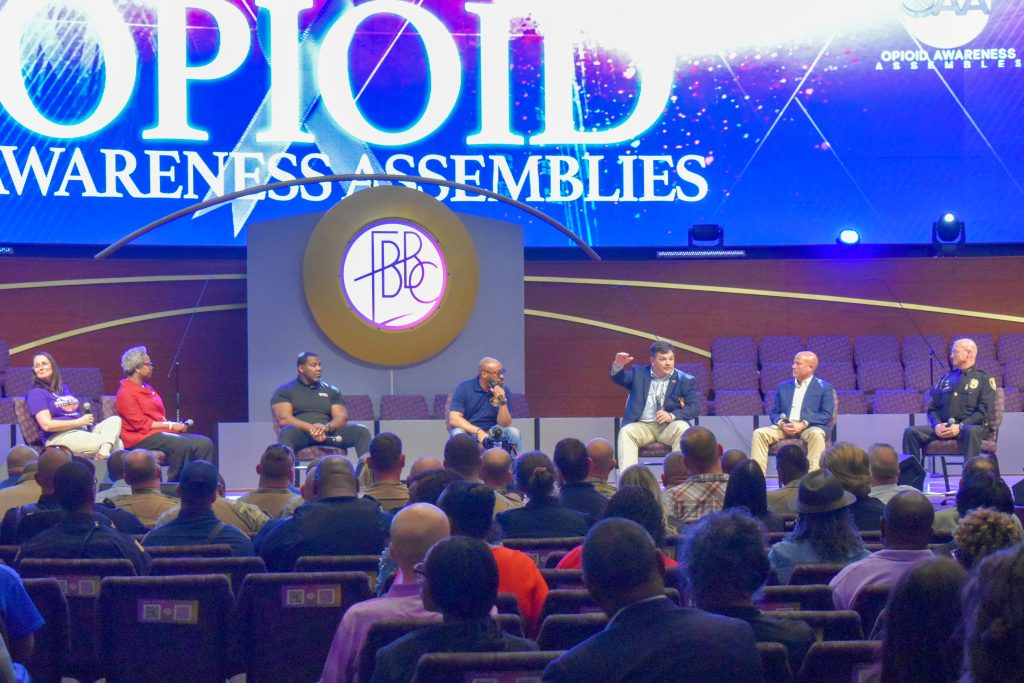
Fellowship Bible Baptist Church hosts a panel discussion on opioid addiction, a partnership between Reclaiming Ground and local experts. (L-R) Tanya Cowperthwaite, Dr. Tonja Simmons Lee, Willis Raines, Tolan Morgan, Matt Moulton, James Williams, Wayne Fisher. (Brieanna Smith/HHJ)
WARNER ROBINS — Reclaiming Ground, an organization known for bringing its message to schools, expanded its outreach to the broader community. On March 19, the organization hosted an opioid awareness assembly at Fellowship Bible Baptist Church, offering candid discussions about the dangers of drug use and educating the public.
The panel featured Reclaiming Ground President Willis Raines; Warner Robins Police Chief Wayne Fisher; Houston County Sheriff Matt Moulton; Houston County Coroner James Williams; Tanya Cowperthwaite, a certified peer specialist in mental health and trauma; and Dr. Tonja Simmons Lee, executive director of counseling services and student support at Central Georgia Technical College. FBBC Pastor Tolan Morgan served as the moderator.
Morgan began by presenting statistics on Houston County’s opioid crisis. As of 2023, the county had the highest number of opioid-related deaths among Middle Georgia counties and the second-highest number of emergency room visits.
The most common age range for opioid-related deaths was 25 to 29 years old, but the crisis also impacted both young children and the elderly. Tragically, 186 children under five and more than 200 adults over 60 lost their lives.
Both Morgan and Moulton emphasized that drugs do not discriminate.
‘This is a problem affecting multiple ethnicities and age groups. It is not just an issue for one set of people,’ Morgan said.
Fisher addressed law enforcement efforts, noting that the police department seized seven ounces of fentanyl in one year. By 2024, that number had surged to 25 ounces—enough to kill 347,281 people. In two recent cases, authorities confiscated 22 pounds of fentanyl, a lethal amount capable of killing over 5 million people.
Moulton explained that fentanyl, a synthetic opioid primarily produced in China and the Middle East, was originally developed for pain management and therapeutic use. However, its affordability contributed to widespread abuse.
Fisher added that fentanyl’s role in pain management eventually led to addiction. When federal authorities tightened prescription regulations, many individuals turned to street drugs like heroin as a substitute.
He emphasized the need for a multi-pronged approach to combat the crisis, highlighting the importance of collaboration between law enforcement, medical professionals, and mental health experts to address the psychological aspects of addiction.
Shifting the focus to mental health, Lee explained that many individuals turn to drugs as a way to cope with depression, anxiety, or post-traumatic stress. She noted that drug use alters the brain’s structure and cellular makeup, leading to addiction.
To combat this, she emphasized the importance of mental health care and family support for those struggling with substance abuse. She also outlined common signs of addiction, including drastic changes in appearance, sleep patterns, interests, or personality.
Williams pointed out that many overdoses are accidental; Users often believe they are taking a different drug, such as methamphetamine, cocaine, or Percocet, without realizing it contains fentanyl. He added that even marijuana can be laced with fentanyl, and law enforcement often doesn’t know until testing is conducted.
Raines warned that children can easily purchase drugs online, often disguised to look like common snack foods. Moulton reinforced the dangers for children, explaining that many accidental overdoses happen when kids mistake these drugs for candy. He also noted that many addicts accidentally overdose while chasing normalcy, often unaware of how much they are consuming.
“When you take that first dose of cocaine, of fentanyl, the marijuana or whatever, it produces, that euphoric feeling that you’re looking for … You get high; You come down an equal distance and now go in the opposite direction. So now you’re below homeostasis. You’re below what is feeling normal. So the next dose you take brings you back up to what your baseline normal was … now to get back to just feeling normal, what do you have to do? Increase the drug. You’ve got to take more,” he said.
Cowperthwaite shared her journey of recovery, saying that she has been sober since February 2017. Her addiction to pain pills led to devastating consequences; Within five years, she was homeless and had strained relationships with her children.
She explained that, like many struggling with addiction, an adverse childhood played a significant role in her substance abuse. Determined to break the cycle, she prioritizes open communication within her family and leans on church and support networks for guidance.
From a scientific perspective, Cowperthwaite discussed how addiction rewires the brain to seek pleasure from drugs, making it difficult to find joy in everyday life.
“[With] someone who doesn’t battle addiction, [if] you do a CT scan and show them images of their favorite food or their children, the cerebral cortex will light up. If you bring in the drug of choice for an addict, that neocortex will light up like a Christmas tree,” she explained.
Lee and Cowperthwaite emphasized the importance of good parenting, with Lee noting that children are highly sensitive and benefit from empathy and support.
After audience questions, Tolan closed the discussion by inviting attendees to accept Jesus Christ as their Lord and Savior, emphasizing that faith can play a powerful role in recovery.
“That’s where it starts. You still need to do the work. You still need to have the proper resources. You still need to have the proper information. But being grounded in the Lord Jesus Christ is where it begins,” he said.
The panel discussion covered a wide range of topics on opioid addiction and prevention. To watch the full discussion, visit Fellowship Bible Baptist Church’s Facebook page.
Before you go...
Thanks for reading The Houston Home Journal — we hope this article added to your day.
For over 150 years, Houston Home Journal has been the newspaper of record for Perry, Warner Robins and Centerville. We're excited to expand our online news coverage, while maintaining our twice-weekly print newspaper.
If you like what you see, please consider becoming a member of The Houston Home Journal. We're all in this together, working for a better Warner Robins, Perry and Centerville, and we appreciate and need your support.
Please join the readers like you who help make community journalism possible by joining The Houston Home Journal. Thank you.
- Brieanna Smith, Houston Home Journal managing editor
Paid Posts
Author

Related Articles

Perry Police Department advise community to pay digital after check fraud scheme hits town
After a lengthy investigation, law enforcement has arrested four individuals tied to a check and identity fraud scheme. Five suspects remain at large.

Will Houston County make pageant history again? Here are some of the 2026 contestants for Miss Georgia.
Ten Houston County girls are headed to Columbus, Georgia, and will compete to be crowned the 2026 Miss Georgia or Miss Georgia’s teen.
Reporting family violence and other crimes in Houston County just got easier with new Crimestoppers app
After a deadly year of domestic violence in 2025, the Sheriff’s Office and Crimestoppers are releasing an app to make reporting that much easier.