
Perry residents rally against rezoning plan
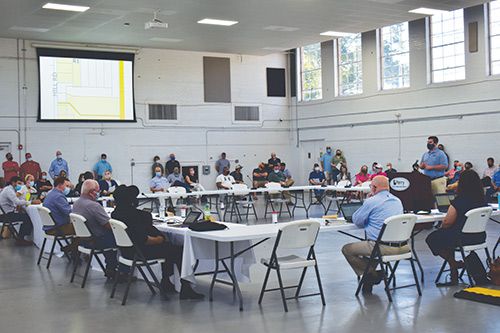
The Perry Planning and Zoning Commission’s meeting on Monday, April 12 hit home for many Perry citizens. Hosting an informational hearing on several items, numerous residents directly and indirectly impacted by the annexation and zoning requests discussed by the commission had the opportunity to come forth and present their concerns. The attending citizens prepared to defend their homes and their belief of the quality of life in their respective communities by gathering in numbers to stand against the requests.
First on the agenda, was to revisit old business from the February 22 meeting. According to the meeting’s agenda, N&D Development, LLC had previously requested the “annexation of property at 111 Hill Road and rezone from Houston County R-AG to city of Perry R-2A, single-family residential.”
Bryan Wood, Community Development Director for the city of Perry, explained how the initial request had been changed since the first meeting and that the city attorney looked it over. He detailed that 5.67 acres is the portion they’d like to annex into the city and a 1.45-acre parcel would remain in the county to prevent an “island,” unlike what was requested in the first application. With an R-2 zone, attached housing is generally common and the city allows four homes per acre, ultimately resulting in more housing and people. Wood shared that he had changed the application to comply with the standards for granting the rezoning application and that the staff recommends approval of the request.
Dylan Wingate of WCH Homes came to represent the applicant and was met with fierce opposition from neighboring residents of the property.
A resident near the property of Hill Road took to the podium and explained that he and his family own horses and livestock adjacent to the property in question. “We are concerned because our property is zoned County R-AG… We feel that this annexation is very different than what is connected to our home. We’re concerned about the size houses going to be built and the number of people and houses that are going to be up right against our home.”
The commission questioned Wingate of his development plan to which he answered that they have not fully stamped out details to provide an accurate answer at this time. Combating this, another nearby resident expressed further concern that such a residential zoning backing up against their property will affect the animals and questioned if a buffer will be provided, to which Wood explained that it was not mandatory.
After the presentation of both sides, the commission decided to go forward with the request presented to bring to the city council’s vote.
Quickly following the first request, another rezoning application was presented by the same development company. Just below the aforementioned property, N&D Development requested to rezone property at 125 Hill Road from R-1, a single-family residential zone, all the way to R-3, a zone for multi-family units. Also tabled from February’s meeting, this rezoning impacted many more people than the first one and several citizens lined up to express their opposition to the request.
Concerns presented to the commission included the lack of a cost analysis done on the development, failure to identify the absorption rate, drainage issues that arise from the development of so many residencies in that limited area, the density level due to the added traffic of the future residents and the lack of a traffic study conducted, and the sheer feeling that many citizens feel like their desire of quality of life is ignored and unimportant.
Citizen Keith Beckham pointed out that the R-3 zoning does not fit in with the surrounding lots. He raised the question that there appears to be a need for R-3 zones and how many R-3 plots have been planted in Perry. The commission admitted that they have no knowledge of that information.
A citizen living in Chinaberry, a subdivision adjacent to the land in question, noted that with the zoning of R-3, eventually someone could have the right to place apartment complexes in that area, which does not conform to the area around it.
At the current zone, it’d be approximately less than 50 homes added, as opposed to the 79-plus homes that could be added at an R-3 level. John Christy commented on the concern of density and expressed that 79 homes sandwiched between an R1 and an R-AG leads to traffic concerns for the roads leading to and from the proposed developed property. “Development is good for the city of Perry, but why not make it conform to the other properties around it and develop it to R1?”
Chairman clarified with Wingate if “the conditions that are suggested by the city staff and their recommendations of including limitations to where it has to be single-family detached use, does your company have any problem with that?” Wingate said no.
A majority of the commission agreed that they were uncomfortable with moving forward with the application to present to the council.
After the old business was settled, an informational hearing on the new business of the annexation of property on Sandefur Road and the rezoning of it from county R-1 to city C-2 began. Scott Free, an out of town developer from California who purchased the property, applied to have the property be a general commercial district. The representative that hired Free admitted to having no knowledge of the actual plans of the development.
A line of citizens came forth providing adequate and comprehensive reasons to oppose this rezoning. The property in question lies on the corner of Sandefur Road and Danny Carpenter Drive. Just nearby sits Mossy Creek Middle School.
A number of reasons to decline the application were given by the residents in the affected community including that the request doesn’t follow the Comprehensive Plan, the rezone would be an example of spot zoning, the safety of the children would be at risk due to the location, there runs a risk of blight, there are already adequate commercial locations nearby, traffic would pose a problem and the values of the homes near the commercial property will be negatively affected.
On top of those reasons, Jason Kliethermes, a Kathleen resident, presented the legal issues observed through the process of the request. Legal concerns raised included that the application should have gone straight to the county instead of the city, the application filed is outdated, incomplete, has discrepancies and includes “misleading and vague” responses.
Sara Kliethermes, wife of Jason Kliethermes, conducted a petition that garnered almost 900 signatures of nearby residents that oppose the annexation and rezoning in just eight days. A resounding reason amongst many in the community pointed out that a commercial district is in close proximity already, therefore the need for something closer that would compromise the “residential character of the neighborhood” is unnecessary.
“Kathleen was originally a rural village,” Sara disclosed. “People choose to live here because of the rural/suburban character of the area. If residents wanted to live near a commercial area, they would have bought a house in that type of area!”
She expressed her concern that if the application is approved, it will provide the gateway for more commercial properties. Sara believes that the result of that would decrease property values due to the “changing [of] the ambiance.”
Dr. Edward Urbansky, a resident of Tyler Ridge subdivision presented the idea of possibly turning the area into a green space, or “pocket park,” that could benefit the community members overall. He states that this will also better go along with the Comprehensive Plan set in place by the city.
Many of the citizens rallied behind Urbansky and the Kliethermes, presenting more and more reasons to the commission as to why they vehemently opposed the application. As a result, the commission voted unanimously to deny the application in question.
Relief filled the room as many cheered and clapped at the denial. However, the Kliethermes expressed that the situation has not fully been closed just yet.
“We won a small battle, but really the war is with the city council,” Jason revealed. “The biggest concern for me is that this happened in 2017. This commission denied a request regarding the same parcel. When it went to city council, they approved it. So the reality of it is that this commission only makes recommendations, city council can do whatever they want to do.”
Jason detailed that the 2017 request was that of a subdivision that was built. “Houston County recommended against, their own commission here recommended against, and the city council passed it. That’s a risk that city council has demonstrated that they will do whatever they want to do regardless of what the citizens and their own commission recommends.”
HHJ News
Before you go...
Thanks for reading The Houston Home Journal — we hope this article added to your day.
For over 150 years, Houston Home Journal has been the newspaper of record for Perry, Warner Robins and Centerville. We're excited to expand our online news coverage, while maintaining our twice-weekly print newspaper.
If you like what you see, please consider becoming a member of The Houston Home Journal. We're all in this together, working for a better Warner Robins, Perry and Centerville, and we appreciate and need your support.
Please join the readers like you who help make community journalism possible by joining The Houston Home Journal. Thank you.
- Brieanna Smith, Houston Home Journal managing editor
Paid Posts
Related Articles
Warner Robins surgeon accused of buying and selling stolen vehicles
Dr. Patrick Narh-Martey of Emory Healthcare Warner Robins has been arrested and accused for knowingly buying and selling stolen vehicles for his rental car business. The case is still under investigation.
Haseya Women’s Club holds groundbreaking ceremony for its first inclusive playground
The Haseya Women’s Club partnered with the City of Perry to open Houston County’s first inclusive playground.
HALO Group to showcase vision and goals to the community with fundraiser
The HALO Group will share their vision and long term goals with the community at their Garden Party Gala fundraiser on Saturday, April 18.