
DAWR talks community improvements in city
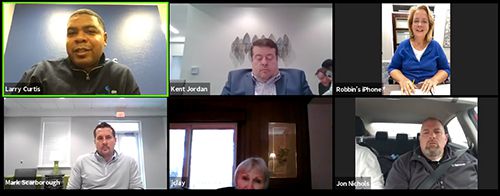
The Development Authority of Warner Robins held their regular monthly meeting on Thursday, February 4 via another teleconference. Robbin Gosline, chair of the DAWR, called the meeting to order and the board promptly made their way down the list of the agenda. Finally, Gosline approached an item that she claimed to be very dear to her heart, jumping into the discussion of the DAWR process and procedural improvement, followed by an introduction of Smart City by David Cook.
“We need to come up with good ways that we can efficiently and more effectively improve the way that we function,” started Gosline. She detailed how evaluating better communication practices will help the DAWR’s internal operation as well as providing a more successful avenue of partnering with the city council and efficiently making information readily available for the public.
“They should have more insight… so that it’s easier for them to find and locate [material],” she expressed. Gosline alluded to the difficulties in navigation the website.
Board member Kent Jordan agreed and offered that the DAWR possibly get its own website. “We don’t have a server right now that our emails are stored on. If we had our own website, I assume some sort or server space would come with that. We could have an email address that is linked to that website. But we could also upload our minutes, we could put information on there about what the development authority does in general, we can update projects, we can put pictures of past projects, we could put information if it’s OK to discuss for future projects.”
Gosline continued by announcing the option of having a virtual “open house” of sorts to get community and public involvement in getting educated on what exactly the development authority’s job entails.
“We had wanted to have an open house for the public to come in. There was so many of the board members that were new that the public and to us and didn’t really have the opportunity to [get] introduced properly. Then COVID took over and everything changed for all of us,” Gosling stated. She went on to point out, “One of the things I’ve found through comments or suggestions or one-on-one conversations in the public, is they really don’t fully understand what our role is and what our purpose is. One of the reasons for the open house… was to help educate those who are interested in learning more about the purpose of the authority and what our roles are, some of the accomplishments we had done to that point in time, the projects we had been working on and the success and value they have brought to the city, how we worked well with the other different… authorities… or the mayor and council, and really make it open for us to more communication with the public.”
Referencing the previous Warner Robins City Council meeting, Gosline presented the notion that the board should have more communication with the mayor and council on proceedings moving forward. She offered that the board brings back the practice of doing quarterly reviews of current and possible projects to the mayor and council, noting how it used to be very effective.
“I think it’s time we kind of step up and start doing a little bit more to improve not only with ourselves, but how we are viewed and how we can work better with the public and with the mayor and council,” Gosline urged.
Encouraging the rest of the board to meditate on other possibilities to make their job efficient, Gosline mentioned that they would revisit some ideas in the next board meeting.
Taking the floor next was middle Georgia native, David Cook. Prepared with a detailed presentation for the economic development board, Cook introduced the importance of Warner Robins taking advantage and transitioning to a smart city.
“Smart City is a wired, high-tech, intensive city (3-GiG+) that connects people, information, and city elements using new technologies and infrastructure to create a sustainable, greener city, competitive and innovative economy, and an enhanced life quality,” explained Cook.
He discussed that every 50 to 80 years, the country experiences what he called a “seismic shift.” The last notable seismic shift happened back in 1960 with the Eisenhower Interstate System. He indicated that those cities that didn’t take advantage of the system tended to suffer immensely, further urging Warner Robins to take this smart city shift by the reins.
Cook detailed 10 benefits of smart cities to include automation, ensuring proper efficiency, mitigating risks and reducing damages, quality of life, connectivity, more inflow of talent, a sustainable ecosystem, smart transportation, smart buildings and big data.
Going forward, Cooke explained that the future lies in the hands of the Millienials and the Zoomers. Due to the mindset changes of Millennials and Gen Z, Smart City has a place in their daily lives. Those generations are rising up and at the point where they will be running government and city momentum. Many are more independent in their thoughts, more aware of happenings to the global scale, and have information at their fingertips.
“They’re looking for efficiency,” Cook explained. The risks that Millenials and Zoomers are taking as far as life decisions are becoming smaller and smaller. After observing the hardships of the older generations, it appears that the newer generations are more cautious of increasing risks that can put them in a compromising position of debt and being tied down to commitments.
“If it is not sustainable, if it is not greener, if it is not competitive and if it is not innovative, you’re not drawing kids.” He explained that though Houston County is putting so much money in the educational system, the children are getting it and then leaving. “They’re leaving and they are not coming back because they do not see their life in Warner Robins. That is your reality right now. You need to give a reason to stay… That is your economy right there.”
Cook then discussed how related smart technology could be implemented by listing out smart emergency services, smart traffic management, smart infrastructure, smart lighting and smart environment.
For example, in terms of smart lighting, Cook described how cities could save so much money regarding power if investing in this. When cities incorporate smart lighting, the lighting has movement detectors that will dim when all is still. When detecting movement, the lights will shine to normal, full capacity, only to dim when not needed. “That’s called energy savings.”
He expressed how smart sensors could identify infrastructure problems before they happen and smart cameras can help first responders arrive as quickly as possible. Smart emergency services technology ultimately saves lives by protecting the emergency personnel and those they are serving.
“If you can move using technology from reactive policing to proactive policing, imagine not only the cost savings, but imagine how much you’re creating a safer environment for your police department, and your crime-solving ability so that people feel safer,” Cook declared. According to his logic, when people feel safer, they choose to stay in their communities and then those communities are able to thrive off of the population.
“Cities… and counties that are moving to Smart City technology are cutting between 10 and 40 percent off of their budget within five years.”
State and federal grants can help fund smart cities, but Cook urged the city to move fast due to the high demand.
In conclusion, the overall benefits of becoming a smart city that were included in the PowerPoint presentation by Cook are listed as “quality of life for citizens, economic development, educational growth of youth, city budget management, lower unemployment and environmental advantages.”
“You are making the decisions for the future,” Cook said, addressing the Development Authority of Warner Robins.
HHJ News
Before you go...
Thanks for reading The Houston Home Journal — we hope this article added to your day.
For over 150 years, Houston Home Journal has been the newspaper of record for Perry, Warner Robins and Centerville. We're excited to expand our online news coverage, while maintaining our twice-weekly print newspaper.
If you like what you see, please consider becoming a member of The Houston Home Journal. We're all in this together, working for a better Warner Robins, Perry and Centerville, and we appreciate and need your support.
Please join the readers like you who help make community journalism possible by joining The Houston Home Journal. Thank you.
- Brieanna Smith, Houston Home Journal managing editor
Paid Posts
Related Articles

CGTC hosts fifth annual mass casualty training, nursing student reflects on role
First responders from all over the county and students from CGTC participated in the university’s fifth annual mass casualty training.
Warner Robins Church’s Chicken settles ADA service animal allegation involving a veteran
An employee refused service to a disabled veteran unless his service animal was removed. Church’s Chicken is located at 1801 Watson Boulevard.
Warner Robins man sentenced to ten years in prison after January knife incident
Joshua Phillips, 29, was sentenced to 20 years, with the first 10 to be served in prison on two counts of aggravated assault after a January incident.