
Perry City Council talks “Grub Crawl”
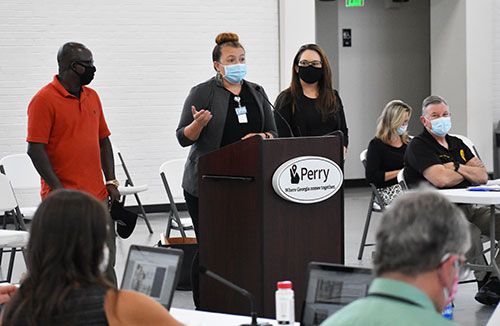
At Monday’s work session of Perry Mayor and Council, Special Events Coordinator Anya Turpin presented the idea for, what she said City Manager Lee Gilmour dubbed, “The Grub Crawl.”
“What this is, is a substitution, or a 2020 solution to Food Truck Friday. Food truck Friday is hands down the event that most people miss when I talk to people out in the community,” Turpin said.
Turpin presented that the idea behind the Grub Crawl would be, instead of taking the food trucks and locating them in Downtown Perry, the food trucks would be spread throughout the city so that they would not all be located in one single place. She later expressed that positioning them throughout the city could cut down on crowding, line length, parking concerns and reduce staffing needs, such as labor and work needed to support the event’s execution.
“As a benefit, this could highlight different areas of the city that maybe people might not know about, or maybe they don’t frequent, and then also still show support for our food trucks…” Turpin said, and added the concern that if there is no support for the food trucks, there was the possibility that, even if Food Truck Friday was able to happen next year, it may not, because the Food Truck Vendors are hurting.
“I think that this is a great way to show support for them, show support for our community, and still be safe,” Turpin advised.
Turpin suggested placement for the trucks, which were all public spaces, such as parks and parking lots—where people could go freely and would most likely not require permission for the trucks to set up shop there. These locations, Turpin continued, were centered around the heart of downtown Perry, and because the event was a “Grub Crawl” and not a food truck event, the local downtown restaurants could also be promoted.
Turpin listed the proposed locations for the event as City Hall, The Perry Area Historical Society, Rozier Park, the Davis Farm Fire Station, The Go Fish Education Center, The Perry Welcome Center, Creekwood Park, Rotary Park, Legacy Park and the Perry Arts Center. Each location would feature two non-competitive vendors, suggesting one food vendor, and one dessert or drink vendor. Turpin explained that there could be a map created with these locations and what food trucks would be there, so that the public could find it.
“It really just depends if they are going to hunt down the food truck or if they are going to hunt down the location. The idea behind this would be, in theory, that people would visit more than one location,” Turpin noted.
Turpin stressed, as well, that they would work with the Houston County Health Department to insure that the vendors were adhering to health regulations, as well as any other standards that needed to be addressed in regard to COVID-19. Turpin also assured that the Grub Crawl was not a replacement for Food Truck Friday, and that when the ability to have mass gatherings became available again, Food Truck Fridays could be reinstated, stating, “This is kind of a back-up, or Plan B, until we can have big gatherings again.”
Council gave permission for Turpin to move forward, and for Turpin to return before council with more details at a later date.
Also on the agenda, was a discussion relative to a traffic calming policy proposed by Gilmour and Director of Community Development Bryan Wood.
Gilmour informed council that the administration suggested a six-point policy in regard to these traffic-calming devices. These criteria stated that a request for such a device would require a petition in which at least 70% of the affected property owners (those who are the owners of residences within 200 feet of the proposed device location) were to sign. Additionally, no street calming devices could be used on streets designated as arterials or major collectors. It was also proposed that the use of street narrowing devices may be allowed if the street is over 1,500 feet in straight length without publically maintained intersections, and that the street’s width would not be reduced to less than 16 feet. Also according to the criteria, speed tables used must be constructed to account for the use of public safety vehicles, and all traffic-calming device installations must be approved by council after a public hearing. The criteria also said that the city would be responsible for the planning, installation, maintenance and funding of the devices.
Councilmember Peterson commented on the question of whether or not property owners, as well as renters, should be allowed to sign the petitions, voicing that it may be unfortunate to not allow the signatures of the people who physically live in the affected area, which may never own the property but deal with the issue. Ultimately, Wood suggested that both the signatures of the renter and the property owner could be allowed, and the status of renter or property owner be indicated, or that both the property owner and renter be required to sign. Gilmour further suggested that in regard to renters’ versus property owners’ signatures, a notice of the public hearing would be sent to a property owner if that property owner’s signature were different than what is on the petition.
Also relative to traffic calming devices, Director of Community Development Wood brought before council a petition for traffic calming devices to be installed at Stonegate Trail and Stonegate Crossing. Wood noted that there are 54 residential lots in the subdivision, 52 of which have homes on them, and 38 residents (35 property owners, and three renters) have signed the petition calling for the devices, equaling out to about 73% of that neighborhood’s residents.
Wood clarified that he had considered speed tables for the installation.
“Typically, you want to try to space speed tables about 400 feet apart, and by doing so, that maintains a consistent speed of 28 to 30 miles per hour… In doing that, you are looking at putting in somewhere in the neighborhood of seven speed tables, about five of them on Stonegate Trail, and two of them on Stonegate Crossing.” Wood advised, and further clarified that with council’s approval to move forward with this plan, he would bring a more defined plan back to council at a later date.
Gilmour questioned whether council would like to implement the policy that was previously discussed involving traffic calming devices. Councilmember Joy Peterson expressed that she felt that because the petition and request were already in process, the policy should not be implemented.
Gilmour commented on the notion of possibly having a public hearing relative to the issue once a plan has been developed by Wood. Gilmour explained that once the idea of cost is figured up, then the next step may not necessarily be to hold a public hearing, but to have the information relayed to the property owners, and if they are OK with the solution being discussed, then to follow through.
It was decided by council that cost would be figured out and the property owners would be contacted, and then the matter would be brought back before council at a later date.
Mayor and council were also presented by City Manager Gilmour with a discussion regarding the Americans with Disabilities Act (ADA), relative to the Downtown District.
Gilmour recommended a policy that would deal with ADA compliance in the Downtown District. First Gilmour noted that ADA compliance should be completed on the property owner’s parcel only, so long as it doesn’t significantly impact the public appearance of a historic structure. Gilmour later noted, prompted by a question from Councilmember Joy Peterson, that a building’s status of historic is currently determined by a Georgia Regional Commission survey, which Gilmour said is from around 1987. Secondly, Gilmour stated that if the first option is not possible, then it should be possible for property owners to use alley easements, and thirdly, if the use of the alleyway is not a practical solution, then the property owner should be granted an alternate easement by the city, which would be subject to council review and approval.
Council concurred that Gilmour should move forward with the policy as proposed.
HHJ News
Before you go...
Thanks for reading The Houston Home Journal — we hope this article added to your day.
For over 150 years, Houston Home Journal has been the newspaper of record for Perry, Warner Robins and Centerville. We're excited to expand our online news coverage, while maintaining our twice-weekly print newspaper.
If you like what you see, please consider becoming a member of The Houston Home Journal. We're all in this together, working for a better Warner Robins, Perry and Centerville, and we appreciate and need your support.
Please join the readers like you who help make community journalism possible by joining The Houston Home Journal. Thank you.
- Brieanna Smith, Houston Home Journal managing editor
Paid Posts
Related Articles

Street tacos, Star Wars and Slice and Spice delights HHJ staff | Warner Robins Take Flight Tour reviews
Take a journey with the HHJ Newsroom as we try flights from the City of Warner Robins’ Take Flight Tour.

Drink a Star Wars flight or eat one as a reminder of home at Woodlands Cafe: HHJ Eats
Woodlands has fruity drinks from a far away galaxy and satisfying southern comfort food for the Take Flight Tour. Here’s how both tasted.

Slice and Spice offers flavorful wings for the city’s tour | HHJ Eats
Slice and Spice featured chicken wings bursting with Indian spices and flavors for the city’s Take Flight tour.