Pearl Stephens TOTY Curtis Singleton: Changing students mindset
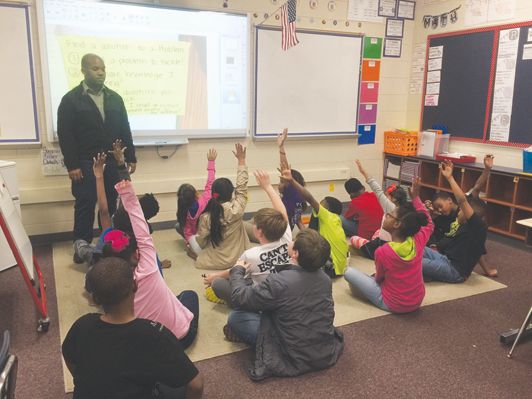
Pearl Stephens Elementary Teacher of the Year Curtis Singleton says at the end of the day, he doesn’t believe that he got the recognition because he was great. “I got it because I asked a bunch of questions, I learned from a lot of people, I worked hard, but I understand that everybody else did the same,” he said.
Growing up in a military family, Singleton said he’s from all over. Most of his schooling was overseas in Germany, which is where he was born. He said his family returned to Warner Robins in 2009, which is when he moved to Illinois to attend Southern Illinois University, where he received his bachelor’s degree in elementary education. He also has a minor in music and received endorsements in art, physical education, music and teaching in other middle school areas.
This is Singleton’s third year teaching third grade at Pearl Stephens. He said he loves the administration and with the school transitioning from their former principal to their current principal, the process has been great since they both share the same vision of keeping morale up.
Why teaching?
“I’ve always favored children. Teaching wasn’t the most important thing at first for me. My main thing was children and making sure that they’re loved and that they feel like they’re cared for. I love the demographics here because I know many students that need that background they need men. I’m not seeing a lot of that in my students, where they’re dealing with their fathers being gone. Initially, and still now, my mindset is ‘How are my children doing mentally, physically and spiritually?’ From there, teaching became a part of it. I love teaching now that I know what I’m doing. As I’ve gotten the training, now I can meet both of my interests together. I can make sure that I love teaching, as well as I’ve always loved my children.”
What brought you into the field?
“It was kind of like my family’s emblem. My mother worked with children. She wasn’t a teacher but her father was. It kind of trickled down. Even from kindergarten up to about third grade, we had other students in the house. I’ve always been surrounded by that type of atmosphere. It just moved up as I got into more organizations in high school. I’ve always been around children. It just seemed like it fits; it’s the right place to be.”
Any inspiration from past teachers?
“The inspiration that I got from a lot of teachers was those teachers who truly tried to invest in creating a relationship with me. I always favored those teachers who didn’t count me as a test score, as just a number that they have to pass through their classroom. Even some of the teachers know that I will come back and visit them because they were big about creating a relationship with me.”
Best part of teaching?
“The best part is the craziness of it. I don’t say that in a negative way. Every single day, I expect something different. I can never expect the same. I’m going to have one day where my children are up, one day they’re down. In actuality, when I go home, I may feel tired but I don’t feel like I’m frustrated. Children are children, and it’s cool to see how they’re developing and growing. I love that about children that I’m going to get something totally different every single day; it’s not going to be the same.”
What is it about teaching that you like the most?
“For me, what I like the most is allowing kids to understand that at the end, they can excel, they can make it having those high expectations for them. I think many times students don’t excel not because they can’t, they just haven’t done it yet. They can be whatever they want to be. My students know when they’re going to graduate college, not high school, because that’s something that is granted you’re going to pass high school; you can’t argue about that. But going to college, that’s something they need to know and keep in their mind. Definitely in our demographics, when they understand ‘when’ you go to college instead of ‘if’ you go to college, I feel like it’s going to happen more because it’s already expected from elementary school. That’s the best part of teaching changing their mindset.”
Most challenging part of teaching?
“The most challenging part is every now and then trying to team up with everybody. As someone who is a teacher, I feel like I want everybody to understand that I’m on their same team. That’s overall, even with parents and administration. I’m on the team of making sure your child excels. The hardest part is getting that team together first. I would rather that the teacher, parent, everybody came together as a team the first day than we’re getting to know each other and we finally become a team. If we’re all connected, I feel like the student understands that we’re all going for the same goal.”
Anything that makes your job difficult?
“I can’t really say a lot makes my job difficult. With teaching, you’re dealing with people, and people are flawed and people are great. It’s a bitter sweet kind of thing. I don’t think there is really a problem. Sometimes you get things you don’t expect and that can be something that seems like a problem; however, I’ve noticed that when I get the worse, maybe something is better coming after that.”
If not teaching, what?
“I would still work with children, maybe in ministry. My goal is to make sure that children are not just excited about learning, but are healthy physically, spiritually and mentally. In any area I can do that outside of school, that’s also my job to make sure, whether it’s in ministry or at a youth center, children feel like they’re valued.”
Advice to students:
“Present yourself for where you’re going. My mom always told me to make sure that I dress really nice because I never know where I’m going to be at, where I’m going to meet that right person to pull me in the place I need to be. I say to a lot of children, ‘Even though it’s easy to have the mindset that I’m only looking at what’s going to happen tomorrow, look for what’s going to happen in the future. See your future there and envision that and take hold of that now instead of waiting until it actually happens.’”
Advice to parents:
“Get into the schools, make sure that you’re ever present in the schools. I work a lot with the young boys in our school. Boys need to see that fathers care about education, that fathers don’t care about discipline so much as education. They don’t want to hear when they get home, ‘Did you act right today?’ They want to hear, ‘What did you learn?’ As a young man, I’ve always seen females teaching and doing these things. It almost becomes like education is valued by just females. Boys don’t value it because who’s telling them to do well? Their mother, aunt, grandma, all the women in the school. My biggest thing is not just the parents but for the men to step up in your school. Make sure that you’re reading to your children and show them that you value education and then discipline won’t be an issue for your boys.”
Home life:
“I have a little brother, Corey Singleton, 22, at Savannah State University, working on a computer engineering degree. My parents are Curtis and Antoinette Singleton, who both work on the base. My hobbies include attending church at Word in Season Ministries and I do a lot of vocal music.”
HHJ News
Before you go...
Thanks for reading The Houston Home Journal — we hope this article added to your day.
For over 150 years, Houston Home Journal has been the newspaper of record for Perry, Warner Robins and Centerville. We're excited to expand our online news coverage, while maintaining our twice-weekly print newspaper.
If you like what you see, please consider becoming a member of The Houston Home Journal. We're all in this together, working for a better Warner Robins, Perry and Centerville, and we appreciate and need your support.
Please join the readers like you who help make community journalism possible by joining The Houston Home Journal. Thank you.
- Brieanna Smith, Houston Home Journal managing editor
Paid Posts
Related Articles

The Westfield School Calendar 2025-2026: Key Dates & Holidays
The The Westfield School Calendar includes key dates for the school year, such as the first and last day of school, holiday breaks, teacher workdays, and high school graduation. Families can use this to plan ahead and stay on top of important schedule changes.

Houston County School Calendar 2025-2026: Key Dates & Holidays
The Houston County School District 2025-2026 Calendar includes key dates for the school year, such as the first and last day of school, holiday breaks, teacher workdays, and high school graduation. Families can use this to plan ahead and stay on top of important schedule changes.