
Robins pays homage to Blackbirds
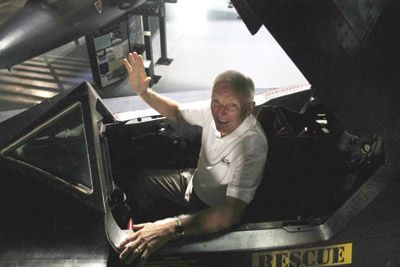
The crowd just wouldn’t stop coming in Saturday at the Museum of Aviation to help honor a couple of record-setting speedsters.
Retired Air Force Maj. Gen. Al Joersz and retired Air Force Lt. Col. George Morgan, who set a speed record more than 40 years ago in a SR-71A Blackbird, were being honored at Blackbird Day, along with retired Air Force Col. Buz Carpenter and other Blackbird veterans.
More than 350 patriotic fans showed up – and kept filing in continuously after the event started – to honor the aviators.
The museum has the Blackbird the men flew in 1976, setting a record for speed that still stands.
The SR-71A Blackbird #958 was retired in May 1995 after 23 years of service, said Carpenter.
Its day of glory was July 28, 1976, when it set the world absolute speed record of 2,193.167 mph. At that rate, could travel from West Coast of the United States to the East Coast in 1 hour and 18 minutes; New York to London in 1 hour, 55 minutes; Los Angeles to Washington, D.C., in 1 hour, 4 minutes; Kansas City to Washington, D.C., in 26 minutes; St. Louis to Cincinnati, 8 minutes.
Saturday was proclaimed Blackbird Day in Houston County, and a proclamation was signed by Warner Robins Mayor Randy Toms; Centerville Mayor John Harley; Perry Mayor James Faircloth Jr. and Tommy Stalnaker, chairman of Houston County Commission.
“It is a delight to see so many of you join us to celebrate what occurred 40 years ago,” said Carpenter. “Your presence here shows not only your interest in this airplane but your interest in supporting this outstanding Museum of Aviation here are Robins Air Force Base. This museum is one of the finest in the country. You can really be proud of it.”
Carpenter put the event in context, asking those in the audience to “turn back the clock 40 years.”
Air Force leaders were looking for some way to dramatically celebrate the country’s 200th birthday, its bicentennial, he said.
“Most Americans were waiting in lines to get gas, and a trip around the world without landing would have taken 17 and one-half hours and used more than 100,000 gallons of gas, not including what the tankers would have needed. It would have reduced dramatically the then-record of 45 hours, but it wasn’t the kind of image we wanted to project. This was also the era of the Cold War and the Soviet Union was considered our enemy.”
With an eye toward positive publicity, it was decided to go for a speeding record. Three records were set on July 27 and 28, 1976, at Beale Air Force Base, just north of Sacramento, Calif., Carpenter said.
Joersz and Martin said they really didn’t have a hand in preparing for the flight other than using a simulator. Joersz was the pilot and Martin was the reconnaissance systems officer, or RSO.
“We weren’t the only ones who could fly this aircraft. We just happened to be in the right place at the right time,” said Martin, who asked for applause from the crowd to recognize the other crews who worked on the Blackbird.
Carpenter said he was in training at that point and observed what they did from the ground.
The Blackbird cruises at Mach 3, or three times the speed of sound, some 2,000-plus mph. “If you burn off fuel you let the airplane climb,” Carpenter said. “It carries 80,000 lbs of fuel, or about 12,400 gallons.”
Putting it in contemporary perspective, Carpenter said the Blackbird was put together with “a slide rule and a calculator instead of computers.”
Lockheed started in the late 30s and came out with new planes about every two years or so, he continued. “Nowadays it’s more like about every 15 to 20 years. It was a completely different atmosphere back then.”
Memo from President Eisenhower pushed real hard for stealth. “He wanted to make it invisible,” he said. “You couldn’t do that but you could reduce the radar image.”
“You sacrifice performance for stealth. Once you build an airplane and try to make it stealthy it’s almost impossible,” said Joersz.
In the Cold War era, Washington and Moscow seemed to be constantly trying to upstage one another, said Carpenter.
“You could say the presence of the Soviet Union made these planes possible,” he said.
“We never would have any of these planes if we weren’t concerned about what the Soviets were doing,” said Joersz.
“When we built the U2 and flew its first mission in 1956, it was assumed we could operate the U2 for a while and not be seen, but it was tracked all the way across the Soviet Union on its first mission,” said Carpenter. “So we quickly went back to the drawing board and wondered what could we build that would be faster, or higher, or be invisible – something that was going to be more survivable.”
In addition to the speed record, the SR-71A has another enviable mark: none were ever downed due to enemy fire.
“I joined the Air Force because I wanted to fly, and was having a great time,” said Joersz. “I never thought about retiring until they told me I might go to the Pentagon, and I knew I didn’t want to be a desk jockey.”
He said he loved the travel. “It was an interesting time to be in the Air Force; lived with my family in six different countries. The travel really enriched the lives of my two daughters. They were in high school in Germany when the Wall came down.
“Travel was one of the benefits of being in the military, if you liked it. It was one of the many positive things about being in the military.”
Carpenter said he is now a docent at the Air and Space Museum at Dulles Airport.
Morgan has gone to the other side of the country.
“Yeah, the Pacific Northwest is a beautiful place in the summer, even with the rain,” he said.
HHJ News
Before you go...
Thanks for reading The Houston Home Journal — we hope this article added to your day.
For over 150 years, Houston Home Journal has been the newspaper of record for Perry, Warner Robins and Centerville. We're excited to expand our online news coverage, while maintaining our twice-weekly print newspaper.
If you like what you see, please consider becoming a member of The Houston Home Journal. We're all in this together, working for a better Warner Robins, Perry and Centerville, and we appreciate and need your support.
Please join the readers like you who help make community journalism possible by joining The Houston Home Journal. Thank you.
- Brieanna Smith, Houston Home Journal managing editor
Paid Posts
Related Articles

How a Warner Robins local is bringing whimsy through a trinket box
Warner Robins local, Ashlee Watson, created the 478 trinket box as a unique way to bring her community together.

‘Please come out and save this restaurant.’ Warner Robins eatery faces financial crisis
The response has been so great from the community that the restaurant ran out of food Tuesday and had to close early. The restaurant expects to restock and reopen Wednesday.
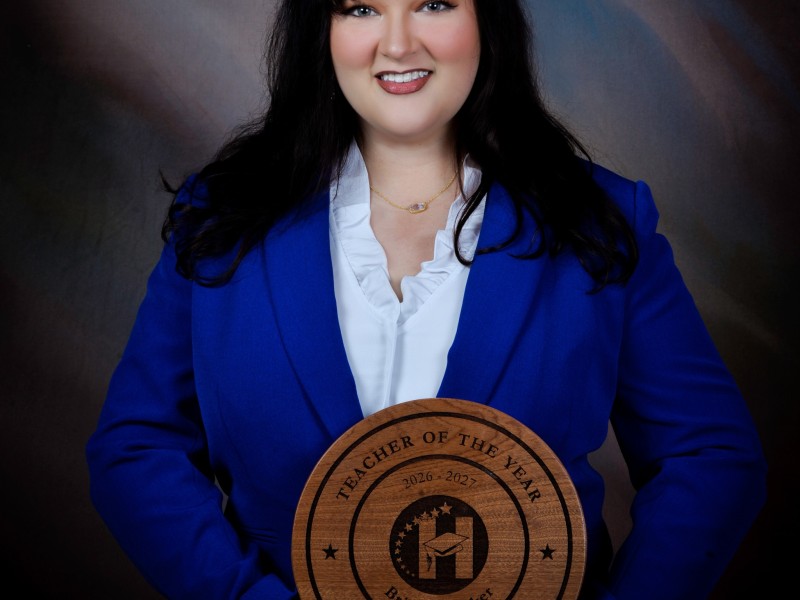
Perry High School art teacher named Houston County Teacher of the Year
Brianna Walker was named the district’s Teacher of the Year. Here’s her story.