
Surviving an Active Shooter – Part One
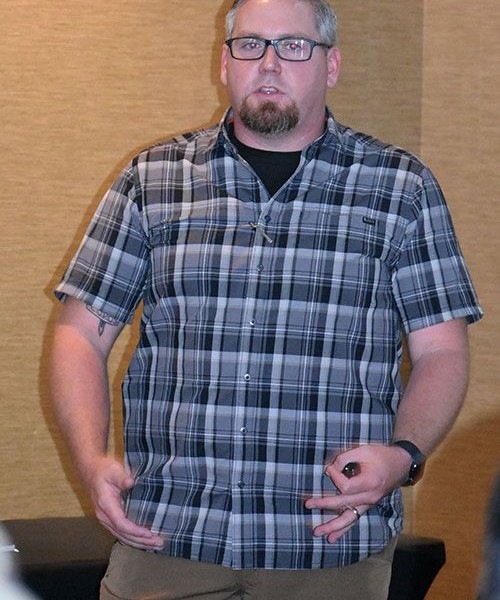
Around about 4:00 on Saturday morning, Rodney Driggers left the state of Florida, en route to central Georgia, where he would ultimately stand in front of a near-full class of registrants, all gathered to learn more about how to survive if they ever found themselves caught in a situation wherein an active shooter was involved.
“I’m a 15-year police officer,” Driggers told his class attendees. “I’ve been with the state of Florida now for 15 years, currently working in the city of Jacksonville. Before that, I worked in a small hometown department right next door and got a lot of experience from that.”
Situations in today’s climate have shifted—and not all for the better. Conditions like COVID-19, social unrest, job loss and an economic downfall have all seemed to result in an increase in crime. Applications for the legal carry of guns have been on the rise because there is a heightened sense of the need to self-protect. Organizations like Focused Fire have stepped up to the plate to offer guidance and instructions so that citizens can learn how to do it safely and legally.
“I’ve been an instructor with Focused Fire for about six months now, but I’ve been an instructor for the past eight years,” said Driggers. “I teach basic recruits, cadets, advance law enforcement classes and things like that. I’ve attended a lot of active shooter training, so here is one thing I’m going to ask of you. Take at least one or two things from this class and put in in your toolbox because subconsciously, if or when something like this was to ever happen, it will be there, and it will regurgitate itself back up—I promise.”
For the next couple of hours, Driggers offered tips, tricks, strategies and tools to help those who had gathered to survive an active shooter attack. He promised them that armed or not, the information would give them some insight into putting them and their families in a position to survive. Among the topics that were covered were, what to expect during an incident, how to survive the incident and what to expect in the aftermath.
“What is an active shooter?” Driggers posed. “It’s an individual that is actively engaged in killing or attempting to kill people in a confined or populated area.” He went on to explain that active shooter events could be unpredictable and evolve very quickly. “In most cases, there’s no pattern,” Driggers elaborated. “There’s no method to the victims. They shoot random places. They go and they try to take innocent lives.”
Referencing the 2017 Las Vegas shooting—dubbed by Wikipedia as “the deadliest mass shooting by an individual in the Western Hemisphere”—Driggers commented on the fact that active shooters are now starting to plan ahead and scope out their choice of location.
“He shot out of the window of a hotel,” Driggers pointed out. “He had to get his guns up there somewhere; so all day, he was preparing for that. He knew the concert was going on, and he was taking vengeance. He took tote bags and rifles and a bunch of ammo up there. He even set cameras up in the hallway so he could see if law enforcement was coming.”
It was also pointed out that an increasing number of active shooters now wear body armor so that they can survive the incidents despite their intent to callously take the lives of many innocent bystanders. Driggers believe that the shooters want to survive because they want to see themselves become infamous in the aftermath. “Because who does the media glorify after a shooting?” he asked. “They very rarely glorify the survivors of that shooting. It’s always the killer. It’s always the shooter. He or she is the one who always gets followed.”
Statics revealed that there were 277 active shooting incidents recorded in the U.S. between the years 2000 and 2018, based on information shared by Driggers. Of the 277 shootings, 121 took place in commerce areas—public businesses like open malls, open-air concerts and the like. Many also took place at schools and even places of worship. Among the 277 shooting incidents, single shooters who acted alone carried out all but four. Law enforcement apprehended 116 of the perpetrators; 103 of them opted to commit suicide, while another 58 were killed (three of those by citizens and one by an armed security guard). In total, only five escaped, but only briefly. They were apprehended later. In 2019 alone, there were 28 active shooter incidents that resulted in 247 casualties (97 killed and 150 wounded—not including the shooters).
“Sixty percent of the open shooter threats are usually over by the time law enforcement arrives,” Driggers mentioned. “Seventy percent are over within five minutes. Anybody ever had to call law enforcement before? How long did it take for them to get to you? What is average response time? Eight to 10 minutes? Twenty minutes? With that being said, it’s a long time. Even five minutes is a long time. It only takes one person to stop the incident. It could be you, me, or somebody else.”
Our five senses play a big part during catastrophic events. “What are you going to see?” Driggers challenged. “What are you going to hear or feel—physically, not emotionally? What are you going to smell and what are you going to taste?”
Some of the sights, he educated, would be blood, death, shell casings, confusion, people running, people hiding, a shooter taking innocent lives … even law enforcement and fire rescue. What would be heard would include screaming, gunfire, verbal commands from law enforcement, yelling, crying, foul language and pleas for help. Among smells would likely be that of gunpowder, blood, perspiration and even flatulence. Driggers said it was very common for people to lose control of their bowels and personal bodily fluids in times like these. What victims of this type violence physically felt were things like injuries, blood, dead bodies, their own reactive heart rate and increased/decreased perspiration. Lastly, tastes experienced might be blood, vomit, acid reflux, dry mouth and other things.
“Let’s talk about the officer’s response,” Driggers suggested. “What are we doing when we get there? Let me give you an officer’s point of view. The amount of time it takes you to hit the brake to avoid hitting the car in front of you, that’s how quickly decisions have to be made,” he said. “There are three main goals every law enforcement officer is trying to accomplish during an active shooter attack: 1) Identify the shooter and take them down. 2) Treat/Take care of victims. 3) Get victims to a safe location/hospital.”
Driggers went on to say that law enforcement ended the incidents by stopping the killer/killing. They treated the wounded by rapid casualty care to stop the dying, and they got innocent people to safety by rapid evacuation—finding a safe assembly site, a safe location but still within the immediate area.
“Everybody else’s safety is ranked higher than the safety of the officers that are there,” Driggers stated. “Who do we worry about last? Ourselves. Your safety and your family’s safety are what’s most paramount to me and to other officers. That’s why we do what we do.”
On the topic of survival, Driggers defined it as a state or fact of continuing to live or exist, typically in spite of an accident, ordeal or difficult circumstance. “Your survival rate increases as your mental and physical fortitude increases,” he taught, further educating that mental and physical preparation took a continuous cycle of planning, organization, training, equipping, exercising, evaluating and taking corrective action. “Train your mind to be on guard. Be hyper vigilant of your surroundings. Make full body scanning something you do on a regular so it’s commonplace for you.”
Other survival skills that Driggers defined were tactical breathing (a “smelling the flowers and blowing out the candles” breathing pattern). This alone, he stipulated, would bring a level of calm by slowing down the heart rate. Self-talk—talking to yourself to calm yourself—is another method to help with survival. It could help with clearer reasoning. Also, have a plan in place—a safety word or phrase for your family to alert them of trouble without alerting the shooter. This could give your family the opportunity to evacuate safely before a situation climaxes.
Driggers went on to talk about a four-step approach to decision-making known as “OODA Loop.” Find out what that is and more on how to survive an active shooter situation in Part 2 of this article, which will appear in the weekend edition of the Houston Home Journal.
HHJ News
Before you go...
Thanks for reading The Houston Home Journal — we hope this article added to your day.
For over 150 years, Houston Home Journal has been the newspaper of record for Perry, Warner Robins and Centerville. We're excited to expand our online news coverage, while maintaining our twice-weekly print newspaper.
If you like what you see, please consider becoming a member of The Houston Home Journal. We're all in this together, working for a better Warner Robins, Perry and Centerville, and we appreciate and need your support.
Please join the readers like you who help make community journalism possible by joining The Houston Home Journal. Thank you.
- Brieanna Smith, Houston Home Journal managing editor
Paid Posts
Related Articles

Street tacos, Star Wars and Slice and Spice delights HHJ staff | Warner Robins Take Flight Tour reviews
Take a journey with the HHJ Newsroom as we try flights from the City of Warner Robins’ Take Flight Tour.

Drink a Star Wars flight or eat one as a reminder of home at Woodlands Cafe: HHJ Eats
Woodlands has fruity drinks from a far away galaxy and satisfying southern comfort food for the Take Flight Tour. Here’s how both tasted.

Slice and Spice offers flavorful wings for the city’s tour | HHJ Eats
Slice and Spice featured chicken wings bursting with Indian spices and flavors for the city’s Take Flight tour.